How is India-ASEAN Cooperation Essential for Indo-Pacific Autonomy?
Click to start listening
Synopsis
Discover how India’s Act East Policy is reshaping its engagement with ASEAN, reflecting a significant shift towards Indo-Pacific autonomy. This article explores the evolution of India-ASEAN relations and their implications for global leadership and economic connectivity.
Key Takeaways
- India’s Act East Policy strengthens ties with ASEAN.
- The narrative has evolved from optimism to strategic repositioning.
- ASEAN's centrality is crucial for global multipolarity.
- Initiatives like the Mekong-Ganga corridor provide alternatives to BRI.
- Effective institutionalization is key for future cooperation.
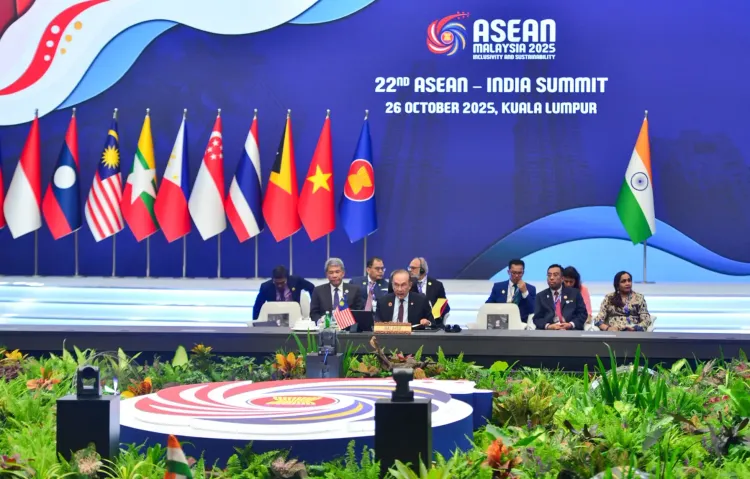
Bangkok, Jan 19 (NationPress) India’s Act East Policy, implemented under the leadership of Prime Minister Narendra Modi, has facilitated a more concentrated engagement with the Association of South-East Asian Nations (ASEAN). This strategy signifies a pivotal transformation emphasizing the increasing acknowledgment of the Indo-Pacific as the principal diplomatic framework, a report highlighted on Monday.
“The India-ASEAN narrative has transitioned from an optimistic stance in 2017, when the dialogue partnership celebrated its 25th anniversary, to a narrative of resurgence in 2022, and has ultimately evolved into a narrative of strategic repositioning and essential reclamation today. What began as a practical implementation of India’s Look East Policy has matured into a regional partnership resilient against geopolitical shocks and the systemic disintegration of the global order,” detailed a report from 'The Geo Strata'.
“As regional strategic narratives grow more polarized concerning alliances, positions, and focal areas, they also reflect a potential influence due to externally projected axes of power. The institutionalization of narratives in the region, aimed at sustaining the concept of a free and open Indo-Pacific, has become increasingly vital,” it further noted.
The report stated that before moving towards development-centric frameworks, the India-ASEAN collaborative narrative must be redefined and fortified through effective institutionalization.
“The US Indo-Pacific strategy upholds ASEAN's centrality. However, for Washington, this has largely manifested as a mere diplomatic gesture. From the viewpoint of the European Union (EU), India and ASEAN are pivotal in establishing a multipolar and rules-based Indo-Pacific. Despite this, such statements are often seen as empty rhetoric,” it indicated.
The report emphasized that India-ASEAN cooperation must be redefined through the lens of global leadership, trade competitiveness, and strategic sustainability. Initiatives like the India-Myanmar-Thailand Trilateral Highway and the Mekong-Ganga corridor could potentially act as alternatives to the Belt and Road Initiative (BRI) corridors, reasserting India-Pacific autonomy by presenting themselves as credible drivers of economic connectivity.
“Given the delays in connectivity projects, limited Foreign Direct Investment flows, and inconsistent trade integration, expectations regarding India’s role in reinforcing ASEAN's centrality are at an all-time high. Cooperation between India and ASEAN enhances middle-power dynamics, mitigates zero-sum geopolitics, and strengthens India’s credibility as an inclusive regional actor, sharing the responsibility of balancing relations with China without directly involving ASEAN in conflicts,” the report concluded.
Point of View
India’s proactive approach towards ASEAN underlines a commitment to regional stability and economic growth. As India positions itself as a key player in the Indo-Pacific, the importance of fostering strong ties with ASEAN cannot be overstated. This partnership is not merely about trade; it’s about establishing a multipolar world where collaboration prevails over conflict.
NationPress
19/01/2026
Frequently Asked Questions
What is India’s Act East Policy?
India’s Act East Policy is a strategic initiative aimed at enhancing India’s engagement with Southeast Asia, focusing on economic partnerships and regional security.
How does ASEAN fit into the Indo-Pacific strategy?
ASEAN is central to the Indo-Pacific strategy as it represents a collective of nations that play a crucial role in maintaining regional stability and promoting economic connectivity.
What are the key initiatives under India-ASEAN cooperation?
Key initiatives include the India-Myanmar-Thailand Trilateral Highway and the Mekong-Ganga corridor, which aim to enhance connectivity and trade in the region.
Why is the India-ASEAN partnership important?
This partnership is vital for balancing regional power dynamics, enhancing trade, and fostering stability in the face of global geopolitical shifts.
What challenges does India face in strengthening ties with ASEAN?
Challenges include delayed connectivity projects, limited foreign direct investment, and the need for effective trade integration.