India-China need pragmatic ties to avoid confrontation, report warns
Synopsis
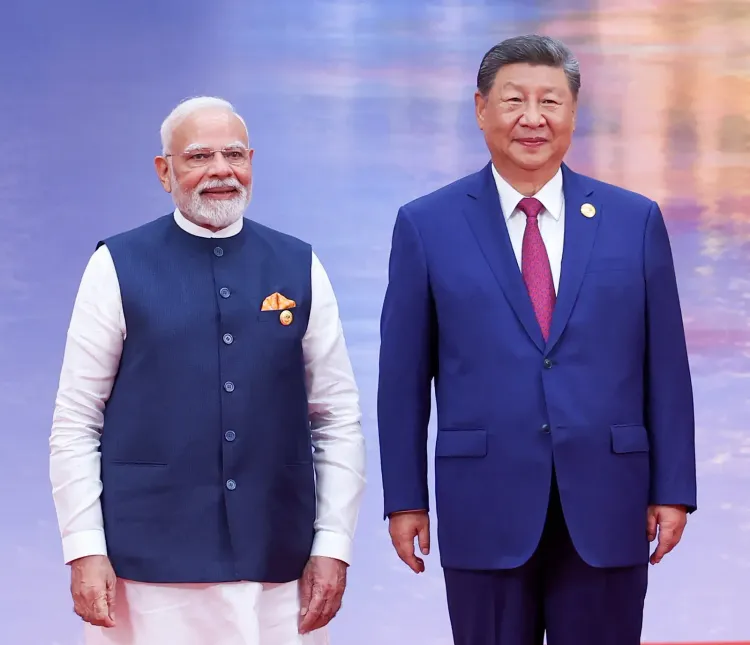
A former Indian diplomat's new assessment lays bare a striking asymmetry: for India, China is arguably its most consequential external relationship; for China, India is just one of many. With normalisation since 2024 still fragile and August 2026 border talks underlining ongoing sensitivity, the report argues that structured pragmatism — not strategic partnership — is the only realistic goal.
Key Takeaways
A report published on 1 September calls for a pragmatic and functional India-China relationship to prevent differences from escalating into confrontation.
Former diplomat Sanjay Kumar Verma highlights a core asymmetry: China is India's most consequential external relationship, but India is one of several priorities for Beijing .
Cautious normalisation has been underway since 2024 , with direct flights resumed, visa procedures eased, and the Kailash Mansarovar pilgrimage restarted.
Border consultations in August 2026 reaffirmed the need for peace along the frontier, but normalisation is described as 'a work in progress.' The report argues Beijing must recognise India as a structural power in the Asian order, not a peripheral one susceptible to pressure.
Restoring people-to-people exchanges — academic, cultural, business, and tourism — is flagged as essential to closing the growing perceptual gap between the two societies.
India and China must build a pragmatic and functional relationship that allows both nations to pursue their respective interests without allowing differences to escalate into open confrontation, according to a recent analytical report. The assessment, published on 1 September, comes as the two Asian giants navigate a cautious normalisation following years of diplomatic strain rooted in the 2020 Galwan Valley crisis.
The Asymmetry at the Heart of the Relationship
Former Indian diplomat Sanjay Kumar Verma, writing in India Narrative, argues that a fundamental imbalance defines how New Delhi and Beijing view each other. 'India and China are often described as the two great civilisational powers of Asia, two of the world's largest countries and increasingly important poles in a changing international order. All of this is true. Yet there is an important asymmetry in their relationship that is less often acknowledged: India and China do not attach the same strategic importance to each other,' Verma wrote.
For India, he notes, China shapes nearly every dimension of national interest — border security, neighbourhood dynamics, economic policy, and strategic alliances. For China, India is significant but competes for attention alongside the United States, Taiwan, Russia, Japan, Europe, and Southeast Asia.
Normalisation in Progress, But Fragile
Verma acknowledges that the sharp deterioration triggered by the Galwan clash of 2020 has gradually given way to cautious diplomatic repair since 2024. Direct flights have resumed, visa procedures have been eased, the Kailash Mansarovar pilgrimage has restarted, and several institutional and people-to-people exchanges are being restored.
'The latest border consultations in August 2026 again underlined the importance of maintaining peace and tranquillity along the frontier. The continuing sensitivity of the border is a reminder that normalisation remains a work in progress,' he noted. The core challenge, according to Verma, is not merely reducing tensions but determining whether intense competition can be kept from spiralling into confrontation.
The Economic Dimension
The report argues that a more balanced economic relationship would serve both countries. It would reduce India's vulnerability to supply-chain disruptions while giving China greater access to one of the world's fastest-growing major markets. Critics of the current trade structure have long pointed to India's significant bilateral trade deficit with China as a structural risk.
What Beijing Needs to Acknowledge
Verma is direct about an adjustment he believes Beijing must make. 'India is no longer a peripheral Asian power whose strategic choices can be influenced primarily through pressure. Its economic weight, military capabilities, geographic position, international partnerships and growing influence in the Global South make India's rise a structural feature of the Asian order,' he wrote. This framing signals that any durable bilateral framework must treat India as an equal actor, not a secondary one.
The People-to-People Deficit
Beyond diplomacy and economics, Verma flags a widening societal gap as a long-term risk. Strained bilateral ties have sharply curtailed engagement between students, scholars, journalists, business communities, and tourists on both sides. 'When societies stop talking to each other, governments increasingly encounter one another through narrow strategic narratives,' he warned. Restoring academic, cultural, business, and tourism exchanges, he argues, is not a matter of goodwill alone — it can help close the growing perceptual gap between the two societies. With neither country able to afford a permanently adversarial relationship, the path forward, the report suggests, lies in structured pragmatism over ideological alignment.
Point of View
A calculation that has repeatedly misfired since 2020. The asymmetry Verma identifies is real, but it cuts both ways — India's growing strategic weight means China's relative inattention carries higher costs than it once did. The call for people-to-people restoration is well-intentioned, but it sidesteps the harder question: can institutional trust be rebuilt when the border dispute remains structurally unresolved? Cautious normalisation is better than open hostility, but it is not a strategy.
NationPress
1 Sept 2026
Frequently Asked Questions
What does the India-China report recommend?
The report recommends that India and China build a pragmatic and functional bilateral relationship that lets both nations pursue their interests while preventing competition from escalating into confrontation. It also calls for a more balanced economic relationship and the restoration of people-to-people exchanges.
What is the asymmetry in the India-China relationship?
According to former diplomat Sanjay Kumar Verma, China is arguably India's single most consequential external relationship, shaping its security, borders, economy, and alliances. For China, however, India is important but competes for strategic attention alongside the US, Taiwan, Russia, Japan, Europe, and Southeast Asia.
How has the India-China relationship changed since the 2020 Galwan crisis?
Since 2024, there has been cautious normalisation: direct flights have resumed, visa procedures have been eased, the Kailash Mansarovar pilgrimage has restarted, and institutional exchanges are being restored. However, border consultations in August 2026 underlined that the frontier remains sensitive and normalisation is still a work in progress.
Why does the report say Beijing needs to adjust its view of India?
The report argues that India is no longer a peripheral Asian power whose choices can be shaped through pressure. Its economic weight, military capabilities, geographic position, global partnerships, and influence in the Global South make India's rise a structural feature of the Asian order that Beijing must acknowledge.
Why does the report stress people-to-people exchanges?
Strained ties have sharply curtailed engagement between students, scholars, journalists, businesses, and tourists on both sides. The report warns that when societies stop communicating, governments meet only through narrow strategic narratives, deepening misperception. Restoring these exchanges is presented as a strategic, not merely symbolic, imperative.