India-Japan partnership targets de-risking of shared economic vulnerabilities
Synopsis
A Tokyo Review analysis reframes the India-Japan relationship not as a hedge against US unpredictability, but as a 'Partnership of Strategic Convergence' built on shared economic vulnerabilities — weaponised supply chains, energy insecurity, and China-dependence on critical minerals. With 129 private-sector deals sealed and JPY 2 trillion in Japanese investment in play, the partnership has moved from diplomatic warmth to structural economic architecture.
Key Takeaways
A Tokyo Review report describes the India-Japan relationship as a 'Partnership of Strategic Convergence' anchored in shared economic vulnerabilities.
Both nations face common risks: weaponised supply chains, energy insecurity, and dependence on China for critical minerals and pharmaceutical ingredients.
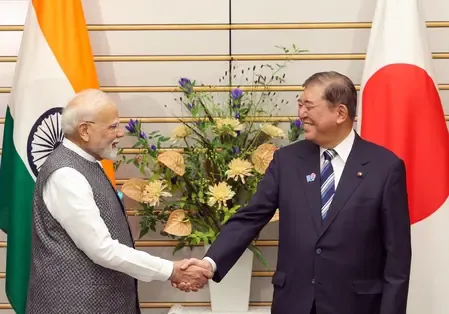
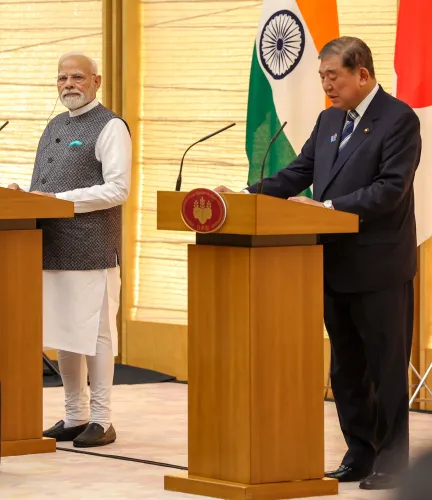
The recent India-Japan summit between PM Modi and PM Takaichi prioritised economic security , energy resilience , and technology .
Nearly 129 private-sector agreements were concluded over the past year, with more than JPY 2 trillion in Japanese investment expected.
The report rejects the framing of Japan's India outreach as a US hedge, calling it 'diversification within an alliance framework.'
The India-Japan bilateral relationship is emerging as a substantive strategic partnership anchored in the de-risking of shared economic vulnerabilities, according to a report by Tokyo Review. The analysis, published in August 2025, identifies weaponised supply chains, energy insecurity, and dependence on China for critical minerals and pharmaceutical ingredients as the structural pressures driving both nations closer together.
Commercial Core of the Partnership
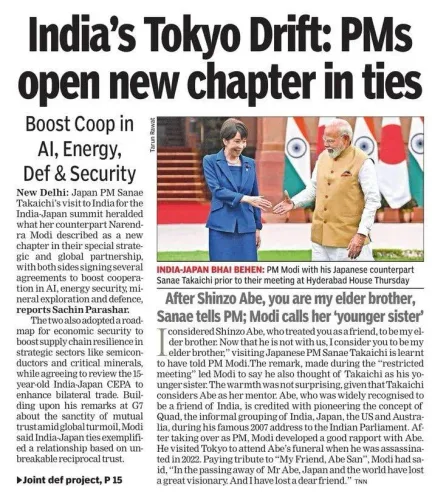
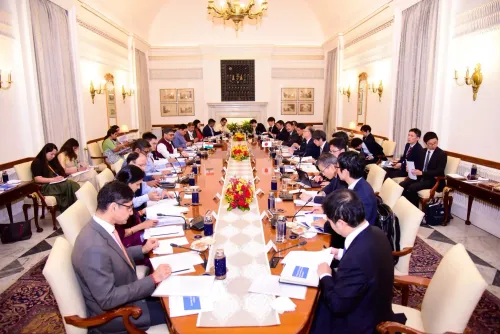
The Tokyo Review report notes that the centre of gravity in the bilateral relationship is 'unmistakably' commercial. These shared vulnerabilities were addressed directly at the recent India-Japan summit, where Prime Minister Narendra Modi and his Japanese counterpart Prime Minister Sanae Takaichi identified three priority areas: economic security, energy resilience, and technology.
According to the report, PM Modi noted at the summit that nearly 129 private-sector agreements had been concluded over the past year, opening the way for more than JPY 2 trillion in Japanese investment into India. The sectors at the heart of those agreements — energy security, defence technology co-development, and semiconductor resilience — reflect a deliberate alignment of industrial strategy between the two economies.
The Personal Diplomacy Signal
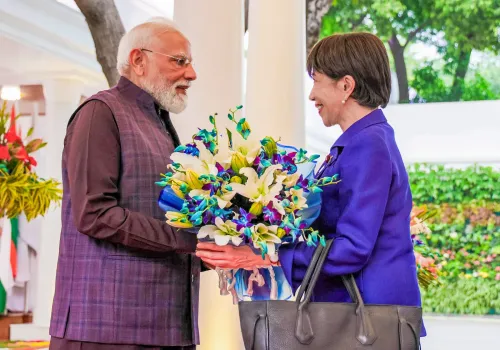
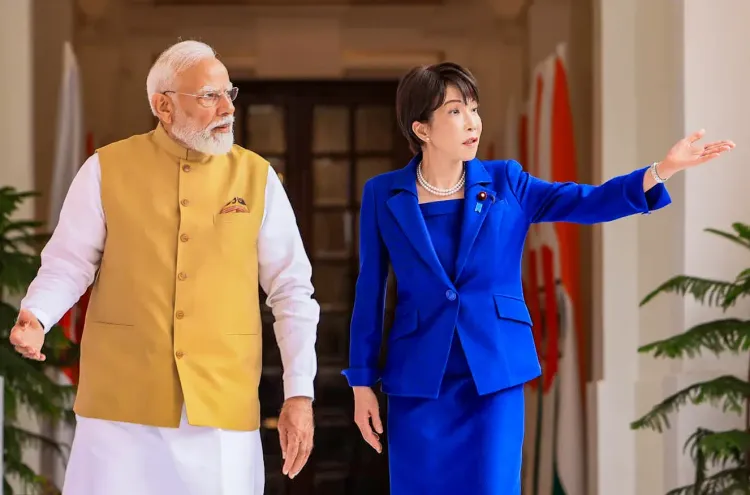
The report also drew attention to the warmth on display during Takaichi's visit to India. It highlighted PM Modi introducing Takaichi as his 'younger sister' — describing it as 'a gesture of closeness rarely extended to a foreign head of state.' Such personal diplomacy, the report suggested, reinforces the depth of political will behind the economic agenda.
Not a Hedge Against the US
The Tokyo Review directly countered interpretations that frame Japan's outreach to India as a hedge against an 'increasingly unpredictable' United States. The report called that reading an oversimplification, arguing instead that the Takaichi visit and the current trajectory of the relationship reflect precisely what both governments have stated: a 'Partnership of Strategic Convergence' — a bilateral relationship worthy of evaluation on its own terms, independent of comparisons with Japan-US or India-US dynamics.
'Japan's outreach to India is thus better understood as diversification within an alliance framework, rather than preparation of an escape route,' the report emphasised.
Why This Partnership Matters Now
The framing matters because it signals durability. Partnerships built around crisis-hedging tend to weaken when the perceived threat recedes. By contrast, a relationship grounded in structural economic complementarity — supply chain resilience, semiconductor access, clean energy — has institutional staying power. This comes amid a broader global trend of democratic economies reconfiguring trade and technology linkages away from single-point dependencies, a pattern accelerated since 2020. For India, Japanese capital and technology transfer offer a credible alternative to Chinese supply chains. For Japan, India's market scale and manufacturing ambition offer a diversification anchor within its alliance architecture.
What Comes Next
The report suggests that economic security cooperation is what will sustain the India-Japan relationship over the long term. With 129 private-sector agreements already in place and JPY 2 trillion in investment on the horizon, the partnership has moved well beyond diplomatic rhetoric. Execution across semiconductor, energy, and defence technology verticals will be the real test of whether strategic convergence translates into measurable outcomes for both economies.
Point of View
But India's track record on converting Japanese interest into deployed capital has been uneven. Semiconductor and energy co-development are long-cycle bets; the partnership's credibility will be measured in factories and grid capacity, not summit communiqués.
NationPress
24 Sept 2026
Frequently Asked Questions
What is the India-Japan 'Partnership of Strategic Convergence'?
It is the official framing both governments have adopted for their bilateral relationship, emphasising alignment on economic security, energy resilience, and technology. A Tokyo Review report describes it as a partnership built around de-risking shared vulnerabilities — including weaponised supply chains and dependence on China for critical minerals — rather than a reaction to US foreign policy shifts.
What was agreed at the recent India-Japan summit?
The summit between PM Narendra Modi and Japanese PM Sanae Takaichi identified three priority cooperation areas: economic security, energy resilience, and technology. PM Modi noted that nearly 129 private-sector agreements had been concluded over the past year, paving the way for more than JPY 2 trillion in Japanese investment into India.
Is Japan's outreach to India a hedge against the United States?
The Tokyo Review report explicitly rejects this interpretation, calling it an oversimplification. It argues that Japan's engagement with India is better understood as 'diversification within an alliance framework' — not preparation of an escape route from the US alliance.
Why are India and Japan focused on supply chain de-risking?
Both nations face structural exposure to weaponised supply chains and dependence on China for critical minerals and pharmaceutical ingredients. Reducing that dependence through bilateral cooperation in semiconductors, energy, and defence technology is a shared strategic priority that predates recent geopolitical tensions.
What sectors are at the centre of India-Japan economic cooperation?
The priority sectors identified at the summit include energy security, defence technology co-development, and semiconductor resilience. These align with the 129 private-sector agreements already concluded and the JPY 2 trillion in Japanese investment expected to flow into India.