India-South Korea green-ammonia shipping corridor can bypass carbon-price stalemate: Report
Synopsis
A new India Narrative report argues that India and South Korea — sitting on complementary strengths in green-fuel production and ammonia-ready shipbuilding — can bypass a decade of failed IMO diplomacy and launch a bilateral green-ammonia corridor anchored at Tuticorin or Kandla and Ulsan, with blended finance bridging the cost gap. The case is urgent: a ship ordered today will burn fuel well into the 2050s.
Key Takeaways
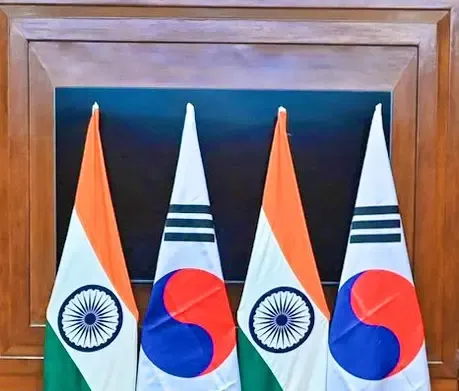
A new India Narrative report calls for a bilateral green-ammonia shipping corridor between India and South Korea , independent of global carbon-pricing talks.
Recommended anchor ports: Tuticorin or Kandla (India) and Ulsan (South Korea), Seoul's designated ammonia bunkering hub.
India contributes green-fuel production capacity; South Korea brings advanced ammonia-ready shipbuilding.
India's approximately $3 billion Maritime Development Fund and bilateral export credit agencies are flagged as blended-finance tools to bridge vessel cost premiums.
South Korea imported $518 million of ammonia in 2025 ; renewables met just 11.4% of its electricity needs against a 20% target for 2030 .
The IMO meets on 4 December 2026 to decide on a binding carbon price for shipping.
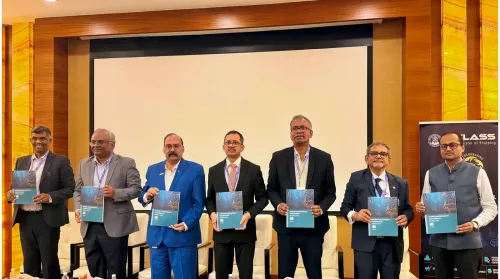
India and South Korea can fast-track shipping decarbonisation through a dedicated green-ammonia corridor without waiting for a global carbon-pricing deal, according to a new report released ahead of the International Maritime Organization (IMO) session on 4 December 2026, which is set to decide on a binding carbon price. The report, published by India Narrative, argues that a focused bilateral corridor between the two nations could cut through the diplomatic gridlock that has repeatedly stalled multilateral negotiations.
The Proposed Corridor and Anchor Ports
The report recommends anchoring the corridor on two specific ports: Tuticorin or Kandla on the Indian side, and Ulsan — which Seoul has officially designated as its ammonia and methanol bunkering hub — on the Korean side. A handful of Korean-built, ammonia-capable vessels would operate between them, running on fuel produced by Indian electrolysers.
The logic is rooted in complementary strengths. South Korea has advanced shipbuilding capacity and ammonia-ready vessel technology but lacks domestic green fuel production. India, by contrast, has ambitious green-hydrogen and ammonia production targets but urgently needs reliable offtake buyers to make those investments viable.
Why Global Negotiations Are Not Enough
The report is notably blunt about the limits of multilateral diplomacy. It points out that many past IMO and comparable negotiations have failed to reach binding agreements. 'Shipowners cannot wait for diplomats and a vessel ordered today will burn fuel into the 2050s,' the report warned.
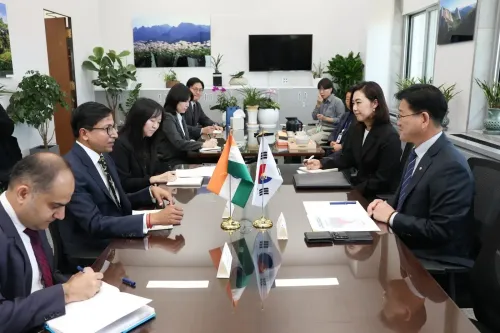
This comes amid a broader pattern of stalled climate diplomacy in the shipping sector, where the IMO's earlier decarbonisation strategy has drawn criticism for lacking enforceable timelines. The report argues that bilateral action is both faster and more credible. 'Two countries that can solve the problem bilaterally are sitting on opposite sides of the Bay of Bengal and the East China Sea, and they have barely begun to talk to each other seriously,' it noted.
Blended Finance to Bridge the Cost Gap
One of the central barriers to ammonia-ready shipping is cost. Dual-fuel and ammonia-capable vessels carry a significant price premium that independent shipowners find difficult to bridge through conventional bank debt. The report calls on both governments to deploy blended finance instruments to close this gap.
It points to India's approximately $3 billion Maritime Development Fund and notes that both countries have export credit agencies and development banks that could co-finance new vessels and bunkering infrastructure. Coordinated deployment of these tools, the report argues, could unlock a commercially viable model that other bilateral pairs could later replicate.
South Korea's Fuel Import Dependency and Renewable Lag
The case for South Korean participation is partly driven by its current fuel vulnerability. South Korea imported $518 million worth of ammonia in 2025, sourcing it predominantly from Indonesia, Saudi Arabia, China, Australia, and Malaysia. Renewables accounted for just 11.4 per cent of South Korea's electricity mix by end-2025, well short of the country's own 20 per cent target for 2030.
Diversifying ammonia sourcing toward India — where solar-powered electrolysis is becoming increasingly cost-competitive — would address both supply security and decarbonisation goals simultaneously.
What Comes Next
The timing of the report is deliberate: the IMO session on 4 December 2026 will be a critical juncture for global shipping climate policy. Whether or not a binding carbon price emerges, the report's authors suggest that India and South Korea need not wait. If the bilateral corridor is formalised, it could serve as a proof-of-concept that accelerates adoption across the broader Asia-Pacific shipping network.
Point of View
And without firm offtake contracts, the 'anchor buyer' logic breaks down. South Korea's 11.4% renewables share also signals that domestic political headwinds could slow its own ammonia transition. The IMO's 4 December session is as much a test of whether global frameworks can still generate credible carbon pricing as it is a backdrop — if they cannot, bilateral corridors like this one move from 'interesting option' to 'only viable path.'
NationPress
12 Nov 2026
Frequently Asked Questions
What is the India-South Korea green-ammonia shipping corridor?
It is a proposed bilateral trade route under which Indian ports — Tuticorin or Kandla — would supply green ammonia produced by domestic electrolysers to South Korean ammonia-ready vessels bunkering at Ulsan. The idea, outlined in a new India Narrative report, would let the two countries decarbonise a slice of shipping without waiting for a global IMO carbon price.
Why is the IMO session on 4 December 2026 significant?
The International Maritime Organization is convening on 4 December 2026 to decide on a binding carbon price for the global shipping industry. The outcome could reshape fuel economics for shipowners, though the report argues that bilateral action should proceed regardless of the result.
Why do India and South Korea need each other for this corridor?
South Korea has world-class shipbuilding and ammonia-compatible vessel technology but no significant domestic green-fuel production. India has large-scale green-hydrogen and ammonia ambitions but needs reliable long-term buyers. The bilateral pairing addresses both gaps simultaneously.
How would the corridor be financed?
The report recommends blended finance combining India's roughly $3 billion Maritime Development Fund with export credit agencies and development banks from both countries to bridge the cost premium on dual-fuel and ammonia-ready ships, which independent owners struggle to cover through conventional debt.
How dependent is South Korea on imported ammonia, and from where?
South Korea imported $518 million of ammonia in 2025, sourcing it mainly from Indonesia, Saudi Arabia, China, Australia, and Malaysia. Diversifying toward Indian green ammonia would address both supply security and climate commitments as Seoul targets 20% renewable electricity by 2030 — a goal it currently lags, with renewables at 11.4% of its mix.