India set to overtake Japan as world's 4th-largest economy by 2027
Synopsis
India is on a path to become the world's fourth-largest economy by 2027, displacing Japan in nominal GDP terms with a projected $4.5 trillion economy. The IMF's diverging forecasts — 7% growth for India versus 0.7% for Japan — capture two starkly different economic stories: one powered by demographics and fiscal discipline, the other weighed down by an ageing population, yen weakness, and persistent inflation.
Key Takeaways
India is projected to surpass Japan to become the world's fourth-largest economy by 2027 , according to IMF forecasts.
India's nominal GDP is expected to reach approximately $4.5 trillion by that point, pushing Japan to sixth place behind both India and the UK.
The IMF projects India's GDP growth at 7 per cent in 2026 , against Japan's 0.7 per cent .
A senior IMF official noted India entered the global energy price surge from a position of strength, backed by fiscal discipline and strong forex reserves .
Japan faces structural headwinds including an ageing population , weak domestic demand, and the yen at a 40-year low against the dollar.
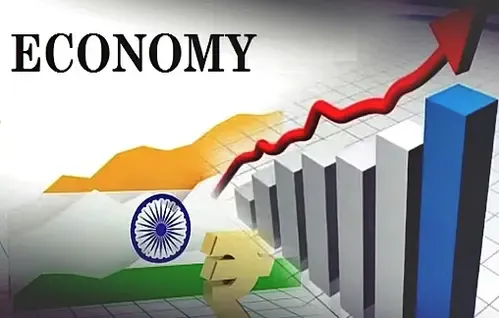
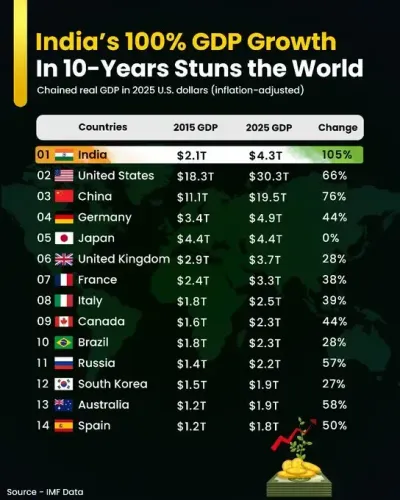
India is on course to become the world's fourth-largest economy by 2027, surpassing Japan in nominal GDP terms, according to projections cited in an IMF report. At that point, India's economy is expected to be valued at approximately $4.5 trillion, pushing Japan down to sixth place — behind both India and the United Kingdom.
India's Growth Trajectory
The IMF's forecasts highlight a sharp divergence in economic momentum between Asia's two major democracies. India's GDP growth is projected at 7 per cent in 2026, reflecting sustained resilience even as geopolitical tensions and global energy price shocks weigh on many other economies. Japan, by contrast, is expected to expand by a modest 0.7 per cent in the same year.
Speaking at the release of the IMF's Asia-Pacific regional economic outlook earlier in October, a senior IMF official noted that India entered the recent surge in global energy prices from a position of strength, supported by solid growth, fiscal discipline, and substantial foreign exchange reserves. According to the IMF, these macroeconomic fundamentals have allowed India to absorb higher energy costs more effectively than most peer economies.
Japan's Structural Headwinds
Japan continues to face a cluster of deep-seated structural challenges. An ageing population, weak domestic demand, and sluggish long-term growth have persistently capped its economic expansion. Consumer prices in Japan have been rising steadily since 2022, and recent geopolitical developments have compounded inflationary pressures through elevated fuel and energy costs.
The yen's sharp depreciation — hitting its lowest level in 40 years against the US dollar over the summer — has further inflated import costs, squeezing households and businesses alike, according to the analysis. Japan's shrinking working-age population adds another structural drag that monetary or fiscal policy cannot easily offset.
What the Rankings Shift Means
Japan currently holds the fourth position in global GDP rankings and is expected to retain it through 2026. However, the IMF's trajectory points to India crossing ahead in 2027. This would make India the third Asian economy — after China and Japan currently — to rank among the world's top five, and would cement its status as the fastest-growing major economy globally.
Notably, India only overtook the United Kingdom to become the world's fifth-largest economy in 2022, having earlier displaced France. The projected leap past Japan would represent another milestone in a rapid, decade-long ascent up the global rankings.
Outlook and Caveats
While the IMF projections are broadly optimistic for India, analysts caution that nominal GDP comparisons are sensitive to currency fluctuations. A significant strengthening of the yen or a sharper-than-expected slowdown in Indian growth — whether from a global recession, domestic demand softness, or geopolitical disruption — could alter the timeline. Sustained execution on fiscal consolidation and infrastructure investment will be critical to India maintaining its growth premium over the coming years.
Point of View
And now stands to leapfrog Japan within five years. Yet nominal GDP rankings are a currency-sensitive metric: a yen recovery or an Indian growth disappointment could shift the timeline. The more durable story is structural — India's demographic dividend is still compounding while Japan's is actively unwinding. That divergence does not reverse easily, which is why analysts increasingly treat the ranking shift as a question of 'when', not 'if'. What remains underscrutinised is whether India's growth is broad-based enough to convert GDP rank into per-capita gains that ordinary citizens actually feel.
NationPress
16 Oct 2026
Frequently Asked Questions
When is India expected to overtake Japan in GDP rankings?
India is projected to surpass Japan to become the world's fourth-largest economy in 2027, according to IMF forecasts. At that point, India's nominal GDP is expected to reach approximately $4.5 trillion.
Where will Japan rank after India overtakes it?
Japan would drop to sixth place in global GDP rankings, behind both India and the United Kingdom, according to the IMF projections cited in the analysis.
What is India's GDP growth forecast for 2026?
The IMF has projected India's GDP growth at 7 per cent in 2026, reflecting strong macroeconomic fundamentals including fiscal discipline and substantial foreign exchange reserves.
Why is Japan's economy growing so slowly?
Japan faces a combination of structural challenges — an ageing and shrinking population, weak domestic demand, and sluggish long-term growth. Inflationary pressures since 2022 and the yen hitting a 40-year low against the dollar have further weighed on its economy.
How quickly has India climbed the global GDP rankings?
India overtook France and then the United Kingdom to become the world's fifth-largest economy in 2022. A move past Japan in 2027 would represent back-to-back ranking jumps within five years, underscoring the pace of India's economic ascent.