Indian-American Gen Z candidate Jay Vaingankar bids for New Jersey's 12th Congressional seat
Synopsis
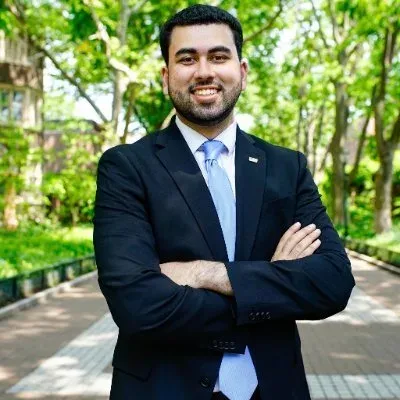
A 28-year-old son of Mumbai immigrants and former Biden White House staffer is running to become New Jersey's first Indian-American and first Gen Z member of Congress — in a 12-candidate primary where the winner may need just 15% of the vote. New Jersey, despite having one of the largest South Asian populations in the US, has never elected an Indian-American to federal or statewide office.
Key Takeaways
Jay Vaingankar , 28 , a former White House and Department of Energy official, is running in the Democratic primary for New Jersey's 12th Congressional District .
If elected, he would be New Jersey's first Gen Z and first Indian-American member of Congress.
The primary field has 12 candidates ; Vaingankar estimates the winner could prevail with as little as 15% of the vote.
His campaign focuses on affordability , clean energy investment , and political reform .
Vaingankar was born in Trenton , raised in central New Jersey, and attended the University of Pennsylvania's Wharton School .
General elections are scheduled for November 2026 .
Jay Vaingankar, a 28-year-old former White House and Department of Energy official, is running in the Democratic primary for New Jersey's 12th Congressional District, seeking to become the state's first Gen Z and first Indian-American member of Congress. The primary, drawing a crowded field of 12 candidates, is for an open seat vacated by the retirement of veteran Democratic Congresswoman Bonnie Watson Coleman.
Who Is Jay Vaingankar
Born in Trenton and raised in East Windsor and Hightstown, Vaingankar is the son of immigrants from Mumbai — his father arrived in the United States on an H-1B visa. He attended the University of Pennsylvania's Wharton School before serving in the Biden administration, working across the White House and the Department of Energy. His biography closely mirrors that of many Indian-American families who settled in central New Jersey over the past three decades.
Key Campaign Priorities
Vaingankar has centred his campaign on three issues: affordability, clean energy investment, and political reform. 'It's that every week you go to the grocery store or you're paying your property taxes or you look at your bills and they're going up every single month,' he said. 'And it's not like the quality of those goods or those services are getting better.'
On energy, he argued against what he called a false trade-off between cost and environmental goals. 'I'm tired of this false choice between should the energy be clean or should it be cheap,' he said, pointing to solar, wind, and nuclear as technologies that can simultaneously lower utility bills and create jobs. 'I think America can lead the Green Tech revolution,' he added.
A Crowded Primary and the Representation Question
With 12 candidates in the race, Vaingankar acknowledged that vote-splitting could be decisive. 'Someone can win this race with maybe 15% of the vote,' he said. Despite the competitive field, he described the biggest obstacle as voter cynicism rather than rival campaigns. 'The biggest competitor that we have is the cynicism that New Jersey isn't ready to elect a young candidate, isn't ready to elect a South Asian candidate,' he said.
Notably, New Jersey — home to one of the largest South Asian populations in the United States — has never sent an Indian-American to Congress or statewide federal office. Vaingankar attributed this to a combination of structural barriers and community attitudes, while pointing to what he described as rising political engagement. 'We're so grateful to see thousands of Indian Americans registering to vote for the first time,' he said.
Community and Volunteer Support
The campaign has drawn backing from several Asian-American political organisations and prominent Indian-American leaders, according to Vaingankar. Hundreds of high school and college students have signed up as volunteers, he said. He entered the race after community members urged him to stand following Watson Coleman's retirement announcement, arguing that voters were tired of electing candidates simply because 'it's their turn.'
US-India Relations and What Comes Next
On foreign policy, Vaingankar stressed the importance of strengthening ties between Washington and New Delhi. 'India's at a crossroads right now,' he said. 'India's one of the fastest growing economies of the world.' He argued the relationship should be grounded in shared democratic values and deeper economic cooperation.
General elections for New Jersey's 12th Congressional District are scheduled for November 2026. With Watson Coleman's retirement drawing national Democratic attention to the seat, the outcome of the primary could signal how the party's next generation of leadership takes shape in one of America's most diverse states.
Point of View
But the structural challenge is real: in a 12-way primary, momentum and name recognition matter more than biography. New Jersey's failure to send a single Indian-American to Congress or statewide federal office — despite hosting one of the country's largest South Asian communities — points to a gap between demographic weight and political organisation that one candidate cannot close alone. The 15%-to-win threshold cuts both ways: it lowers the bar for a historic upset, but it also means a well-funded establishment candidate can consolidate just enough of the field to prevail. Whether this race becomes a turning point for South Asian political representation, or another near-miss, will depend on whether community mobilisation translates into a coordinated vote rather than a divided one.
NationPress
26 Sept 2026
Frequently Asked Questions
Who is Jay Vaingankar and why is he running for Congress?
Jay Vaingankar is a 28-year-old former White House and Department of Energy official running in the Democratic primary for New Jersey's 12th Congressional District. He entered the race after veteran Congresswoman Bonnie Watson Coleman announced her retirement, arguing that voters want a new generation of leadership focused on affordability and clean energy.
What would make Jay Vaingankar's election historic?
If elected, Vaingankar would become New Jersey's first Gen Z and first Indian-American member of Congress. New Jersey has one of the largest South Asian populations in the United States but has never sent an Indian-American to Congress or statewide federal office.
How competitive is the New Jersey 12th Congressional District primary?
The Democratic primary has 12 candidates, making it highly competitive. Vaingankar himself has noted that a candidate could potentially win with as little as 15% of the vote due to vote-splitting across the large field.
What are Jay Vaingankar's main policy positions?
Vaingankar's campaign centres on three issues: reducing the cost-of-living burden on working families, investing in clean energy technologies such as solar, wind, and nuclear to lower utility bills and create jobs, and broader political reform. He has also stressed strengthening the US-India relationship.
When is the New Jersey 12th Congressional District general election?
The general election for New Jersey's 12th Congressional District is scheduled for November 2026. The Democratic primary, which features 12 candidates competing for the open seat, precedes that contest.