Why Were Three Indians Aboard a Russian Oil Tanker Seized by the US?
Synopsis
The recent seizure of a Russian-flagged oil tanker by US forces, which included three Indian nationals among its crew, raises significant questions about maritime security and international relations. This incident, described as a coordinated operation, highlights growing tensions over sanctions and energy trade. What implications does this event hold for global diplomacy?
Key Takeaways
Three Indian nationals were aboard a seized Russian oil tanker.
The tanker Marinera was apprehended in the North Atlantic.
The seizure was part of a coordinated US operation .
Russia condemned the action as a violation of international law .
The incident raises concerns over sanctions and maritime security .
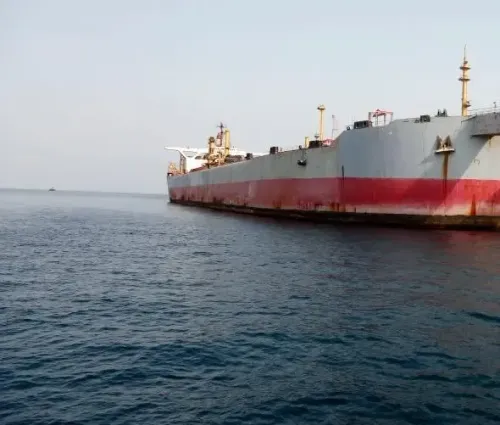
New Delhi, Jan 8 (NationPress) Three Indian citizens were part of the 28 crew members on a Russian-flagged oil tanker that was apprehended by forces from the United States in the North Atlantic, according to media reports.
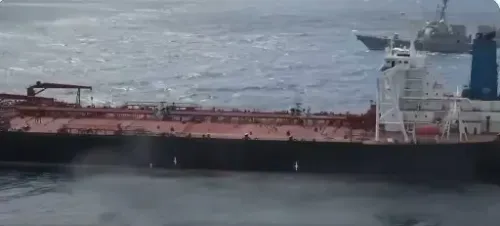
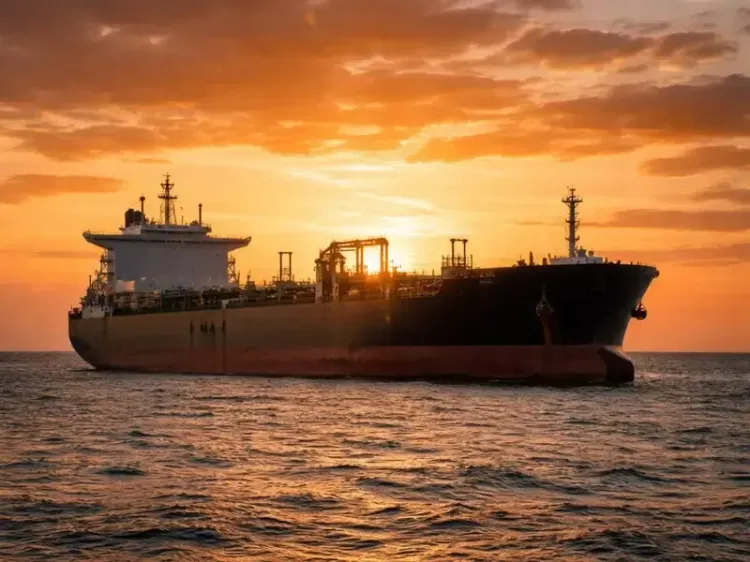
The tanker, known as Marinera and formerly called Bella 1, was intercepted after a lengthy maritime chase that allegedly commenced in the Caribbean Sea and continued into the North Atlantic.
Reports indicate that the tanker had a diverse crew consisting of 17 Ukrainians, six Georgians, three Indians, and two Russians, including the captain of the ship. Currently, all crew members are in the custody of US authorities, although there has been no indication regarding their potential release.
The seizure occurred on Wednesday as a result of what has been characterized as a synchronized operation by US agencies, with assistance from British forces. US officials have claimed that the tanker had connections to Venezuela and may have been attempting to bypass international sanctions.
According to media sources citing US officials, the operation was executed collaboratively by the US Coast Guard and military units, with UK support. British airbases were reportedly utilized to aid the operation, and Royal Air Force surveillance aircraft monitored the vessel as it navigated through waters between Iceland and the UK.
The incident has prompted strong reactions from Russia, which has condemned the act as a breach of international maritime law. Russia’s Transport Ministry stated that no nation has the authority to use force against vessels legitimately registered under another country's flag.
Russian lawmakers reacted vehemently. Alexei Zhuravlev, Deputy Chairman of the State Duma Committee on Defence, was quoted as labeling the seizure an act of piracy and a direct affront to Russian sovereignty. He remarked, "This is the most common form of piracy -- the capture of a civilian vessel by an armed American fleet," asserting that such actions equate to an attack on Russian territory since the tanker was operating under the Russian flag.
As diplomatic tensions heighten, the capture of the Marinera underscores the increasing friction surrounding sanctions enforcement, maritime security, and the global energy trade. With ongoing investigations and official responses evolving, this incident is being closely scrutinized for its broader geopolitical ramifications.
Point of View
It is crucial to remain unbiased and focus on the facts surrounding the incident involving the Marinera. The apprehension of the tanker and its multinational crew raises vital questions about international maritime law and geopolitical tensions, especially concerning sanctions and energy security. Our commitment is to report on these developments while considering the perspectives of all involved parties.
NationPress
1 Oct 2026
Frequently Asked Questions
What led to the seizure of the Marinera?
The Marinera was apprehended by US forces during a coordinated operation, allegedly due to its links with Venezuela and efforts to circumvent international sanctions.
How many crew members were aboard the tanker?
The Marinera had a total of 28 crew members, including 17 Ukrainians, six Georgians, three Indians, and two Russians.
What has been Russia's response to the seizure?
Russia condemned the seizure as a violation of international maritime law and described it as an act of piracy that challenges Russian sovereignty.
What are the implications of this incident?
The seizure has heightened diplomatic tensions and raised issues regarding sanctions enforcement, maritime security, and global energy trade.
What actions were taken by US and UK forces?
The operation involved the US Coast Guard and military units, with support from British forces and surveillance from Royal Air Force aircraft.