India signs 15 critical minerals deals since 2025 in global energy race
Synopsis
India has quietly become one of the world's most aggressive movers in the critical minerals race — 15 international agreements since January 2025, 56 mineral blocks auctioned, and a ₹16,300 crore mission targeting the full supply chain through FY31. The shift from resource identification to industrial strategy signals that New Delhi sees mineral security as the hidden foundation of its clean-energy and semiconductor ambitions.
Key Takeaways
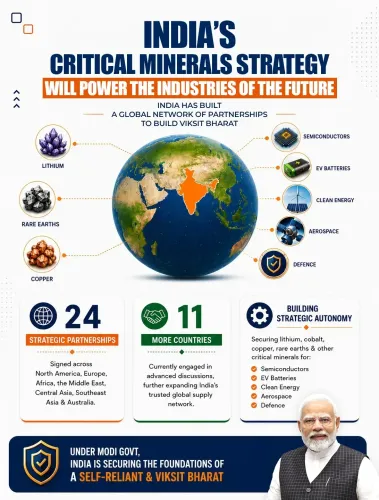
India has signed at least 15 critical minerals agreements since January 2025 , among the highest globally.
The National Critical Mineral Mission , approved in January 2025 , runs through FY31 with ₹16,300 crore in government expenditure and ₹18,000 crore in targeted PSU investment.
56 of 88 critical mineral blocks auctioned by the Centre had been successfully awarded as of June 2026 — a success rate of over 63% .
The 9th tranche of mineral block auctions, covering 20 blocks across eight states , was launched at the fourth mining ministers' conference this month.
Minerals covered include strategically vital rare earth elements , graphite , and vanadium , critical for EVs, defence, and advanced electronics.
1,200 domestic exploration projects are underway under the Geological Survey of India , alongside plans for 50 foreign mining assets through PSUs and private players.
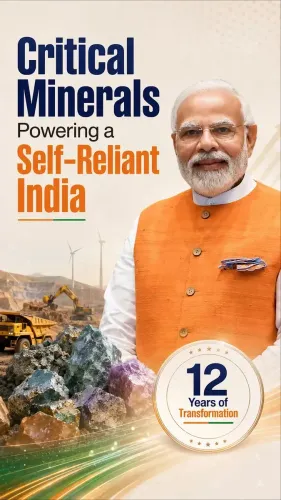
India's critical minerals programme has shifted decisively from a resource-mapping exercise into a full-scale industrial development strategy, with the government signing at least 15 critical minerals-related agreements since January 2025 — making India one of the world's most active participants in the global race to secure materials essential for the energy transition.
The Strategic Imperative
India's ambitions in electric mobility, renewable energy, semiconductor manufacturing, modern defence equipment, and advanced electronics depend not only on technology and capital, but critically on reliable supplies of the underlying minerals, according to a recent analytical report. Without securing that supply chain, the country's clean-energy and advanced-manufacturing targets remain structurally vulnerable.
National Critical Mineral Mission: Scale and Scope
The government's National Critical Mineral Mission, approved in January 2025, anchors the strategy. The programme, running from FY25 through FY31, envisages government expenditure of ₹16,300 crore and aims to catalyse a further ₹18,000 crore in investment by public sector undertakings (PSUs). The mission targets the entire value chain — from exploration and mining through to processing, recycling, and recovery.
Implementation targets are substantial: 1,200 domestic exploration projects are being led by the Geological Survey of India, with plans to secure 26 foreign mining assets through PSUs and 24 through private-sector entities.
Auction Pipeline Gains Momentum
Mineral block auctions have emerged as the most visible indicator of the programme's accelerating pace. As of June 2026, the Ministry of Mines reported that 56 of the 88 unique critical and strategic mineral blocks put up for auction by the Central Government had been successfully auctioned — a success rate exceeding 63 per cent. The blocks covered minerals critical to energy, electronics, defence, and advanced manufacturing.
Earlier this month, the fourth conference of mining ministers witnessed the launch of the 9th tranche of critical and strategic mineral block auctions, offering 20 mineral blocks across eight states. The same event also saw the launch of a third tranche of exploration licence auctions, comprising 11 exploration blocks across six states. Strategically important minerals covered include rare earth elements, graphite, and vanadium.
Processing Incentives and Private Sector Pull
Beyond exploration and auctions, India has introduced processing incentives designed to deepen domestic value addition rather than simply exporting raw ore. This marks a qualitative shift: earlier rounds of the programme focused on identifying what India has underground; the current phase is about building the industrial infrastructure to convert those resources into usable inputs for high-tech manufacturing sectors.
The expanding scope also includes a push for international partnerships, with bilateral and multilateral agreements giving India preferential access to mineral-rich jurisdictions — positioning the country as a midstream player in global critical minerals supply chains, not merely a consumer.
What Comes Next
With the 9th auction tranche now underway and exploration licences being issued in parallel, the pipeline of actionable projects is set to grow through FY26. The critical question is whether domestic processing capacity — still nascent in several key minerals — can scale in step with exploration gains. Industry observers note that India's window to shape the global critical minerals order is narrow, given competing moves by China, the United States, and the European Union.
Point of View
But the gap between exploration and processing remains the programme's Achilles heel. Signing agreements and auctioning blocks is the easy part — building the domestic refining and processing capacity to rival China's near-monopoly in rare earth processing is a decade-long industrial challenge that the ₹16,300 crore mission alone cannot solve. The 63% auction success rate sounds impressive until you ask how many auctioned blocks have moved from award to actual extraction. The real scorecard for this programme will be written in FY28 and FY30, not in press releases from mining ministers' conferences.
NationPress
21 Nov 2026
Frequently Asked Questions
What is India's National Critical Mineral Mission?
India's National Critical Mineral Mission is a government programme approved in January 2025, running from FY25 to FY31, with a budgeted government outlay of ₹16,300 crore and a target of catalysing ₹18,000 crore in PSU investment. It covers the full value chain — from exploration and mining to processing, recycling, and recovery of critical minerals needed for clean energy and advanced manufacturing.
How many critical mineral agreements has India signed since 2025?
India has signed at least 15 critical minerals-related agreements since January 2025, making it one of the most active countries globally in securing mineral supply partnerships for the energy transition.
What is the status of India's critical mineral block auctions?
As of June 2026, 56 of the 88 unique critical and strategic mineral blocks put up for auction by the Central Government had been successfully awarded — a success rate of over 63%. A 9th tranche of auctions, covering 20 blocks across eight states, was launched earlier this month at the fourth mining ministers' conference.
Which minerals are covered under India's critical minerals strategy?
India's programme covers a wide range of minerals essential to energy, electronics, defence, and advanced manufacturing. Strategically important minerals highlighted in recent auction tranches include rare earth elements, graphite, and vanadium — all critical for electric vehicles, semiconductors, and modern defence systems.
Why does critical mineral security matter for India's economy?
India's goals in electric mobility, renewable energy, semiconductor manufacturing, defence equipment, and advanced electronics all depend on reliable access to specific minerals. Without a secured and domestically processed supply of these materials, India's clean-energy and high-technology manufacturing ambitions remain exposed to global supply-chain disruptions and geopolitical risk.