India signs 15 critical minerals pacts since Jan 2025, trails only US globally
Synopsis
India has quietly become the world's second-most active nation in securing critical mineral deals, signing 15 agreements since January 2025 — ahead of China, the EU, Canada, and Saudi Arabia. With a ₹16,300 crore national mission and partnerships stretching from Argentina's lithium fields to Australian cobalt assets, India is making its most concerted push yet to avoid the supply-chain chokepoints that could derail its entire clean energy agenda.
Key Takeaways
India signed 15 critical minerals agreements since January 2025 , according to a Climate Action Live report released on 12 November 2026 .
India surpassed China , Canada , Saudi Arabia , and the EU (each with 11 pacts); only the US (41 pacts) signed more.
The National Critical Mineral Mission (FY25–FY31) envisages ₹16,300 crore in government spending and ₹18,000 crore in PSU investment.
State-owned KABIL has signed a deal with Argentina's CAMYEN for five lithium brine blocks covering 15,703 hectares in Catamarca .
India has also partnered with Australia , Germany , and Norway on lithium, cobalt, processing, and supply chain diversification.
The mission targets 1,200 domestic exploration projects and acquisition of 50 foreign mining assets (26 via PSUs, 24 via private sector).
India has signed 15 critical minerals-related agreements since January 2025, placing it among the world's most active nations in the race to secure resources vital for the global energy transition, according to a new report by Climate Action Live. The figure puts India ahead of major economies including China, Canada, Saudi Arabia, and the European Union, each of which signed 11 such agreements over the same period.
Only the United States, which concluded 41 critical minerals partnerships, outpaced India during this timeframe, the report noted.
Why Critical Minerals Matter for India
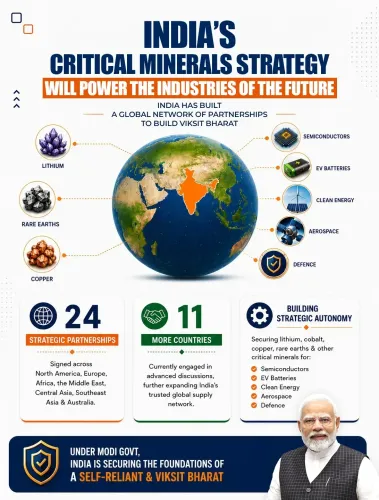
India's agreements reflect a growing recognition that its clean energy ambitions are contingent on securing reliable access to resources that are either unavailable or domestically insufficient. These include lithium, cobalt, nickel, graphite, copper, and rare earth elements — all essential inputs for electric vehicles, batteries, wind turbines, electricity grids, and semiconductors.
This comes amid intensifying global competition for critical mineral supply chains, with the United States, European Union, and China all accelerating their own resource-securing strategies ahead of the energy transition deadline many governments have set for mid-century.
The National Critical Mineral Mission
India's National Critical Mineral Mission, approved in January 2025, aims to strengthen the full minerals value chain — from exploration and mining through to processing, recycling, and recovery. The programme runs from FY25 through FY31 and envisages government expenditure of ₹16,300 crore, while also seeking to catalyse ₹18,000 crore in investment from public sector undertakings.
The mission encompasses 1,200 domestic exploration projects led by the Geological Survey of India, along with plans to secure 26 foreign mining assets through public sector undertakings and a further 24 through the private sector.
Key International Partnerships
Among the notable bilateral arrangements, state-owned Khanij Bidesh India Ltd (KABIL) has signed a deal with Argentina's CAMYEN to explore and develop five lithium brine blocks covering 15,703 hectares in the province of Catamarca. India has also entered into an arrangement with Australia to jointly invest in lithium and cobalt assets, according to the report.
Cooperation has further expanded with Germany and Norway, covering critical minerals supply chain diversification, research, processing, and recycling — aimed at building India's capacity to process minerals into higher-value products and establish a more robust domestic industrial ecosystem.
What Comes Next
With FY31 as the mission's horizon, India's focus will now turn to translating partnership agreements into operational mining and processing assets. Industry analysts note that moving from signed agreements to functioning supply chains has historically been the harder challenge — a gap India's policymakers will need to close to realise the full value of this diplomatic momentum.
Point of View
And the ₹16,300 crore National Critical Mineral Mission, while ambitious, still leaves the country dependent on foreign soil for the minerals it needs most. The real competitive risk is not falling behind the US in pact counts, but falling behind China in processing capacity — a bottleneck that no number of bilateral agreements alone can solve. Unless India simultaneously builds domestic refining infrastructure, it risks becoming a deal-maker that still ships raw dependence home.
NationPress
12 Nov 2026
Frequently Asked Questions
How many critical mineral agreements has India signed since January 2025?
India has signed 15 critical minerals-related agreements since January 2025, according to a Climate Action Live report. This places India second globally, behind only the United States, which signed 41 such agreements in the same period.
What is India's National Critical Mineral Mission?
The National Critical Mineral Mission is a government programme approved in January 2025 running from FY25 to FY31. It aims to build India's full critical minerals value chain — from exploration and mining to processing, recycling, and recovery — with ₹16,300 crore in government expenditure and ₹18,000 crore in PSU investment.
Which countries has India partnered with for critical minerals?
India has signed partnerships with Argentina, Australia, Germany, and Norway, among others. KABIL's deal with Argentina's CAMYEN covers five lithium brine blocks in Catamarca, while Australia cooperation focuses on lithium and cobalt assets, and Germany and Norway partnerships target processing and supply chain diversification.
Why are critical minerals important for India's clean energy goals?
Critical minerals such as lithium, cobalt, nickel, graphite, copper, and rare earth elements are essential components of electric vehicles, batteries, wind turbines, electricity grids, and semiconductors. India lacks sufficient domestic reserves of many of these, making international agreements critical to its clean energy transition targets.
How does India compare to China and the EU in securing critical mineral deals?
India outpaced both China and the European Union, each of which signed 11 critical minerals agreements since January 2025, compared to India's 15. Only the United States, with 41 agreements, signed more during the same period, according to the Climate Action Live report.