Inflation pushes up to 10 million into poverty in Bangladesh, report warns
Synopsis
Bangladesh's inflation crisis has pushed as many as 10 million people into poverty, with nearly half of all households now in debt — and the government's own finance adviser warning the country inherited a fragile economy marred by cronyism, a broken banking sector needing $40 billion, and an energy policy that failed to build resilience.
Key Takeaways
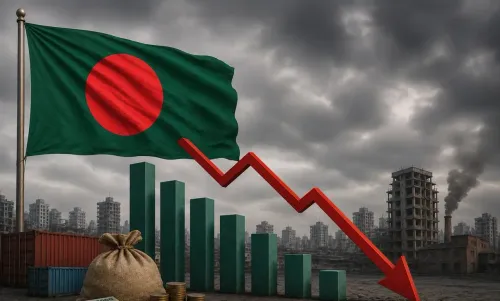
Persistent inflation has pushed between 8 million and 10 million people below the poverty line in Bangladesh , according to a Traders Union report.
47.42% of Bangladeshi households — mostly rural — have fallen into debt as living costs have surged against stagnant incomes, per Bangladesh Bureau of Statistics (BBS) data.
Finance adviser Rashed Al Mahmud Titumir says the government inherited a fragile economy with high inflation, rising unemployment, and weak private-sector investment.
The banking sector requires approximately $40 billion to be repaired, according to Titumir, who also alleged systemic cronyism and patronage.
The government plans to allocate 2% of GDP to education and has launched family-card and farmer-card initiatives recognised by the IMF and World Bank .
Middle East tensions have further raised fuel prices, adding to Bangladesh's energy insecurity and economic pressure.
Persistent inflation has driven between 8 million and 10 million people in Bangladesh below the poverty line, according to a new report citing Rashed Al Mahmud Titumir, adviser on finance and planning to the Prime Minister. The findings, published by Traders Union, a Cyprus-based financial publication, paint a stark picture of an economy under severe structural stress.
Household Finances Under Severe Strain
The report notes that household finances across Bangladesh have deteriorated sharply, with savings being depleted and families taking on debt to manage rising daily costs. A separate survey by the Bangladesh Bureau of Statistics (BBS) found that nearly 47.42% of households — the majority in rural areas — have fallen into debt as living expenses have skyrocketed against stagnant earnings.
Titumir, speaking at a meeting, acknowledged that the current government 'inherited a fragile economy' marked by high inflation, rising unemployment, and weak private-sector investment, describing the present moment as a 'critical transition' for the country.
Unemployment and Energy Crisis Compound the Problem
The adviser flagged youth unemployment — particularly among educated young people — as a major concern. He noted that recent Middle East tensions have further elevated fuel prices and added to economic pressure. The weak purchasing power of low- and middle-income groups, he argued, is compounding both unemployment and energy insecurity in a damaging feedback loop.
Titumir also criticised the previous administration's energy policy, alleging it failed to 'expand solar energy, explore domestic gas resources and ensure sustainable energy security.' He stressed that stronger energy policy is essential to attract investment and generate employment, and highlighted Bangladesh's need to develop renewable energy and reduce dependence on imported fuel.
Banking Sector and Governance Challenges
According to Titumir, the banking sector alone requires approximately $40 billion to be repaired, a figure that underscores the depth of the financial system's vulnerabilities. He alleged that cronyism and patronage had systematically weakened the economic framework over time.
On education, the adviser stressed the importance of overhauling the system to build a skilled workforce capable of addressing joblessness, noting that the government plans to allocate 2% of GDP to education.
Government Measures and International Recognition
Citing a World Bank report, Titumir highlighted the government's family-card and farmer-card initiatives as poverty-reduction measures that have received recognition from both the International Monetary Fund (IMF) and the World Bank. He also flagged the spread of misleading information and distorted gross domestic product (GDP) data circulating on social media as an additional challenge to public understanding of the economy.
What Comes Next
With household debt levels rising, energy costs elevated, and the banking sector requiring massive recapitalisation, Bangladesh faces a complex recovery path. Analysts will be watching whether the government's social safety-net programmes and proposed education investments can translate into measurable poverty reduction in the near term.
Point of View
But the more revealing detail is the near-50% household debt figure from the BBS survey, which suggests the poverty shock is structural rather than cyclical. Bangladesh's challenge is not just inflation: it is a banking sector that reportedly needs $40 billion in repairs, an energy policy that critics say was hollowed out under the previous government, and youth unemployment that risks becoming a generational crisis. The government's family-card and farmer-card programmes are a start, but social safety nets cannot substitute for the private-sector investment and energy security that the adviser himself admits are currently absent.
NationPress
22 Oct 2026
Frequently Asked Questions
How many people has inflation pushed below the poverty line in Bangladesh?
Between 8 million and 10 million people in Bangladesh have been pushed below the poverty line due to persistent inflation, according to a report by Traders Union citing finance adviser Rashed Al Mahmud Titumir. The figure reflects deepening household financial stress as savings are depleted and debt rises.
What is the state of household debt in Bangladesh?
Nearly 47.42% of households across Bangladesh have fallen into debt, with the majority in rural areas, according to data from a special survey by the Bangladesh Bureau of Statistics (BBS). Rising living expenses against stagnant earnings are cited as the primary driver.
Why does Bangladesh's banking sector need $40 billion?
Finance adviser Rashed Al Mahmud Titumir has said approximately $40 billion is required to repair Bangladesh's banking sector, which he alleges was weakened by cronyism and patronage under the previous administration. No detailed repair timeline has been publicly outlined.
What measures is the Bangladesh government taking to reduce poverty?
The government has launched family-card and farmer-card initiatives that have been recognised by the IMF and World Bank as poverty-reduction measures, according to Titumir. It also plans to allocate 2% of GDP to education to build a skilled workforce and address unemployment.
How have Middle East tensions affected Bangladesh's economy?
Recent Middle East tensions have further raised fuel prices, adding to energy insecurity and economic pressure in Bangladesh, according to Titumir. Bangladesh is heavily dependent on imported fuel, and the adviser has stressed the need to develop renewable energy to reduce this vulnerability.