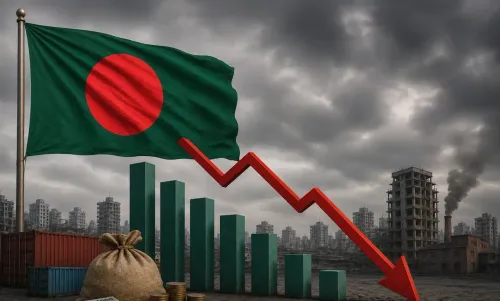
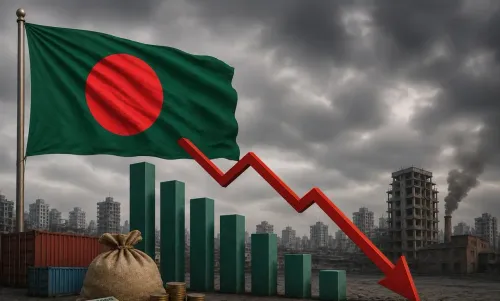
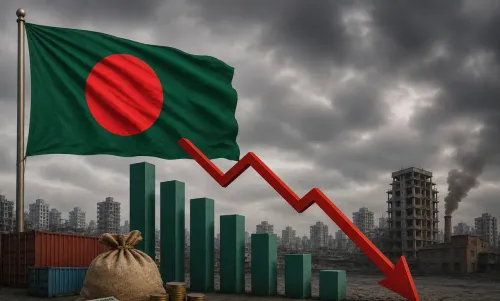
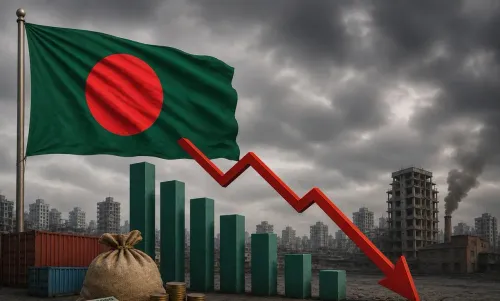
Bangladesh economic crisis: World Bank flags 3.4% growth, banking risks in 2026 report
Synopsis
The World Bank's October 2026 Bangladesh Development Update delivers a stark verdict: growth is stuck at 3.4 per cent — nearly half the decade average — with a fragile banking sector, energy shortages, and a social protection system that leaves 62 million near-poor exposed. The report's most striking finding is that the richest urban households capture nearly half of all electricity subsidies meant to help the poor.
Key Takeaways
The World Bank's October 2026 Bangladesh Development Update projects GDP growth at 3.4 per cent in FY27 — unchanged from FY26 and well below the decade average of 5.6 per cent .
Private investment fell 0.5 per cent and public investment fell 0.7 per cent in FY2025–26 ; real exports of goods and services dropped 4.8 per cent .
Imported LNG now meets about one-third of Bangladesh's gas demand; factories have been forced to curtail output or suspend operations.
Approximately half of the poorest households are excluded from safety-net programmes, while 62 million near-poor face the risk of poverty.
Bangladesh spends roughly 3.5 per cent of GDP on energy subsidies and social protection, yet the richest urban households receive nearly half of all electricity subsidies.
Growth may recover marginally to 3.9 per cent in FY28 , contingent on faster structural reforms in banking, energy, and social protection.
Bangladesh is grappling with a deepening economic crisis, as a fragile banking sector, chronic energy shortages, weak revenue collection, persistent inflation, and eroding competitiveness combine to suppress growth, according to the World Bank's October 2026 Bangladesh Development Update released on Tuesday, 6 October 2026. The report, titled Make Subsidies and Social Protection Work Better for the Poor, warns that without faster structural reforms, the country's recovery will remain elusive.
Growth Stuck Below Decade Average
Bangladesh's GDP growth is projected at 3.4 per cent in FY27, identical to the FY26 estimate and well below the country's decade-long average of 5.6 per cent, the World Bank said. Growth may inch up to 3.9 per cent in FY28, but the institution cautioned that banking sector vulnerabilities, energy constraints, a weak business environment, and limited fiscal room are likely to weigh on any recovery. The primary drag, according to the report, was a sharp contraction in investment: private investment fell by 0.5 per cent and public investment by 0.7 per cent in the 2025–26 fiscal year, while real exports of goods and services declined by 4.8 per cent.
Energy Crisis Throttles Industry
Energy security has emerged as one of Bangladesh's most acute structural bottlenecks. Declining domestic gas production has compelled the country to increasingly rely on imported liquefied natural gas (LNG), with imports now meeting approximately one-third of total gas demand. Fuel and gas shortages have disrupted industrial activity, while transmission and distribution bottlenecks have restricted the effective utilisation of existing power-generation capacity. Factories have been forced to operate below capacity or temporarily halt operations, and businesses have incurred higher costs from dependence on diesel generators. The World Bank warned that prolonged energy supply constraints could delay any meaningful recovery in private investment and industrial output.
Social Protection Gaps Leave Millions at Risk
Bangladesh's social protection architecture is falling short of those it is meant to serve, the report found. Roughly half of the poorest households remain excluded from safety-net programmes, while an estimated 62 million people living just above the poverty line risk sliding into poverty if economic shocks continue. Subsidy spending is also poorly targeted: Bangladesh allocates approximately 3.5 per cent of GDP annually to energy and fertiliser subsidies and social protection, yet the richest urban households receive nearly half of all electricity subsidies, undermining the redistributive intent of these expenditures.
Banking Sector and Fiscal Pressures
The banking sector remains fragile, adding another layer of uncertainty to the growth outlook. Weak revenue collection has narrowed fiscal space, limiting the government's ability to deploy counter-cyclical measures or invest in the structural reforms needed to restore competitiveness. Critics argue that without a credible banking-sector clean-up and a recalibration of subsidy allocation toward the genuinely poor, the fiscal burden will persist without commensurate development gains. This comes amid a broader deterioration in Bangladesh's external competitiveness, with export performance already under pressure.
What the World Bank Recommends
The October 2026 Development Update urges Bangladesh to accelerate structural reforms across the banking, energy, and social protection sectors. Specifically, it highlights the need to better target subsidies and safety-net programmes toward vulnerable households, reform energy import and distribution frameworks to reduce industrial disruption, and strengthen revenue mobilisation to create fiscal headroom. Without these measures, the World Bank suggests, growth could remain anchored well below the levels needed to sustain poverty reduction and employment generation in one of South Asia's most populous economies.
Point of View
And the World Bank report makes that case with uncomfortable clarity. A decade-average growth rate of 5.6 per cent built on cheap labour and high garment exports is now colliding with underinvested energy infrastructure, a banking sector that never completed post-crisis clean-up, and a subsidy architecture that redistributes wealth upward rather than downward. The 62-million near-poor figure is the report's most politically consequential number: it signals that the country's poverty-reduction gains of the past two decades are reversible. The most telling distortion is the electricity subsidy data — spending 3.5 per cent of GDP on support systems while directing half the benefit to the richest urban households is not a welfare policy; it is a fiscal liability. Without reforms that follow the money to the most vulnerable, the next Development Update risks delivering the same verdict.
NationPress
6 Oct 2026
Frequently Asked Questions
What did the World Bank say about Bangladesh's economy in October 2026?
The World Bank's October 2026 Bangladesh Development Update projected GDP growth at 3.4 per cent in FY27, unchanged from FY26 and significantly below the decade average of 5.6 per cent. It identified a fragile banking sector, energy shortages, weak revenue collection, and poorly targeted subsidies as the key structural drags.
Why is Bangladesh's economic growth so low compared to its historical average?
Growth has fallen sharply due to a contraction in both private and public investment, a 4.8 per cent drop in real exports, chronic energy supply disruptions, and a weak business environment. The World Bank says these structural weaknesses will continue to suppress growth without faster reforms.
How serious is Bangladesh's energy shortage?
Imported LNG now meets roughly one-third of Bangladesh's total gas demand as domestic production declines. Fuel and gas shortages have forced factories to operate below capacity or suspend operations, raising costs through diesel-generator dependence. The World Bank warns prolonged energy constraints could delay a recovery in private investment.
Who is left out of Bangladesh's social protection system?
Around half of the poorest households in Bangladesh are excluded from safety-net programmes. An estimated 62 million people living just above the poverty line risk falling back into poverty if economic conditions worsen.
How are Bangladesh's subsidies distributed, and what is the World Bank recommending?
Despite spending approximately 3.5 per cent of GDP on energy subsidies and social protection, the richest urban households receive nearly half of all electricity subsidies. The World Bank is urging Bangladesh to better target these transfers toward the most vulnerable, reform the energy sector, and strengthen revenue mobilisation to create fiscal space for structural investment.