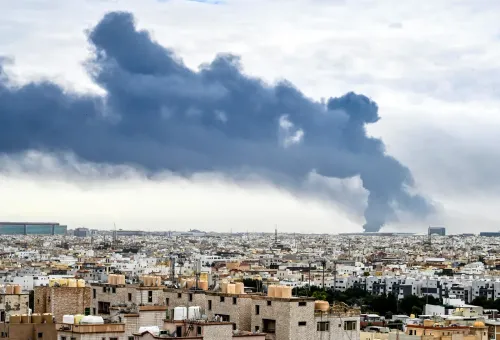
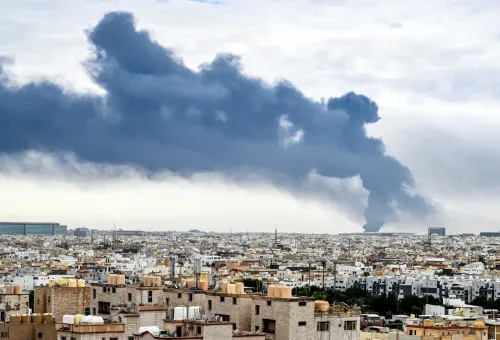
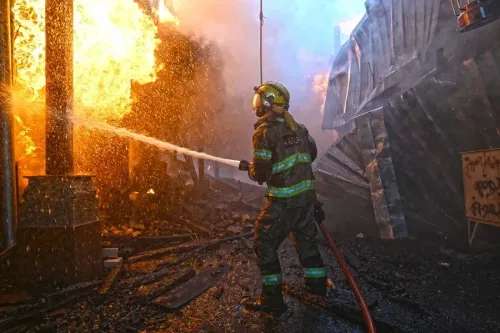
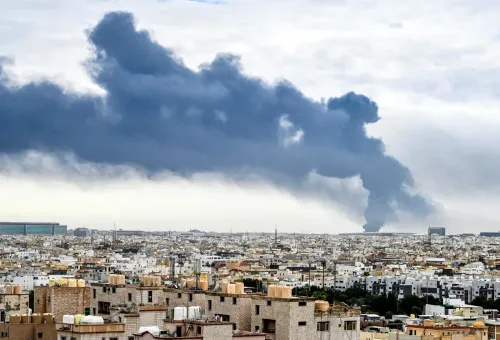
Kuwait airport attack caused by US Patriot malfunction, not Iran missiles: Iranian envoy
Synopsis
Iran's Ambassador to India has flatly denied that Iranian missiles struck Kuwait International Airport, claiming instead that a malfunctioning US Patriot defence system caused the damage — and calling circulating videos of the attack fabricated. With one Indian national dead and a fragile ceasefire already fraying, the envoy's remarks mark a sharp escalation in Tehran's public messaging.
Key Takeaways
Iran's Ambassador to India, Mohammad Fathali , denied that Iranian missiles struck Kuwait International Airport , attributing damage to a US Patriot defence system malfunction .
One Indian national was killed and dozens injured in the Wednesday, 4 June airport attack.
Iran invoked UNGA Resolution 3314 to label Kuwait and Bahrain's cooperation with US forces as acts of aggression against Iran.
The ambassador said a ceasefire announced on 8 April has been 'repeatedly violated by US forces,' prompting Iranian military responses.
Iran dismissed circulating videos of the attack as fabricated, citing a daylight–midnight discrepancy.
Tehran says it remains open to diplomacy but will respond to any territorial aggression 'with greater severity' if necessary.
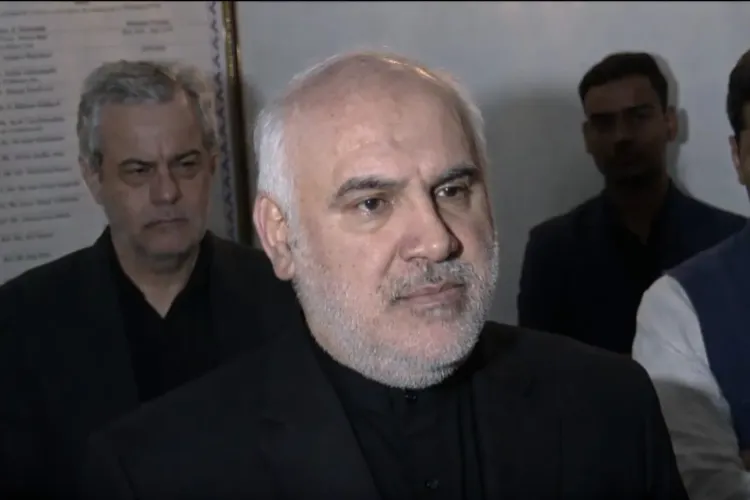
Mohammad Fathali, Ambassador of Iran to India, stated on Friday, 5 June that assessments by Tehran's military experts found no Iranian missiles were launched toward Kuwait International Airport, attributing the damage instead to a malfunction of US-made Patriot defence systems. His remarks came days after a Wednesday attack on the airport killed one Indian national and injured dozens of others.
Iran's Account of the Airport Incident
Ambassador Fathali, speaking in an exclusive interview from New Delhi, said the interceptor missiles of the US-made Patriot system 'fell onto the terminal after failing to intercept Iranian missiles targeted elsewhere.' He further argued that any Iranian drone launches targeting US military objectives in Kuwait occurred 'around midnight and under conditions of darkness,' and that circulating photos and videos showing the alleged attack 'clearly show broad daylight,' which he claimed demonstrates the footage is fabricated. The ambassador placed responsibility for civilian casualties squarely on what he called 'US–Zionist aggressors and all parties that cooperate with them.'
Iran's Position on the Ceasefire and Self-Defence
Fathali acknowledged that a ceasefire announced on 8 April had been 'repeatedly violated by US forces in recent days,' prompting Iranian military forces to respond 'within the framework of their legitimate right to self-defence.' He was unambiguous that Iran's national security and sovereignty constitute a 'red line,' warning that any attack on Iranian territory 'will be met with a reciprocal response at the same level, and if necessary, with greater severity.' Despite this, he maintained that Iran remains committed to the ceasefire and open to diplomacy.
On Kuwait, Bahrain, and International Law
The ambassador characterised the actions of Kuwait and Bahrain as 'a flagrant violation of the fundamental rules of international law,' invoking United Nations General Assembly Resolution 3314, which he said classifies allowing aggressor parties to use a country's territory or facilities to attack Iran as an act of aggression. Iran, he said, reserves the right to target 'the origin and source of such attacks' in exercising its right to self-defence.
On the US House Resolution and Diplomacy
Asked about a recent US House resolution seeking to restrict President Donald Trump's authority in the Iran conflict, Fathali declined to characterise it as evidence of internal US division, saying Iran does not comment on the internal affairs of other countries. He did, however, describe such measures as 'a step toward preventing the spread of tensions,' and reiterated that Iran believes disputes must be resolved 'at the negotiating table and through constructive dialogue, not on the battlefield.'
Iran's Message to the International Community
Fathali concluded by stating that Iran has 'not initiated any war in more than three centuries' and that its message to the United States and the world is that 'sustainable peace, stability, and security can only be achieved through respect for the rights of nations, adherence to the principles of international law, and equal, constructive dialogue.' He called on the US to 'accept the reality of a powerful, independent Iran' and recognise the legitimate rights of the Iranian people. The interview signals that, despite Iran's public openness to diplomacy, Tehran is unlikely to de-escalate unilaterally as long as it perceives ceasefire violations by US forces.
Point of View
And that is precisely its strategic value for Tehran. By invoking UNGA Resolution 3314, Iran is also laying a legal foundation to justify future strikes on Kuwaiti and Bahraini infrastructure — a warning that mainstream coverage has largely buried beneath the he-said-she-said framing. The death of an Indian national adds a direct bilateral dimension that New Delhi cannot afford to treat as a spectator issue. Iran's simultaneous insistence on dialogue while reserving the right to strike 'with greater severity' is not a contradiction — it is a calibrated posture designed to keep diplomatic channels open while deterring further escalation.
NationPress
26 Sept 2026
Frequently Asked Questions
What did Iran's ambassador say about the Kuwait airport attack?
Iran's Ambassador to India, Mohammad Fathali, said Tehran's military experts found no Iranian missiles were launched toward Kuwait International Airport. He claimed the damage was caused by a malfunction of US-made Patriot defence systems, whose interceptor missiles fell onto the terminal.
Was an Indian national killed in the Kuwait airport attack?
Yes, one Indian national was killed and dozens of others were injured in the attack on Kuwait International Airport on Wednesday, 4 June. The Iranian ambassador acknowledged the civilian casualties but attributed responsibility to what he called US–Zionist aggressors.
What is Iran's position on the April 8 ceasefire?
Iran says it remains committed to the ceasefire announced on 8 April but claims it has been repeatedly violated by US forces in recent days. The ambassador said Iranian forces responded to these violations under their right to self-defence.
Why did Iran invoke UN Resolution 3314 regarding Kuwait and Bahrain?
Ambassador Fathali cited UNGA Resolution 3314 to argue that Kuwait and Bahrain, by allowing their territory and facilities to be used for military operations against Iran, have themselves committed acts of aggression. Iran said this justifies targeting the origin of such attacks.
Is Iran open to diplomatic talks with the United States?
Yes, the Iranian ambassador stated that Iran believes disputes can be resolved through diplomacy and remains open to dialogue based on mutual respect. However, he warned that Iran's national security and sovereignty are a red line and that any aggression will be met with a reciprocal — or stronger — response.