The Iran Conflict: Challenges to Pakistan's Role as a Middle Eastern Security Pillar
Synopsis
Amid the escalating Iran conflict, Pakistan's internal divisions are laid bare. Shia protests and government responses highlight a deep struggle over identity and security. Can Pakistan redefine its role in a rapidly shifting geopolitical landscape?
Key Takeaways
Protests reveal deep societal divisions in Pakistan.
Government response is a balancing act between support for Iran and avoiding conflict with Israel.
Pakistan faces multiple domestic challenges, including insurgencies and economic woes.
The notion of nuclear deterrence as a path to regional leadership is under scrutiny.
Reevaluating security in the contemporary geopolitical landscape is essential for Pakistan's future.
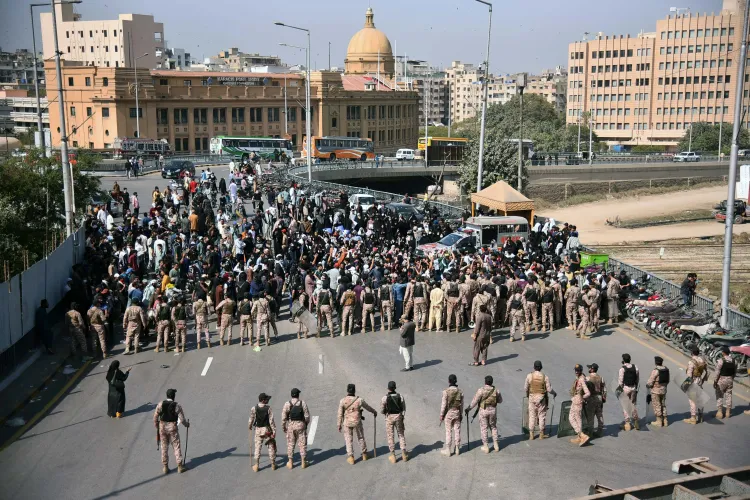
Islamabad, March 5 (NationPress) The fallout from the US-Israeli strikes on Iran and Tehran's subsequent retaliation has revealed deep divisions within Pakistan's society, according to experts. Particularly, Shia communities took to the streets in protest following the assassination of Iran's Supreme Leader Ayatollah Khamenei, calling for solidarity while challenging Islamabad's stance. These protests transcended mere foreign policy debates; they were fundamentally about identity, belonging, and whether the state's priorities resonate with the realities faced by its citizens.
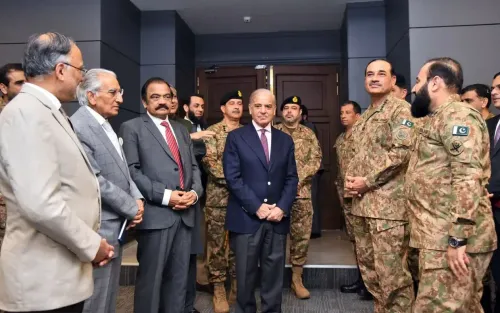
The Pakistani government's reaction has been a delicate balancing act. It condemned the strikes, reaffirmed its support for Iran as a neighboring Muslim nation, and deployed security forces to manage unrest. However, there was a swift effort to clarify that Pakistan would not engage in direct conflict with Israel or act as a proxy in a broader regional war. Officials maintain that this narrative does not reflect Islamabad's strategic position.
A nation's strength is often assessed during crises, and Pakistan is currently facing multiple challenges. Domestically, it is confronting insurgents such as the Balochistan Liberation Army and Tehreek-e-Taliban Pakistan. Economically, the country is in turmoil, with its most popular leader imprisoned for several years, raising concerns about his fundamental rights. Moreover, Pakistan is engaged in a conflict with Afghanistan along its western border, and tensions with India remain high following Operation Sindoor, which New Delhi claims is merely on hold.
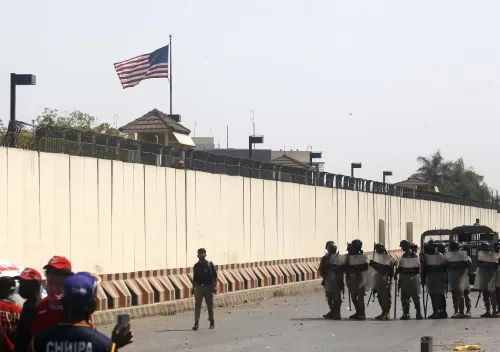
In this context, Pakistan is increasingly wrapped up in the Middle East conflict, with its approximately 15 percent Shia population reacting vehemently to the assassination of a prominent religious figure. Recently, a violent mob attacked the US Consulate in Karachi, resulting in the deaths of at least 22 Pakistanis.
Amidst this turmoil, Pakistan grapples with a contradiction: it positions itself as the custodian of the so-called 'Islamic bomb' while proclaiming rhetorical unity among Muslims in the wider Middle East. However, in practice, the nation often finds itself influenced by various global powers. To understand this, one must look back at history; after India developed its indigenous nuclear capabilities in the 1970s and Pakistan was partitioned, political leaders like Zulfikar Ali Bhutto believed that acquiring a nuclear deterrent would help in maintaining state integrity.
Pakistan's nuclear ambitions were primarily directed against India, yet the country lacked the financial resources to support such a program. The Middle Eastern nations stepped in to assist. In February 1974, shortly after the Arab-Israeli War of 1973, Bhutto convened the second Organisation of Islamic Cooperation (OIC) Summit. Recognizing the financial windfall the Middle Eastern nations received due to the 1973 oil embargo and rising oil prices, Bhutto sought to use this funding for Pakistan's nuclear ambitions. He argued that all civilizations had nuclear capabilities except for the Islamic world, asserting that if Pakistan succeeded in developing nuclear arms, it could aid the Islamic community in times of need. This appeal garnered significant funding from countries like Libya and Saudi Arabia.
Last year, Iranian Commander Mohsen Rezaei claimed that Pakistan assured Iran that if Israel were to deploy a nuclear bomb against Iran, Pakistan would reciprocate. However, Pakistan promptly denied this assertion, with Defence Minister Khawaja Muhammad Asif stating on X that, "Our nuclear capability is intended for the welfare of our people and the defense of our nation against hostile intentions from adversaries."
There are instances when the language of deterrence borders on bravado. Six months before the escalation with Iran, Asif hinted at the possibility that Saudi Arabia might receive nuclear "coverage" under a defense agreement with Islamabad, only to later clarify that nuclear arms were "not on the radar." Such vagueness does little to instill confidence in a populace that seeks clarity.
This is why the idea of Pakistan as a security guarantor in the Middle East — an "Islamic nuclear state" ready to enforce regional order — begins to falter. Nuclear weapons, despite their formidable destructive capacity, do not automatically confer regional leadership. They serve as a last resort to deter invasion, not to dictate the fates of distant conflicts. If Islamabad feels increasingly vulnerable, it is not due to a failing arsenal; rather, it is because the very principles of strategic deterrence have been undermined. When a nation's neighbors can be attacked and their leaders eliminated by foreign powers without immediate global retribution, it necessitates a reassessment of where true security lies.
The pressing question for Pakistan now is whether it can redefine its understanding of security in an age where conventional and nuclear weapons no longer offer invulnerable protection, and where threats are equally political and economic as they are military. Ultimately, the apprehension on Pakistan's streets is one of isolation and entanglement. This fear, as much as any missile or doctrine, will influence Pakistan's decisions in the near future.
Point of View
It is crucial to analyze the repercussions of the Iran conflict on Pakistan's societal fabric and its geopolitical aspirations. The protests illustrate a deep-seated identity crisis while raising critical questions about the nation's strategic direction. Our focus remains on fostering a nuanced understanding of these dynamics.
NationPress
3 Oct 2026
Frequently Asked Questions
What sparked the recent protests in Pakistan?
The protests were triggered by the assassination of Iran's Supreme Leader Ayatollah Khamenei, leading Shia communities in Pakistan to demand solidarity and question the government's stance.
How has the Pakistani government responded to the Iran conflict?
The government condemned the strikes on Iran, reaffirmed support for Iran as a neighboring Muslim state, and deployed security forces to manage unrest while distancing itself from direct confrontation with Israel.
What are the implications of Pakistan's nuclear capabilities?
Pakistan's nuclear capabilities are primarily aimed at deterring threats from India; however, the notion of being a regional security guarantor through nuclear power is increasingly challenged by current geopolitical realities.
What challenges does Pakistan face domestically?
Pakistan is grappling with insurgencies, economic instability, and political unrest, particularly with its most popular leader imprisoned and tensions with neighboring countries.
Can Pakistan redefine its security strategy?
The question remains whether Pakistan can adapt its understanding of security in a context where conventional and nuclear deterrents are not sufficient against evolving political and economic threats.