Jaishankar meets CARICOM foreign ministers in New York, eyes deeper economic and digital ties
Synopsis
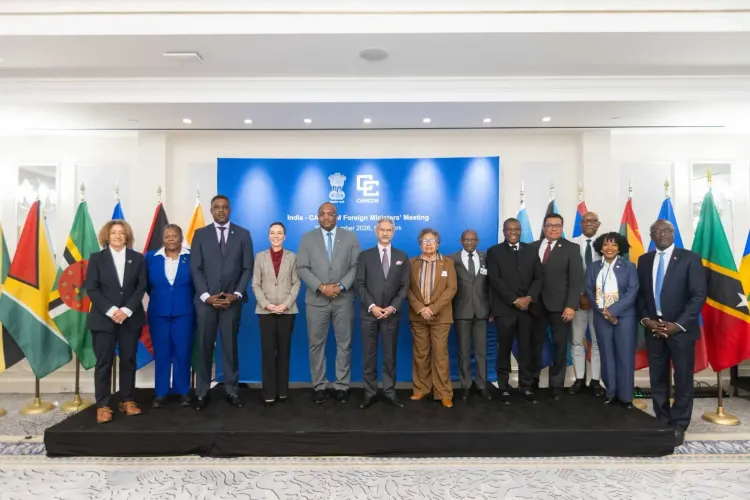
On the sidelines of the UN General Assembly, External Affairs Minister Jaishankar sat down with all 15 CARICOM foreign ministers, pitching a deeper India-Caribbean partnership spanning digital training, solar energy, medical aid and climate alliances — a quiet but methodical expansion of India's Global South coalition-building.
Key Takeaways
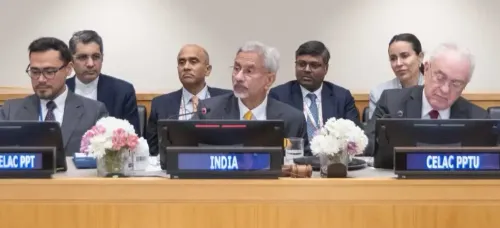
Jaishankar met foreign ministers of all 15 CARICOM nations in New York on 24 September 2026 .
He stressed deeper cooperation in economic, digital and mobility domains and offered customised training programmes.
Suriname, Trinidad and Guyana have large populations of Indian descent; India shares a colonial history with the other members.
CARICOM countries were invited to join the International Solar Alliance and Global Biofuels Alliance , both headquartered in India.
India has supplied BHISHM Cube portable hospital units, haemodialysis machines, and conducted artificial limb camps in the region.
SME support and Quick Impact Projects have been completed in several Caribbean nations and are ongoing in others.
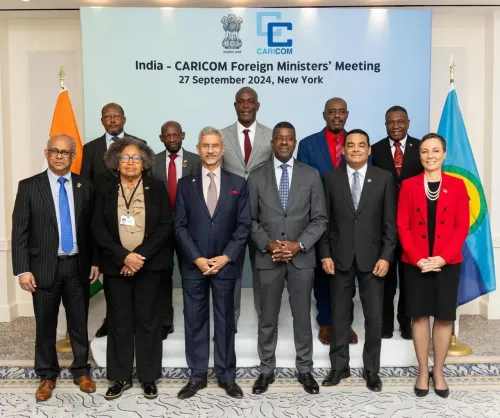
External Affairs Minister S. Jaishankar met with foreign ministers from the 15-member Caribbean Community (CARICOM) grouping in New York on Wednesday, 24 September 2026, discussing ways to strengthen bilateral ties across economic, digital, and mobility domains. The meeting, held on the sidelines of the UN General Assembly session, underscores India's continuing push to deepen engagement with the Global South.
Key Themes of the Meeting
Jaishankar emphasised the need to 'further deepen our ties, especially in economic, digital and mobility domains,' according to his post on X following the meeting. He also 'highlighted our solidarity derived from our shared history and developmental challenges,' drawing on centuries of intertwined colonial experience and, in the case of Suriname, Trinidad, and Guyana, substantial populations of Indian descent.
Training, Solar Energy and Climate Alliances
The EAM urged CARICOM nations to make fuller use of India-provided training slots and offered to design customised programmes in areas of their choosing. India already runs training initiatives across the Global South, with a particular focus on digital technologies. Jaishankar also spotlighted India's role in facilitating solar power installations across the Caribbean and invited member nations to formally join the International Solar Alliance and the Global Biofuels Alliance — both headquartered in India and dedicated to accelerating clean-energy adoption and climate action.
Small Enterprises, Quick-Impact Projects and Medical Aid
Jaishankar told his counterparts that programmes for small and medium enterprises (SMEs) and Quick Impact Projects (QIPs) — which channel finance and resources into fast-turnaround, community-level schemes — have already been completed in several Caribbean nations and remain ongoing in others. On the medical front, India has conducted artificial limb fitment camps, gifted haemodialysis units, and supplied the portable BHISHM Cube hospital system — a compact, deployable medical unit designed for disaster response — to select CARICOM partners.
Strategic Context: India and the Caribbean
This meeting is part of a broader Indian diplomatic push at the United Nations General Assembly, where Jaishankar has held a series of bilateral and multilateral engagements. India's outreach to CARICOM reflects a deliberate strategy to build South-South coalitions, secure support in multilateral forums, and expand the footprint of its flagship climate and technology alliances. Notably, the Caribbean grouping represents a bloc of small island developing states particularly vulnerable to climate change, making the solar and biofuels pitch especially resonant. How many of the 15 members formally join the two alliances will be a measure of the meeting's concrete outcomes.
Point of View
But Jaishankar's structured CARICOM outreach at the UNGA is tactically significant. Small island states punch above their weight in multilateral forums — the UN General Assembly, climate negotiations, and reform debates at the WTO — and locking in goodwill through tangible aid (BHISHM Cubes, dialysis units, solar panels) is a low-cost way to build a reliable voting bloc. The invitations to join the International Solar Alliance and Global Biofuels Alliance are also about norm-setting: the more members these India-anchored bodies acquire, the greater their legitimacy as alternatives to Western-led climate architecture. The real test is follow-through — past South-South pledges have often stalled at the announcement stage.
NationPress
24 Sept 2026
Frequently Asked Questions
Why did Jaishankar meet CARICOM foreign ministers in New York?
Jaishankar met the foreign ministers of all 15 CARICOM nations on the sidelines of the UN General Assembly on 24 September 2026 to discuss deepening India-Caribbean ties in economic, digital, and mobility areas. The meeting also covered India's ongoing assistance programmes and climate-energy cooperation.
What is CARICOM and which countries have links to India?
CARICOM, the Caribbean Community, is a 15-member regional grouping of Caribbean nations. Among them, Suriname, Trinidad and Tobago, and Guyana have substantial populations of Indian descent, while India shares a common history of colonisation with the others.
What did India offer CARICOM countries in terms of training and technology?
Jaishankar urged CARICOM nations to utilise India's existing training slots and offered to design customised programmes, particularly in digital technologies. India already runs several such initiatives for Global South countries.
What are the International Solar Alliance and Global Biofuels Alliance?
Both are multilateral organisations headquartered in India that promote clean-energy adoption and climate action. Jaishankar invited CARICOM countries to formally join both bodies as part of a broader push to expand their membership and global influence.
What medical and development assistance has India provided to Caribbean countries?
India has conducted artificial limb fitment camps, gifted haemodialysis units, and supplied BHISHM Cube portable hospital systems — compact units designed for disaster deployment — to select CARICOM partners. SME support programmes and Quick Impact Projects have also been completed or are ongoing across several Caribbean nations.