Quad Foreign Ministers' Meet 2026: Jaishankar calls for deeper Indo-Pacific cooperation
Synopsis
The Quad's first Foreign Ministers' Meeting of 2026 in New Delhi went well beyond diplomatic ritual — Jaishankar laid out an expanding agenda covering undersea cables, critical minerals, counter-terrorism, and maritime law, signalling that the grouping is evolving from a security dialogue into a full-spectrum regional architecture with growing responsibilities.
Key Takeaways
Jaishankar hosted the Quad Foreign Ministers' Meeting in New Delhi on 26 May 2026 — the grouping's first such meeting of the year.
The four nations — India , US , Japan , and Australia — reaffirmed commitment to deepen cooperation in surveillance , logistics , undersea cables , HADR , and capacity building .
Ministers stressed safe and unimpeded maritime commerce and strict observance of international law.
Discussions covered energy , fertiliser , and critical mineral availability, as well as supply chain resilience.
All four nations agreed on zero tolerance for terrorism and the right of targeted nations to defend themselves.
Jaishankar said the Indo-Pacific will grow even more critical to global trade and security, and the Quad must scale its role commensurately.
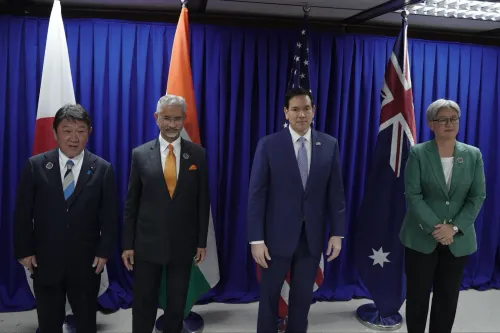
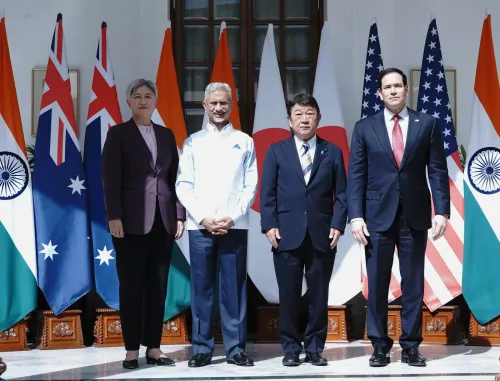
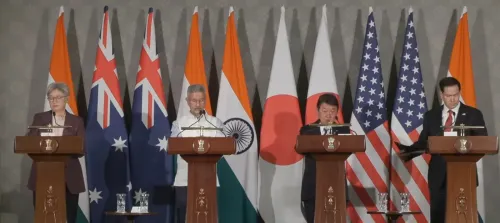
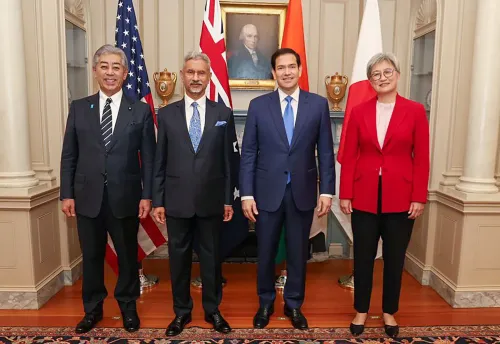
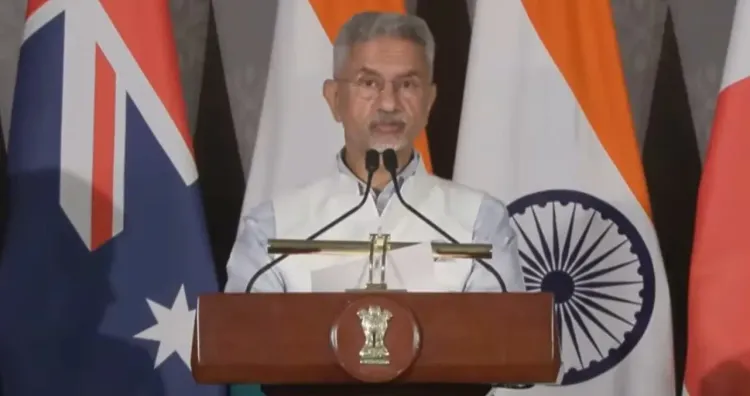
External Affairs Minister S. Jaishankar on Tuesday, 26 May 2026, declared that the Quad's overarching aim is to intensify cooperation among its four member nations while extending assistance to others in the region. Jaishankar made the remarks at a joint press address in New Delhi alongside the Foreign Ministers of Japan, Australia, and the United States, following the Quad Foreign Ministers' Meeting — the grouping's first such gathering of 2026.
Key Themes of the Meeting
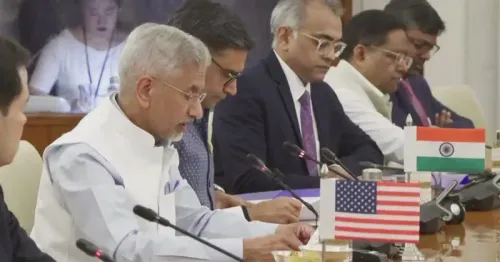
Jaishankar said discussions were squarely focused on issues of direct relevance to the Indo-Pacific, with the four maritime democracies exchanging perspectives on the current state of the world. He described the bilateral exchanges as 'an exercise of considerable value', given the distinct geographic positions each nation occupies across the Indo-Pacific.
The meeting reaffirmed commitments to deepen collaboration across several domains: surveillance and domain awareness, logistics networks, undersea cables, training, capacity building, and humanitarian assistance and disaster relief (HADR) activities.
Maritime Security and International Law
A significant portion of the agenda was devoted to maritime commerce. The four nations reaffirmed the importance of safe and unimpeded maritime trade and stressed the need to scrupulously observe international law. This comes amid ongoing tensions in key Indo-Pacific sea lanes, where freedom of navigation remains a contested principle.
Jaishankar noted that as market economies, all four Quad members are committed to promoting economic resilience, strengthening supply chains, diffusing trusted and secure technologies, and enhancing production capacities. The ministers also discussed availability of energy, fertilisers, critical minerals, and strategic resources.
Zero Tolerance for Terrorism
Counter-terrorism emerged as another focal point. Jaishankar stated unequivocally that there must be zero tolerance for terrorism, and that nations subjected to terrorist attacks retain the right to defend themselves. He described the Quad as a grouping of open societies that foster innovation, and said people-to-people exchanges — spanning business forums, healthcare initiatives, and digital activities — would be expanded in the period ahead.
The Road Ahead for Quad
Jaishankar underscored that the Indo-Pacific's strategic and economic weight will only grow in the coming years, and that the Quad's responsibilities must scale accordingly. 'Whether it is economic activity, energy trade or maritime commerce, the Indo-Pacific will become even more important to the world,' he said, adding that the grouping must prepare for that expanded role.
Notably, this was the Quad's first Foreign Ministers' Meeting in 2026, following two such meetings in 2025. The frequency signals a consolidating institutional rhythm for a grouping that began as an informal security dialogue and has steadily expanded its remit into trade, technology, and humanitarian cooperation.
Point of View
Undersea cables, and supply chain resilience places the Quad squarely in the contest over strategic infrastructure, not just military posture. The counter-terrorism language, given India's recent security environment, carries pointed bilateral weight beyond the multilateral framing. What mainstream coverage underplays is the frequency signal: two meetings in 2025, and the first of 2026 already done by May — a pace that suggests the Quad is no longer a reactive grouping but a proactive one with a standing agenda.
NationPress
9 Oct 2026
Frequently Asked Questions
What was decided at the Quad Foreign Ministers' Meeting in New Delhi in 2026?
The Quad Foreign Ministers — from India, the US, Japan, and Australia — met in New Delhi on 26 May 2026 and reaffirmed cooperation across maritime security, undersea cables, logistics, HADR, supply chains, critical minerals, and counter-terrorism. EAM Jaishankar said the goal is to intensify cooperation among the four nations while also assisting others in the Indo-Pacific.
What did Jaishankar say about terrorism at the Quad meeting?
Jaishankar stated that there must be zero tolerance for terrorism and that nations subjected to terrorist attacks have the right to defend themselves. Counter-terrorism was identified as a shared priority among the four democratic nations.
How often does the Quad hold Foreign Ministers' meetings?
The Quad held two Foreign Ministers' meetings in 2025, and the 26 May 2026 gathering was the first of the current year. The increasing frequency reflects the grouping's growing institutional momentum.
Why is the Indo-Pacific central to Quad discussions?
Jaishankar described the four Quad nations as maritime democracies located at different ends of the Indo-Pacific, making the region naturally central to their strategic interests. He noted that the Indo-Pacific's importance to global economic activity, energy trade, and maritime commerce will only increase.
What economic issues did the Quad Foreign Ministers discuss?
The ministers discussed promoting economic resilience, strengthening supply chains, diffusing trusted and secure technologies, enhancing production capacities, and ensuring availability of energy, fertilisers, and critical minerals — reflecting the Quad's expanding focus beyond security into strategic economics.