Is Jamaat-e-Islami Preparing for a Shariah Law Agenda Ahead of the February Elections?

Synopsis
As Bangladesh approaches the February elections, Jamaat-e-Islami finds itself in a challenging position, advocating for Shariah law while simultaneously denying plans to implement it. This strategic ambiguity raises important questions for voters and highlights ideological divides in the country's political landscape.
Key Takeaways
Jamaat-e-Islami promotes both Shariah law and a non-implementation stance.
Grassroots leaders advocate for voting as a religious duty.
Strategic ambiguity raises questions about political integrity.
The February elections are pivotal for Bangladesh's future.
Voter clarity is essential for informed decision-making.
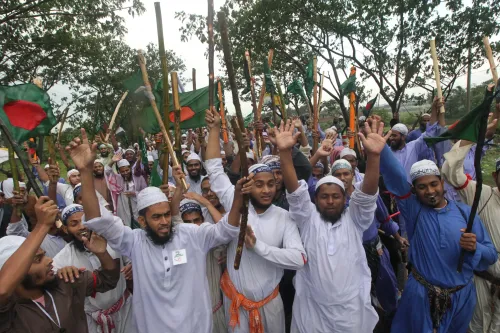
Dhaka, Jan 28 (NationPress) Even though the radical Islamist party Jamaat-e-Islami in Bangladesh occasionally suggests it will not enforce Shariah law if it gains power, its leaders, including candidates for the upcoming general elections on February 12, openly push for the establishment of Shariah law during television discussions. Additionally, at the grassroots level, mid- and lower-tier leaders rally support for the Jamaat electoral symbol 'daripalla' (balance scale) as a religious obligation, with some even referring to it as a “ticket to paradise,” according to a report released on Wednesday.
As reported by the prominent Bangladeshi newspaper Prothom Alo, this presents a stark contradiction: while Jamaat claims it will not enact Shariah, the narrative advocating for it is being actively disseminated among supporters.
“Jamaat-e-Islami is caught in a significant political quandary. The very presence of the word ‘Islam’ in its name, coupled with its longstanding campaign under the banner ‘We want Allah’s law,’ leads a faction of its core base to support Jamaat in the hope of realizing Islamic Shariah. Simultaneously, Jamaat seems aware that pursuing state power renders the politics of Shariah implementation counterproductive,” the report outlined.
The report highlighted that this indicates “strategic ambiguity,” a tactic Jamaat has adopted as elections approach. Instead of clarifying its position, Jamaat aims to uphold both narratives at once—a practice that should be deemed unacceptable.
“Choosing to vote for Jamaat instead of the BNP (Bangladesh Nationalist Party) is fundamentally different from voting for the BNP over the Awami League and vice versa. There are crucial ideological disparities involved. Jamaat’s ameer must clearly and publicly declare whether Jamaat-e-Islami intends to implement Islamic Shariah if it attains power. If so, a transparent framework for what that Shariah would encompass must also be presented,” the report stated.
It emphasized that if Jamaat or any other “Islamic” party in Bangladesh announces intentions to establish Shariah, it raises the question of whether such a party can legitimately engage in politics under the current constitutional framework.
The report concluded, “As the election nears, Jamaat must promptly clarify its position on Shariah to empower voters to make an ‘informed decision’ during the election process. Jamaat’s leadership should acknowledge that its strategic ambiguity regarding this issue directly contradicts its well-known slogan, ‘We want the rule of honest people,’ and amounts to, quite simply, duplicity (munafiqi, in religious terms).”
Point of View
I believe that Jamaat-e-Islami's dual narrative on Shariah law poses a critical challenge for voters in Bangladesh. The need for transparency in political agendas is paramount, especially in a nation where faith and politics intertwine. The electorate deserves clarity to make informed decisions in the upcoming elections.
NationPress
14 Oct 2026
Frequently Asked Questions
What is Jamaat-e-Islami's stance on Shariah law?
Jamaat-e-Islami has publicly indicated that it may not implement Shariah law if elected, yet its leaders promote it actively in various forums.
How does Jamaat-e-Islami's dual narrative affect voters?
The dual narrative creates confusion among voters, who are left uncertain about the party's true intentions regarding Shariah law and governance.
What is the significance of the February elections in Bangladesh?
The February elections are crucial as they will determine the future political landscape of Bangladesh and the role that religious agendas will play.
What does 'strategic ambiguity' mean in this context?
Strategic ambiguity refers to Jamaat-e-Islami's approach to maintain conflicting narratives about Shariah to appeal to different voter bases without committing to a clear position.
Why is transparency important in political campaigns?
Transparency allows voters to make informed choices, ensuring that political leaders are held accountable for their promises and policies.