Does Bangladesh’s Jamaat-e-Islami Conceal a Radical Agenda Behind a Moderate Image?
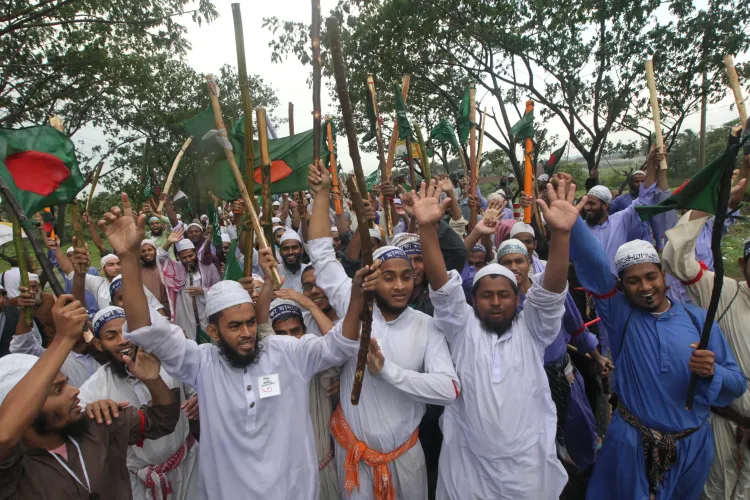
Synopsis
Explore how Jamaat-e-Islami's constitution reveals a contradiction to its moderate claims, advocating for divine sovereignty while proposing regressive policies for women. This article delves into the dual messaging of the party and its implications for Bangladesh's democratic values.
Key Takeaways
Jamaat-e-Islami's constitution contradicts its moderate narrative.
The party employs a dual messaging strategy.
Voting is framed as a divine mandate, complicating political choice.
Proposals concerning women indicate a regressive agenda.
The absence of women in leadership roles reveals structural exclusion.
Dhaka, Jan 31 (NationPress) The foundational tenets of Bangladesh's radical Islamist party, Jamaat-e-Islami, starkly contrast with its proclaimed 'moderate' image. Its constitution explicitly states that sovereignty belongs to God rather than the populace, with the ultimate aim being 'Iqamat-e-Deen', which seeks to establish Islam as an all-encompassing way of life.
According to a report from the Hong Kong-based Asia Times, “Jamaat has become adept at delivering a 'dual message'. In the comfortable confines of diplomatic missions, senior officials dispense pleasant reassurances. They advocate for constitutional governance and renounce the immediate enforcement of Sharia law, striving to project themselves as a harmless, faith-oriented civil society entity.”
“However, in the local arenas where elections are contested, the facade crumbles. Here, the discourse revolves not around civic responsibility but rather divine obligation. Voting transforms into a measure of faith, with selecting Jamaat equated to earning a ‘divine reward’, while opposing it could lead to moral decline,” it further elaborated.
The report notes that by framing the ballot as a passage to the afterlife, Jamaat effectively marginalizes the opposition, with figures like Shahriar Kabir labeling a vote for the party's emblem, the Daripalla (the scales), as an “imanic, or faith-based, duty.”
It emphasizes that a party genuinely committed to Bangladesh's constitutional ideals—such as equality, individual freedom, and social unity—would adjust its ideology accordingly, which Jamaat has failed to do.
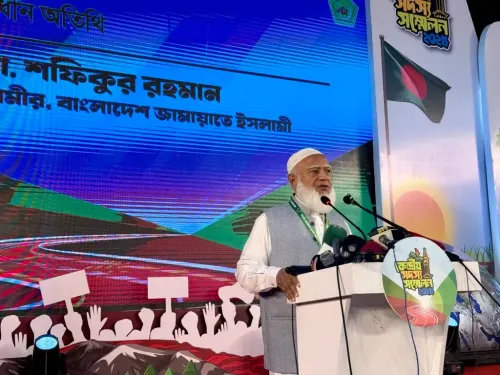
“This ideological rigidity is most evident in Jamaat’s perspective on women. The party leader, Shafikur Rahman, alongside senior officials, has proposed a social agenda that would ‘reward’ domestic confinement, limit women's working hours, and control their mobility,” the report stated.
“Such proposals reflect a viewpoint in which women’s economic independence—crucial to Bangladesh’s US$450 billion economy—is viewed as a challenge to be managed. In a country where women constitute roughly 35 percent of the formal workforce, particularly in the garment industry, these policies represent a strategy for national regression,” it noted.
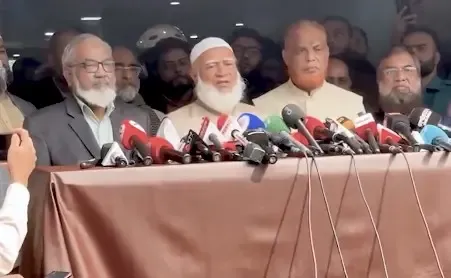
The report highlights the structural exclusion within Jamaat, pointing out that the party's electoral decision-making body lacks any female representation. When senior leaders assert that women should only perform in the presence of other women, it indicates a broader campaign to erase female presence from public life, media, and education.
“Should Jamaat succeed in monopolizing virtue, it will replace legal accountability with ethical conviction, jeopardizing the very pluralism that enabled its ascent,” the report concluded.
Point of View
I believe it's crucial to critically analyze Jamaat-e-Islami's influence in Bangladesh politics. While the party presents a moderate front, its foundational beliefs and proposed policies suggest a troubling deviation from democratic values, emphasizing the need for vigilance in preserving pluralism and equality.
NationPress
1 Oct 2026
Frequently Asked Questions
What is Jamaat-e-Islami's stance on women's rights?
Jamaat-e-Islami has proposed policies that may restrict women's economic independence and mobility, reflecting a conservative worldview that contrasts with the progressive role women play in Bangladesh's economy.
How does Jamaat-e-Islami portray itself internationally?
Internationally, Jamaat-e-Islami presents itself as a moderate, faith-based civil society movement, often disavowing immediate implementation of Sharia law in diplomatic circles.
What does the term 'Iqamat-e-Deen' mean?
'Iqamat-e-Deen' refers to the establishment of Islam as a comprehensive system of life, which is a central tenet of Jamaat-e-Islami's ideology.
Are there women in Jamaat-e-Islami's leadership?
No, Jamaat's elected policymaking body does not include any women, indicating a structural exclusion within the party.
What implications does Jamaat's ideology have for Bangladesh's democracy?
Jamaat's ideological rigidity and radical views pose a potential threat to the pluralism and democratic values inherent in Bangladesh's constitution.