Does Jamaat's Conflicting View on Sharia Affect Its Poll Credibility?
Synopsis
In a revealing report, the dual stance of Jamaat-e-Islami on Sharia raises questions about its credibility in upcoming polls. With a history of attracting voters for an Islamic governance system, the party's conflicting messages create uncertainty. Will Jamaat clarify its position to the public, or is this a strategic ploy for power?
Key Takeaways
Jamaat-e-Islami's conflicting views on Sharia create voter confusion.
The party's leaders assure international audiences of non-enforcement.
Domestically, Jamaat promotes Sharia as a religious duty.
Political analysts label this as strategic ambiguity .
Clear communication is essential for Jamaat's credibility.
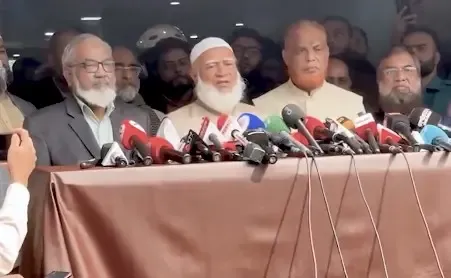
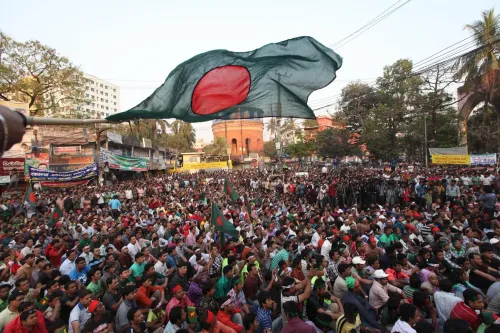
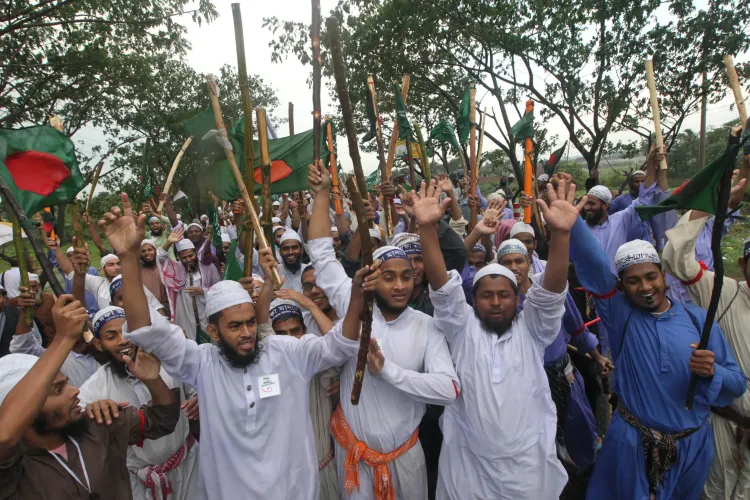
Dhaka, Feb 10 (NationPress) The radical Islamist party Jamaat-e-Islami of Bangladesh has revealed a conflicting viewpoint regarding Sharia, as reported on Tuesday. The report pointed out that a substantial portion of the party's followers have historically cast their votes for Jamaat, harboring hopes of establishing an Islamic governance system in Bangladesh.
As highlighted by a report from The Diplomat, recent statements from the party's senior leaders have shied away from the topic of Sharia implementation.
It emphasized that Jamaat is trying to persuade the international community that it would not enforce Sharia if it gains power.
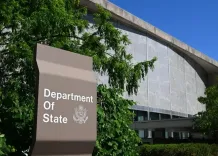
Referring to a recent international media report, The Diplomat noted that Jamaat's leadership has assured American diplomats that they do not intend to impose Sharia.
However, on a local level, Jamaat continues to advocate for the establishment of Sharia during grassroots campaigns, with leaders allegedly portraying voting as a religious obligation and even linking it to the promise of reaching paradise. This conflicting message leads to confusion among average voters.
“While Jamaat leaders claim they are not planning to impose Sharia, they still adhere to its principles. They assert that women cannot be the party's Ameer (leader) due to Sharia prohibitions. Even as they profess to distance themselves from it, Sharia remains a guiding factor in their decisions,” the report indicated.
“Moreover, there are additional contradictions. For the first time, Jamaat has fielded a non-Muslim candidate, which, while ostensibly signaling inclusivity, starkly contradicts the party's ideology and constitution. Consequently, the question persists: What does Jamaat truly represent? What are their genuine aspirations? Is this ambiguity merely a power-seeking strategy, or are there more profound political calculations involved?” it questioned.
The report notes that political analysts describe this dual messaging as “strategic ambiguity”, a tactic of intentionally evading a clear position on a crucial issue to convey varying messages to different audiences.
“Though this may offer short-term political advantages, it significantly undermines credibility over time. This is precisely what is unfolding with Jamaat,” it observed.
Stressing that these two contradictory paths cannot coexist, the report stated, “If Jamaat genuinely wishes to achieve political power within a democratic context, it must unequivocally articulate its stance on Sharia implementation. Should the establishment of Sharia be their primary objective, that agenda must be transparently communicated to the public.”
Point of View
It is essential to maintain an unbiased stance while analyzing Jamaat-e-Islami's conflicting messages regarding Sharia. The party's dual approach raises valid concerns about its intentions and credibility. Our commitment lies in providing a platform for diverse opinions while focusing on factual reporting, ensuring that our audience is well-informed about the political landscape.
NationPress
14 Oct 2026
Frequently Asked Questions
What is Jamaat-e-Islami's position on Sharia?
Jamaat-e-Islami has shown a contradictory stance on Sharia, assuring international audiences of non-enforcement while promoting it domestically.
Why is Jamaat's dual messaging problematic?
This dual messaging creates confusion among voters and undermines the party's credibility in the long run.
What does strategic ambiguity mean in politics?
Strategic ambiguity refers to a deliberate avoidance of a clear stance on key issues to communicate different messages to various audiences.
How does this affect Jamaat's electoral prospects?
While it may yield short-term benefits, the lack of a clear position could harm Jamaat's credibility and voter trust in future elections.
What should Jamaat do to improve its image?
Jamaat needs to clearly articulate its stance on Sharia implementation if it aspires to regain the trust of its voters.