Japan eyes India for long-range missile, drone training amid Indo-Pacific security push
Synopsis
Japan has confirmed it has sent military personnel to India to explore training grounds for its long-range surface-to-ship missiles — weapons with a roughly 1,000-km reach that cannot be easily tested on Japanese soil. The move signals that India-Japan defence ties are moving from dialogue to operational integration, with drone launch-site coordination also reportedly on the table.
Key Takeaways
Japan has dispatched personnel to India to coordinate training options for GSDF long-range surface-to-ship missiles and small attack drones.
GSDF Chief of Staff General Masayoshi Arai confirmed the deployment on 28 October 2026 , noting the ~ 1,000-km missile range poses a major training challenge domestically.
A 34-member GSDF delegation had already visited India from 4 to 9 October 2026 , meeting the Indian Army , DRDO , CLAWS , and WARDEC .
General Arai described India as an important partner in the Indo-Pacific amid a 'complex and challenging security environment.' Specific deployment details were withheld by Tokyo , citing the sensitivity of its relationship with New Delhi .
Japan has dispatched personnel to India to coordinate on defence-related matters, as Tokyo explores training options for the Japanese Ground Self-Defense Force's (GSDF) long-range surface-to-ship missiles and small attack drones. The move, confirmed on Tuesday, 28 October 2026, underscores the deepening strategic convergence between the two nations in a rapidly shifting Indo-Pacific security environment.
What the GSDF Chief Confirmed
Addressing a press conference, GSDF Chief of Staff General Masayoshi Arai acknowledged the deployment to India, framing it as part of a broader effort to identify viable training environments for missiles with an approximately 1,000-km range — a scale that makes domestic training sites within Japan logistically challenging.
'As you just asked, it is true that we have sent personnel to coordinate various matters with India. So, if we're going to operate a relatively long-range missile like the SSM, how do we conduct training that takes advantage of this range, that's a big challenge. Regarding this point, we are currently considering how to ensure a training environment within Japan, and how to utilise training environments abroad as needed,' General Arai stated.
He declined to elaborate further on the deployment specifics, citing the sensitivity of Japan's relationship with India. When asked whether the coordination also covered potential launch sites for small attack drones, Arai confirmed: 'That includes things like that, and there are various shooting possibilities that we are adjusting.'
India as a Strategic Partner in the Indo-Pacific
General Arai emphasised that Tokyo regards New Delhi as a critical partner in the Indo-Pacific region. He stressed the urgent need to advance defence cooperation and exchanges amid what he described as an increasingly complex and challenging security environment — language that implicitly references growing Chinese military assertiveness and North Korean missile developments in the region.
Notably, this development comes amid a broader pattern of Japan expanding its military posture beyond traditional constraints. Japan's defence budget has been on a significant upward trajectory, and the country has been actively pursuing overseas training arrangements as it seeks to operationalise its longer-range strike capabilities.
GSDF Delegation Visit Earlier This Month
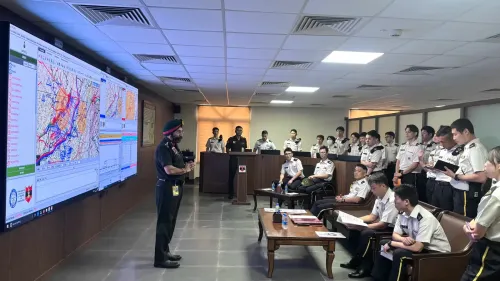
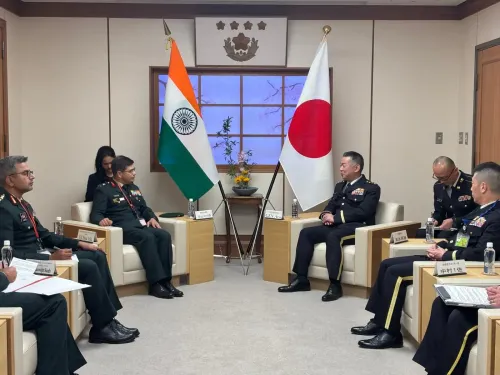
The coordination visit follows a 34-member delegation from the GSDF Command and General Staff Course that visited India from 4 to 9 October 2026 as part of a Foreign Study Tour. During the visit, the delegation interacted with representatives of the Indian Army and the Defence Research and Development Organisation (DRDO), and also toured the Centre for Land Warfare Studies (CLAWS) and the Wargame Research and Development Centre (WARDEC).
The Indian Army, in an official post on X, described the engagement as follows: 'Strengthening India-Japan Defence Cooperation. A 34-member delegation from the Japanese Ground Self-Defense Force, JGSDF Command and General Staff Course, visited India from 04 to 09 October 2026 as part of its Foreign Study Tour. The delegation interacted with representatives of the Indian Army and DRDO and visited CLAWS and WARDEC, gaining insights into India's defence capabilities, military training and emerging technologies.'
The Army added that 'the visit also included an exposure to India's rich cultural heritage. The engagement further strengthened professional military ties, mutual understanding and the enduring defence partnership between India and Japan.'
Strategic Context and What It Means
India and Japan have steadily elevated their defence relationship over the past decade, with bilateral ties now designated at the level of a Special Strategic and Global Partnership. Joint exercises, defence technology sharing, and logistical access agreements have all advanced in recent years. This latest development — Japan potentially using Indian territory or airspace for long-range missile and drone training — would mark a qualitative step forward in operational defence cooperation.
The move also aligns with India's own interest in deepening defence partnerships with like-minded Indo-Pacific democracies, even as it maintains its tradition of strategic autonomy. If formalised, a training arrangement of this nature would have broader signalling value across the region.
Further details are expected to emerge as both sides continue diplomatic and military-level coordination in the weeks ahead.
Point of View
000-km-range weapons, giving India a concrete utility that few other partners can offer. What mainstream coverage underplays is the signalling dimension: a Japan-India missile training arrangement, even if framed as logistical, sends a clear message to Beijing about the depth of Quad-aligned military cooperation. The unresolved question is whether New Delhi, ever careful about entanglements, will formalise this or keep it deliberately ambiguous — and whether that ambiguity is itself a strategic asset.
NationPress
28 Oct 2026
Frequently Asked Questions
Why is Japan sending military personnel to India for missile training?
Japan is exploring overseas training environments for its Ground Self-Defense Force's surface-to-ship missiles, which have a range of approximately 1,000 km — a scale that makes domestic training within Japan logistically difficult. India has been identified as a potential partner for such training, according to GSDF Chief of Staff General Masayoshi Arai.
What kind of weapons are involved in Japan's training coordination with India?
The coordination covers long-range surface-to-ship missiles with a roughly 1,000-km range and small attack drones. General Arai confirmed that 'various shooting possibilities' related to these systems are being discussed with India.
What was the purpose of the 34-member GSDF delegation that visited India in October 2026?
The 34-member GSDF Command and General Staff Course delegation visited India from 4 to 9 October 2026 to deepen defence cooperation, interact with the Indian Army and DRDO, and gain insights into India's military training and emerging technologies. The delegation also visited CLAWS and WARDEC.
How significant is the India-Japan defence relationship?
India and Japan share a Special Strategic and Global Partnership and have expanded bilateral defence ties significantly over the past decade, including joint exercises, defence technology exchanges, and logistical access arrangements. This latest development potentially represents a move toward operational military cooperation.
Did Japan reveal specific details about its deployment to India?
No. GSDF Chief General Masayoshi Arai declined to disclose further details about the deployment, citing the sensitivity of Japan's relationship with India. He confirmed personnel had been sent but did not elaborate on numbers, locations, or timelines.