Japan-India FOIP cooperation: Key driver of Indo-Pacific resilience

Synopsis
Japan's FOIP vision is no longer just a strategic slogan — it is hardening into a regional resilience framework, and India is central to it. A new East Asia Forum report lays out how the Japan–India partnership, spanning semiconductors, critical minerals, and maritime security, is quietly becoming the connective tissue of the Indo-Pacific order.
Key Takeaways
The East Asia Forum report identifies Japan–India cooperation as a key driver within the Free and Open Indo-Pacific (FOIP) framework.
India's industrial scale and maritime presence complement Japan's technological and financial capacities , creating functional bilateral synergy.
The Quad Foreign Ministers' Meeting in New Delhi in May 2026 reinforced FOIP's pivot toward maritime security, energy, and critical minerals.
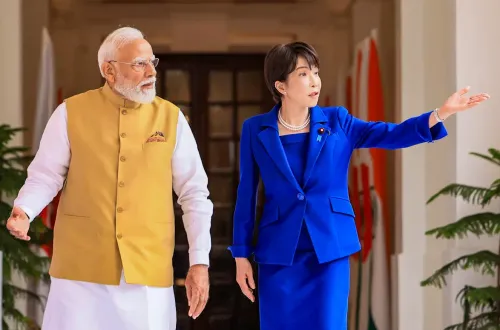
Japanese Prime Minister Sanae Takaichi's visit to India is expected to accelerate cooperation on economic security and regional resilience.
Priority areas for deeper cooperation include semiconductors , critical minerals , supply chain resilience , and defence industrial coordination.
The report calls for stronger institutionalisation of economic security cooperation through the Quad and ASEAN-linked frameworks .
Japan–India cooperation within the Free and Open Indo-Pacific (FOIP) framework is emerging as a critical pillar of regional stability, underpinned by the complementarity between India's scale and Japan's advanced technological, financial, and institutional capacities, according to a report published by the Australia-based East Asia Forum. The analysis highlights how the bilateral partnership is evolving well beyond development aid into a comprehensive agenda spanning maritime security, economic resilience, and critical technology.
Why This Partnership Matters
India's expanding industrial base and its status as a resident maritime power have positioned it as a crucial node in global supply chain diversification. Japan, in turn, contributes capital and advanced technology to advance resilience-focused regional initiatives. Together, the two nations bridge the Western Pacific and the Indian Ocean, reinforcing the connective fabric of the broader Indo-Pacific network.
According to the East Asia Forum report, Japan's FOIP vision is evolving 'from a strategic vision into a regional framework for providing public goods — a structural response to intensifying geopolitical competition, supply chain fragmentation, and uncertainty across the region.'
Geopolitical Pressures Reshaping the Agenda
Intensifying geopolitical competition — particularly the US–China technological rivalry — combined with disruptions to global supply chains and heightened maritime instability, has increased regional vulnerability. The report notes that Tokyo's FOIP is taking shape as a framework to enhance the region's capacity to absorb external shocks, with the Japan–India partnership playing an increasingly important role within this architecture.
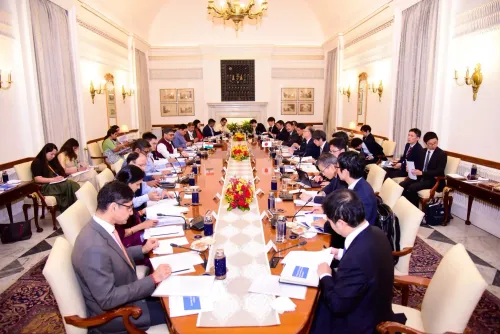
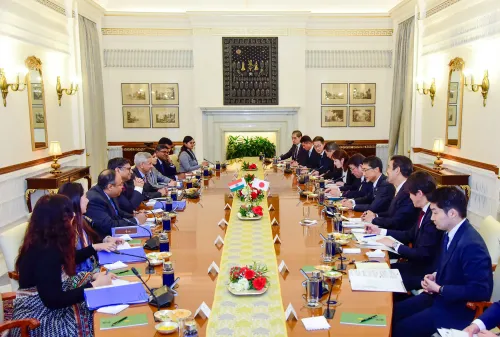
The Quad Foreign Ministers' Meeting held in New Delhi in May 2026 underscored this shift. Discussions centred on maritime security, energy cooperation, and critical minerals — all aligned with Tokyo's pivot toward a resilience-oriented regional framework.
Takaichi Visit Adds Momentum
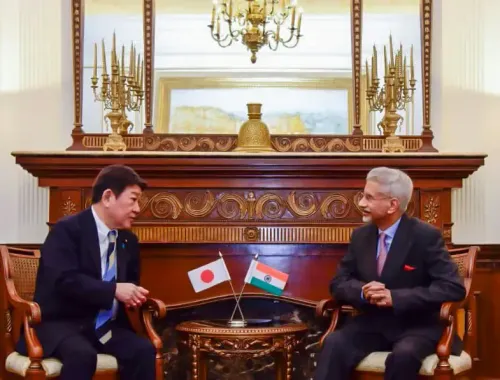
The recently concluded visit of Japanese Prime Minister Sanae Takaichi to India is expected to reinforce implementation momentum across economic security and regional resilience priorities. The report identifies defence industrial cooperation, semiconductors, and critical minerals as focal areas where the bilateral relationship is deepening.
This visit comes amid a broader recognition that the Japan–India axis is no longer peripheral to Indo-Pacific architecture — it is increasingly central to it.
Where Cooperation Can Be Strengthened
The East Asia Forum report identifies several areas requiring further work. A stated priority is the institutionalisation of economic security cooperation, particularly in supply chain resilience and industrial policy coordination for semiconductors and critical technologies. Networked cooperation through the Quad and ASEAN-linked frameworks is also flagged as increasingly important.
As the region navigates a period of sustained geopolitical flux, the depth and pace of Japan–India cooperation will be a key indicator of whether FOIP translates from vision into verifiable regional architecture.
Point of View
But the harder question is whether institutionalisation will keep pace with geopolitical urgency. Both nations have a history of well-articulated bilateral agendas that stall at the implementation stage — semiconductor supply chain coordination and defence industrial linkages remain works in progress despite years of dialogue. The Takaichi visit and the Quad ministerial are positive signals, but FOIP's credibility as a regional public-goods framework will ultimately be measured by delivery on critical minerals access and semiconductor resilience — not by the frequency of high-level meetings. India's domestic policy bandwidth, particularly on industrial licensing and FDI in sensitive tech sectors, will be as decisive as any bilateral commitment.
NationPress
3 Oct 2026
Frequently Asked Questions
What is the Free and Open Indo-Pacific (FOIP) framework?
The Free and Open Indo-Pacific is a strategic vision, originally articulated by Japan, aimed at maintaining a rules-based regional order across the Indo-Pacific. It is evolving into a framework for delivering regional public goods — covering maritime security, supply chain resilience, energy cooperation, and critical technology — as a structural response to intensifying geopolitical competition.
Why is Japan–India cooperation significant within FOIP?
Japan and India bring complementary strengths to the FOIP framework: India offers industrial scale and a resident maritime presence in the Indian Ocean, while Japan contributes advanced technology, capital, and institutional capacity. Together, they bridge the Western Pacific and Indian Ocean, reinforcing the broader Indo-Pacific network's resilience.
What did the Quad Foreign Ministers' Meeting in New Delhi cover?
The Quad Foreign Ministers' Meeting held in New Delhi in May 2026 focused on maritime security, economic security, energy cooperation, and critical minerals. The discussions reflected the broader shift in Tokyo's FOIP strategy toward a resilience-oriented regional framework.
What was the significance of Japanese PM Takaichi's visit to India?
The visit of Japanese Prime Minister Sanae Takaichi to India is expected to reinforce momentum for implementing the Japan–India bilateral agenda, particularly in economic security and regional resilience. Defence industrial cooperation, semiconductors, and critical minerals are among the priority areas.
Where does Japan–India cooperation need to improve, according to the report?
The East Asia Forum report identifies the further institutionalisation of economic security cooperation — especially in supply chain resilience and industrial policy coordination for semiconductors and critical technologies — as a key priority. Strengthening networked cooperation through the Quad and ASEAN-linked frameworks is also highlighted as increasingly important.