Jinnah's 1947 partition legacy echoes in Asim Munir's ambitions: analyst
Synopsis
On the day Pakistan celebrates independence, a Times of Israel analysis draws a damning arc from Jinnah's partition — which reportedly killed around two million people in months — to Pakistani Army Chief Asim Munir's present-day ambitions, arguing that religious nationalism as a state-building tool has already failed Pakistan once, in 1971, and the lessons remain unlearned.
Key Takeaways
Political analyst Vas Shenoy argues in The Times of Israel that Jinnah's obstinacy drove the 1947 partition , which modern estimates suggest killed around two million people in months.
Between ten and fifteen million people were displaced during partition — one of the largest forced migrations in human history.
East Pakistan broke away in 1971 to become Bangladesh , disproving the premise that shared Muslim identity alone could sustain a unified nation.
Shenoy argues that Jinnah's imposition of Urdu as the sole state language in 1948 — despite Bengali being the majority tongue — planted the seeds of that rupture.
The report draws a parallel between Jinnah's maximalist vision and Pakistani Army Chief General Asim Munir's current ambitions.
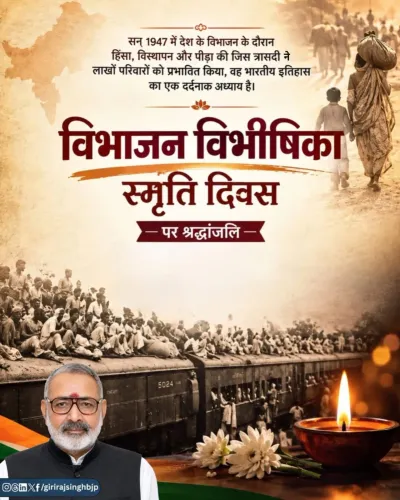
India observes 14 August as Partition Horrors Remembrance Day , marking the suffering of Hindus, Muslims, and Sikhs alike.
As Pakistan marks its Independence Day on 14 August, a political analysis published in The Times of Israel argues that the day remains one of grief for millions of Indians — Hindus, Muslims, and Sikhs alike — whose lives were shattered when united India was partitioned in 1947. The report contends that the obstinacy of Muhammad Ali Jinnah that drove that catastrophic division now finds a parallel in the ambitions of Pakistani Army Chief General Asim Munir.
The Human Cost of Partition
Political researcher, consultant and entrepreneur Vas Shenoy, writing in The Times of Israel, painted a stark picture of the violence that accompanied partition. 'Trains arrived at stations carrying corpses instead of passengers. Women were abducted, raped and forcibly converted to Islam. Families that had lived beside one another for generations suddenly found themselves on opposite sides of an international frontier,' he wrote.
Shenoy noted that the precise death toll may never be established with certainty, but 'modern estimates have now grown to around two million' — a figure he contextualised against the six million Jewish victims of the Holocaust, which unfolded over five years. The partition killings, he argued, compressed comparable carnage into a matter of months. Additionally, he noted that between ten and fifteen million people were uprooted from their homes.
When Shared Religion Failed to Hold a Nation Together
Shenoy argued that partition's founding premise — that a shared Muslim identity could sustain a unified nation — was disproved by history within a generation. East Pakistan broke away in 1971 after years of political discrimination, repression, and war, emerging as Bangladesh. According to Shenoy, the supposedly common religious bond proved insufficient to bridge the divide between Bengalis and West Pakistanis, who were separated by language, culture, economic interests, and geography.
He further noted that if Pakistan had been conceived solely as a homeland for South Asian Muslims, tens of millions of Muslims would not have chosen to remain in India after 1947. And if Islam alone were sufficient to constitute a nation, Bangladesh, he argued, should never have separated from Pakistan.
The Language Contradiction and the Urdu Question
Shenoy pointed to Pakistan's choice of Urdu as its national language as an early and telling contradiction. Urdu was not the majority mother tongue of any of the principal regions that formed the new country; its cultural heartland lay largely in northern India — particularly Uttar Pradesh, Delhi, and Lucknow — and it arrived with the Muhajir political and bureaucratic elite.
The contradiction was sharpest in East Pakistan, whose Bengali-speaking population was the country's largest linguistic group. Yet, Shenoy noted, Jinnah insisted in Dhaka in 1948 that Urdu alone would be the state language. 'In 1971, Bangladesh demonstrated the limits of religion as a substitute for language, culture and identity,' he wrote.
A Warning Rooted in Pakistan's Own History
Shenoy argued that Pakistan's own fractured history ought to make it cautious about grand political projects rooted in religious identity. 'The two-state solution of 1947 did not end Hindu-Muslim hostility. Nor did it create a unified Muslim nation: Pakistan itself broke in two within twenty-four years,' he wrote.
The analysis draws a direct line from Jinnah's maximalist political vision — which critics argue prioritised ideological purity over human cost — to what the report characterises as General Munir's contemporary ambitions, suggesting that the pattern of overreach rooted in religious nationalism has not been broken. As India observes Partition Horrors Remembrance Day on 14 August, the report underscores that the consequences of 1947 continue to shape the subcontinent's political landscape.
Point of View
But the report conflates two distinct phenomena — a founding political leader and a military commander — without fully establishing the causal link. What the analysis does capture well is the structural failure of religious nationalism as a state-building tool: Pakistan's own 1971 rupture is the most potent refutation of its founding logic, and that fact is rarely foregrounded in mainstream commentary. The more uncomfortable question the piece gestures toward but does not fully answer is why, 78 years on, both India and Pakistan remain captive to the trauma of partition rather than having institutionalised its lessons into durable peace frameworks.
NationPress
30 Sept 2026
Frequently Asked Questions
What is Partition Horrors Remembrance Day?
Partition Horrors Remembrance Day is observed in India on 14 August each year to commemorate the immense suffering, mass displacement, and loss of life that accompanied the partition of British India in 1947. The day recognises the pain endured by Hindus, Muslims, and Sikhs alike who were caught in the violence and upheaval of that period.
How many people died during the 1947 partition of India?
According to political analyst Vas Shenoy, writing in The Times of Israel, modern estimates place the death toll at around two million people — a figure he notes is comparable in scale to the Holocaust, but compressed into just a few months. Between ten and fifteen million people were also displaced from their homes.
Why did East Pakistan separate to become Bangladesh in 1971?
East Pakistan broke away in 1971 after years of political discrimination, repression, and ultimately war, becoming Bangladesh. Analysts like Shenoy argue this demonstrated that a shared Muslim identity was insufficient to hold together populations divided by language, culture, economic interests, and geography — directly undermining partition's founding rationale.
What was the Urdu language controversy in early Pakistan?
Despite Urdu not being the mother tongue of any major region in Pakistan, Jinnah declared it the sole state language in Dhaka in 1948. This alienated the Bengali-speaking majority of East Pakistan, whose linguistic and cultural identity was sidelined. Analysts argue this decision was a key driver of the 1971 separation.
How does the report connect Jinnah to Pakistani Army Chief Asim Munir?
The report, authored by political researcher Vas Shenoy in The Times of Israel, argues that the pattern of overreach rooted in religious nationalism — which it attributes to Jinnah's maximalist political vision — is echoed in General Asim Munir's contemporary ambitions. The analysis suggests Pakistan has not broken from this historical pattern despite its consequences.