Jordan's Aqaba-Ma'an freight railway: a missing IMEC link takes shape
Synopsis
Jordan finally broke ground on a modern freight rail network on 5 October — and analysts say it could fill the single most critical gap in IMEC's overland route. With Saudi Arabia, the UAE and Israel all building out their rail systems, Jordan's 418-km planned network is the missing link between the Gulf and the Mediterranean, and potentially the piece that makes IMEC viable as a physical corridor.
Key Takeaways
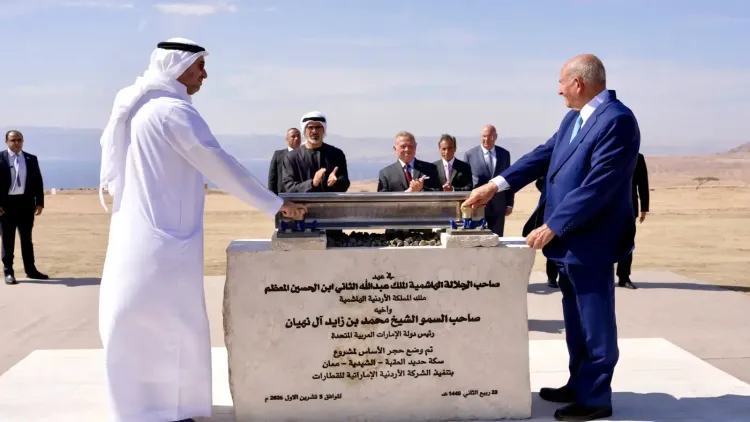
Jordan's King Abdullah II and Abu Dhabi Crown Prince Sheikh Khaled laid the foundation stone for the Aqaba-Shidiya-Ma'an railway on 5 October 2026 .
The project is officially a phosphate and potash freight line, but analysts see it as Jordan's entry point into the IMEC overland corridor.
Jordan was not a signatory to the original IMEC memorandum signed at the 2023 G20 Summit in New Delhi , leaving a structural gap in the corridor's rail component.
A wider Jordanian rail plan envisions an approximately 418-kilometre network linking Aqaba , Ma'an , Madouneh and the Amman area.
The network could eventually connect with Saudi Arabia , extend north to Syria and Turkey , and link westward to Israel's rail network and Haifa port.
Analyst Vas Shenoy argues Jordan must convert its geographic position into dry ports, logistics hubs, industry and employment — not merely a transit corridor.
Jordan's King Abdullah II and Abu Dhabi Crown Prince Sheikh Khaled bin Mohamed bin Zayed Al Nahyan laid the foundation stone for the Aqaba-Shidiya-Ma'an railway on 5 October 2026, marking the beginning of what analysts say could become a pivotal component of the India-Middle East-Europe Economic Corridor (IMEC). The project, officially intended to transport phosphate and potash to the Red Sea, is also being seen as Jordan's first step toward building the modern freight rail network it has lacked for decades — and a potential bridge in the wider IMEC architecture linking India, the Gulf and the Mediterranean.
Why Jordan Is the Missing Piece in IMEC
Since IMEC was announced at the 2023 G20 Summit in New Delhi, maps of the corridor have consistently depicted a route running through India, the UAE, Saudi Arabia, Jordan, Israel and on to Europe. Yet Jordan was notably absent from the original IMEC memorandum signed in 2023. The gap, analysts argue, is not a technicality but a structural weakness in the corridor's overland rail component.
According to Vas Shenoy, an Italian-Indian entrepreneur and analyst writing in Caṇakya — The Indo Mediterranean Initiative, the problem is one of connectivity. 'The maritime connection between India and the UAE already exists. The Emirates have built Etihad Rail. Saudi Arabia has a rapidly expanding railway network. On the Mediterranean side, Israel's railway reaches Beit She'an, close to the Jordanian border, connecting it to Haifa. In between lies Jordan, without the railway continuity necessary to connect these systems,' Shenoy wrote.
What the New Railway Covers
The Jordanian-Emirati project, as described by Shenoy, would connect Shidiya and Ghor Al-Safi with Aqaba and the proposed Ma'an dry port. But for Amman, this is part of a larger ambition: an approximately 418-kilometre line linking Aqaba, Ma'an and Madouneh to the Amman area. From there, the network could eventually extend toward Saudi Arabia, northwards to Syria and Turkey, and — under different political circumstances — westwards to the Israeli railway network and the Mediterranean.
'Ma'an, and particularly Madouneh, therefore become important points not only for IMEC, but for a much broader regional transport architecture,' Shenoy noted.
Jordan's Strategic and Economic Imperative
For Jordan, the stakes extend well beyond logistics. Shenoy argues that Amman cannot afford to be merely a transit corridor through which sealed containers pass between Saudi Arabia and the Mediterranean. 'Its national interest lies in converting geography into dry ports, logistics, industry, employment and investment,' he wrote.
This comes amid the broader resilience shown by the strategic partnership among India, the UAE and Israel — a relationship that, according to reports, sits at the intersection of regional security, political architecture and economic resilience. The recent Flydubai terrorist attack has, according to the analysis, further underscored the importance of deeper cooperation among the three nations and the infrastructure that connects them.
The Geopolitical Dimension
Jordan's geography makes it difficult to bypass. As Shenoy observed, 'The most natural route between the Saudi and Israeli railway networks crosses Jordanian territory. Without that connection, the Middle Eastern railway component of IMEC remains incomplete.' The project therefore carries significance that transcends freight volumes — it is, in effect, a geopolitical infrastructure bet on regional normalisation and economic integration.
Notably, this is the first concrete rail infrastructure move in IMEC's overland corridor since the corridor was announced at the G20, and it comes as India deepens its Gulf partnerships on multiple fronts. Whether the line eventually integrates into IMEC will depend on political developments between Jordan and Israel, but the foundation stone marks a significant first move toward closing the corridor's most conspicuous gap.
Point of View
But because of what it represents structurally: the first physical infrastructure move to close IMEC's most glaring overland gap. The corridor has been largely a map exercise since its G20 announcement — impressive on paper, incomplete on the ground. Jordan's absence from the original IMEC memorandum was always the elephant in the room, given that the most natural rail route between Saudi Arabia and Israel runs through Jordanian territory. The deeper question is political: Israeli-Jordanian rail integration is contingent on a regional normalisation that remains uncertain. India, as IMEC's eastern anchor, has an interest in pushing for Jordan's formal inclusion — quietly, if necessary — because without it, the corridor's overland rail case is structurally hollow.
NationPress
10 Oct 2026
Frequently Asked Questions
What is the Aqaba-Shidiya-Ma'an railway project in Jordan?
It is a freight rail line whose foundation stone was laid on 5 October 2026 by Jordan's King Abdullah II and Abu Dhabi Crown Prince Sheikh Khaled. Officially designed to transport phosphate and potash to the Red Sea port of Aqaba, it is also seen as the foundation of a wider modern rail network that could integrate Jordan into the IMEC overland corridor.
Why does Jordan matter for the IMEC corridor?
Jordan sits geographically between Saudi Arabia's expanding railway network and Israel's rail line, which reaches Beit She'an near the Jordanian border. Without rail continuity through Jordanian territory, the Middle Eastern overland component of IMEC remains physically incomplete. Jordan was not a signatory to the original IMEC memorandum signed at the 2023 G20 Summit in New Delhi.
What is the full scale of Jordan's planned railway network?
Beyond the initial Aqaba-Shidiya-Ma'an line, Jordan plans an approximately 418-kilometre network linking Aqaba, Ma'an and Madouneh to the Amman area. From there, connections could extend to Saudi Arabia, northward to Syria and Turkey, and potentially westward to the Israeli rail network and the Mediterranean port of Haifa.
How does the Flydubai terrorist attack relate to IMEC?
According to the analysis, the attack underscored that the infrastructure connecting India, the UAE and Israel is not purely a trade question — it sits at the intersection of regional security, political architecture and economic resilience. It reinforces why deeper cooperation among the three nations, including on connectivity projects like IMEC, carries strategic weight beyond commerce.
What is IMEC and when was it announced?
The India-Middle East-Europe Economic Corridor (IMEC) is a multimodal trade and infrastructure corridor announced at the G20 Summit in New Delhi in 2023. It envisions a route linking India to the UAE, Saudi Arabia, Jordan, Israel and Europe through a combination of maritime and overland rail connections.