IMEC digital cable project viable ahead of railway link, report says
Synopsis
IMEC's freight railway grabs headlines, but a new analysis argues the corridor's 9,000-km Blue Raman digital cable — backed by 400 million euros and EU support — is the piece most ready to move. The case: cables need only two endpoints and paying customers; railways need borders, ports, and trains to align every time a shipment moves. IMEC may deliver real value before a single freight train runs.
Key Takeaways
The India–Middle East–Europe Economic Corridor (IMEC) , launched at the G20 summit in 2023 , includes a digital cable network, electricity lines, and a clean hydrogen pipeline alongside its flagship freight railway.
The 9,000-km Blue Raman subsea cable is identified as IMEC's most immediately viable component, requiring only endpoint connections and paying customers to become operational.
An EU Global Gateway document confirms 400 million euros in investment for the Blue Raman cable, including 37 million euros from the European Union .
The freight railway faces far greater complexity, needing seamless coordination across borders, ports, and customs regimes every time a shipment moves.
The report recommends a project-by-project approach: advance components with clear costs, customers, and schedules first, rather than waiting for the full corridor to be ready.
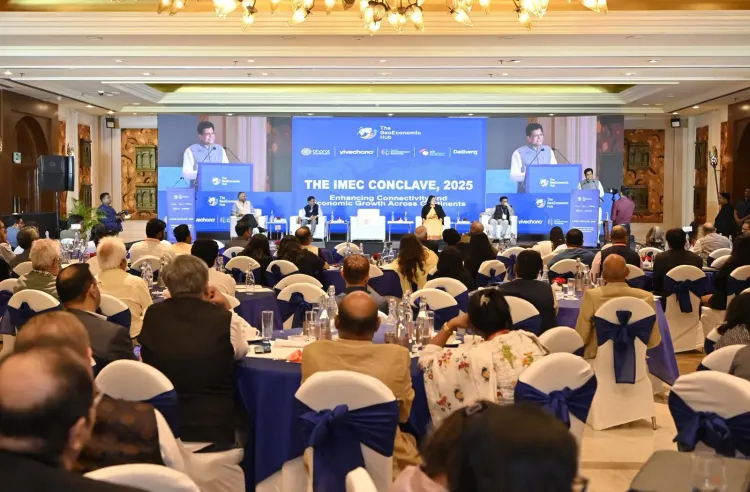
The India–Middle East–Europe Economic Corridor (IMEC), announced at the G20 summit in 2023, encompasses far more than a freight railway — it includes plans for a digital submarine cable network, electricity transmission lines, and a clean hydrogen export pipeline, according to a new analysis. Crucially, the digital component may be the first to deliver tangible results, well before the railway ever lays a track.
Digital Cable: The Fastest Path Forward
According to the report, the 9,000-km Blue Raman subsea cable — embedded within IMEC's digital framework — stands out as the corridor's most immediately actionable element. Unlike the freight railway, which requires ships, trains, ports, and border crossings to function in concert for every single shipment, a digital cable requires only connections at either end and paying customers willing to use it.
The analysis notes that the digital project 'appears to be viable' because it would connect customers at both ends who are willing to pay for the service — a market-readiness that the railway component has yet to demonstrate. Securing investment and providing a useful connection, the report argues, would be 'an achievement in its own right' even if carried out independently of the rail link.
EU Backing and the Blue Raman Cable
An EU Global Gateway document places the Blue Raman cable squarely within IMEC's digital architecture, listing a total investment of 400 million euros, of which 37 million euros comes directly from the European Union. This financial commitment gives the digital strand of IMEC a degree of institutional backing that other components currently lack.
This comes amid broader EU interest in diversifying digital infrastructure away from routes that pass through geopolitically sensitive chokepoints. The Blue Raman cable, connecting India to Europe via the Middle East, fits squarely into that strategic logic.
A Project-by-Project Approach
The report advocates assessing IMEC one component at a time rather than treating it as an all-or-nothing proposition. If the digital link secures customers, it can advance while governments negotiate the far more complex rail questions. The same logic, the report notes, could apply to the electricity connection or hydrogen pipe — provided either attracts firm funding and confirmed buyers.
Notably, the analysis argues that progress on individual strands should be credited for what each delivers, rather than being dismissed because the full freight corridor remains on the drawing board. IMEC, in this framing, could begin providing 'useful connections before its trains run.'
The Railway Challenge
By contrast, the freight railway component faces a fundamentally different and more complex set of requirements. It demands seamless coordination across multiple sovereign borders, port authorities, rail gauges, and customs regimes — a logistical challenge that has historically stalled similar multimodal corridors. While ambitions for the rail link remain intact, the timeline for implementation is considerably longer than for the digital or energy strands.
What Comes Next
The report's core recommendation is that policymakers prioritise projects whose costs, customers, and schedules are already clear. The digital cable appears closest to meeting that bar. Progress on IMEC's electricity and hydrogen components will depend on whether financing and offtake agreements can be secured in parallel with the diplomatic groundwork still under way on the railway side. All eyes will be on how quickly the Blue Raman cable moves from blueprint to operational status.
Point of View
Indivisible corridor has always been its political strength and its operational weakness. Breaking it into fundable, executable components — as this analysis recommends — is the only realistic path to early deliverables. The Blue Raman cable has money, an EU endorsement, and a clear customer logic; the railway has ambition and geopolitical goodwill but no clear implementation timeline. What mainstream coverage misses is that IMEC's credibility as a China-alternative trade route depends on showing early wins — and a live digital cable is a far more persuasive proof of concept than another summit communiqué. The hydrogen pipeline and electricity link, meanwhile, will live or die on offtake agreements that have not yet been publicly disclosed.
NationPress
5 Oct 2026
Frequently Asked Questions
What is IMEC and when was it announced?
The India–Middle East–Europe Economic Corridor (IMEC) is a multimodal connectivity initiative announced at the G20 summit in 2023. It aims to link India to Europe via the Middle East through a combination of freight railways, digital cables, electricity lines, and a clean hydrogen pipeline.
What is the Blue Raman subsea cable?
The Blue Raman is a planned 9,000-km submarine cable that forms the digital backbone of IMEC, connecting India to Europe via the Middle East. An EU Global Gateway document lists 400 million euros in investment for the cable, including 37 million euros from the European Union.
Why is the digital cable considered more viable than the IMEC railway?
A digital cable requires only connections at either end and paying customers to operate, making it far simpler to implement than a freight railway. The railway demands coordinated functioning of ships, trains, ports, and border crossings across multiple countries for every shipment — a logistical challenge with a much longer implementation timeline.
What other components does IMEC include besides the railway and digital cable?
Beyond the freight railway and digital cable network, IMEC's agreement also includes plans for electricity transmission lines and a pipeline to export clean hydrogen. Progress on these will depend on securing firm funding and offtake agreements.
What approach does the report recommend for IMEC's development?
The report recommends assessing and advancing IMEC one project at a time, prioritising components whose costs, customers, and schedules are already clear. It argues that completed links should be credited for what they deliver individually, rather than being measured solely against the full, unrealised freight corridor.