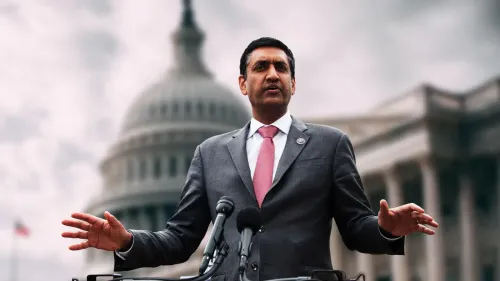
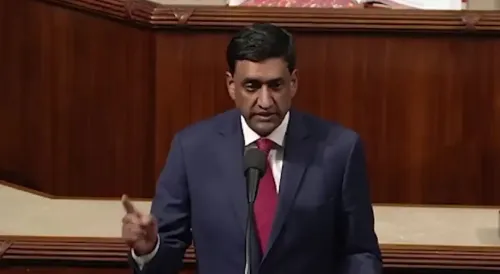
Ro Khanna urges Democrats to cut Iran war funding, end Israel aid
Synopsis
Indian American Congressman Ro Khanna is pushing Democrats to use a short-term spending bill to cut US military funding in Iran and end aid to Israel — tying anti-war sentiment directly to Republican midterm losses. He has simultaneously unveiled a sweeping New Deal-style domestic agenda, arguing that economic populism and foreign policy restraint must now define the party's path forward.
Key Takeaways
Congressman Ro Khanna urged Democrats on 5 November to block US military combat funding in Iran via a continuing resolution.
He separately called for zeroing out all US aid to Israel in the same spending measure.
Khanna argued that opposition to the Iran war and corruption allegations drove Republican losses in the midterms.
He proposed a National Industrial Bank to invest in semiconductors, rare earths, advanced manufacturing, and AI.
His domestic agenda includes Medicare for All , free public college, a Work for America programme, and zero-down-payment home loans for qualifying renters of seven years .
Khanna cited a billionaire tax co-sponsored with Senator Bernie Sanders as the primary financing mechanism.
Indian American Congressman Ro Khanna has called on Democrats to block funding for US military combat operations in Iran through a short-term government spending measure, arguing that public opposition to the war was a key factor behind Republican losses in the midterm elections. The California Democrat made the demand on 5 November, framing it as a course-correction the party must pursue in the aftermath of Tuesday's vote.
Key Demands on Iran and Israel
In a post on X, Khanna wrote: 'Support a continuing resolution prohibiting the financing of any combat activities of the U.S. military in Iran. End the Iran war like we did for Vietnam.' Separately, he urged Democrats to 'Support the zeroing out of all aid to Israel in the continuing resolution,' linking both demands to a broader reassessment of overseas military spending.
Khanna made the proposals in a post responding to Vice President JD Vance's commentary on the election results. He argued that the Iran war and allegations of corruption had contributed to the Republican defeat. Notably, his post did not include legislative language specifying when a prohibition would take effect, which funds it would cover, or whether it would contain exceptions.
A New Deal Blueprint for the Democratic Party
Beyond foreign policy, Khanna laid out an ambitious domestic agenda in a separate opinion article, urging Democrats to pursue an economic programme modelled on President Franklin D. Roosevelt's New Deal. He argued that the election result presented an opportunity to address the cost of essentials, economic inequality, and communities left behind by industrial change.
Central to his proposal is the creation of a National Industrial Bank to invest in sectors including semiconductors, rare earth minerals, advanced manufacturing, medical innovation, shipbuilding, and artificial intelligence. He also called for convening major business and technology leaders to channel investment into schools, jobs, apprenticeships, and entrepreneurship in deindustrialised communities.
Work for America and Social Spending Proposals
Khanna proposed a Work for America programme modelled on the New Deal's Works Progress Administration, offering young people opportunities in community rebuilding, care services, technology projects, and vocational training. His domestic agenda additionally included Medicare for All, free public college, expanded trade schools, and housing affordability measures.
On housing, he said he was working on legislation to provide zero-down-payment, low-interest home loans to qualifying individuals who had worked and paid rent for seven years.
How He Proposes to Pay for It
To finance his proposals, Khanna pointed to a federal tax on billionaires that he said he had co-sponsored with Senator Bernie Sanders. He also argued that cutting spending on weapons and wars should form part of the party's fiscal approach — directly linking his anti-war stance to his domestic investment agenda.
Significance and What Comes Next
Khanna's intervention comes at a pivotal moment for the Democratic Party as it processes the midterm results and debates its next direction. His simultaneous push on foreign policy restraint and New Deal-style domestic investment reflects a broader progressive argument that the party's electoral fortunes are tied to economic populism. Whether Democratic leadership embraces these conditions in continuing resolution negotiations remains to be seen.
Point of View
End Israel aid, launch a National Industrial Bank, and pass Medicare for All — read less like legislative strategy and more like a progressive manifesto dropped into a moment of party vulnerability. The continuing resolution tactic is a real lever, but bundling so many contentious conditions risks fracturing Democratic caucus unity precisely when coherence is most needed. His New Deal framing is politically shrewd, but the gap between FDR's institutional capacity and today's polarised Congress is vast. The more pointed question is whether Democratic leadership will treat Khanna's post as a pressure campaign to negotiate with, or a flank to contain.
NationPress
5 Nov 2026
Frequently Asked Questions
What is Ro Khanna asking Democrats to do on Iran?
Khanna is urging Democrats to include a provision in a short-term government spending bill — known as a continuing resolution — that would prohibit funding for US military combat activities in Iran. He drew a parallel to the legislative moves that ended US military involvement in Vietnam.
Why does Khanna want to cut aid to Israel?
Khanna called for zeroing out all US aid to Israel in the same continuing resolution, as part of a broader push to reduce overseas military spending. He presented the demand alongside his Iran proposal as conditions for Democratic support of the spending measure.
What is Khanna's New Deal economic agenda?
Khanna has proposed an economic programme modelled on Franklin D. Roosevelt's New Deal, centred on a National Industrial Bank to invest in semiconductors, AI, shipbuilding, and advanced manufacturing. It also includes a Work for America jobs programme, Medicare for All, free public college, expanded trade schools, and zero-down-payment home loans.
How does Khanna propose to finance his domestic proposals?
Khanna pointed to a federal billionaire tax he said he co-sponsored with Senator Bernie Sanders, and argued that reducing spending on weapons and overseas wars should also form part of the party's fiscal approach.
What was the political context behind Khanna's demands?
Khanna made his proposals on 5 November in the wake of Republican losses in the midterm elections, arguing that public opposition to the Iran war and corruption allegations were contributing factors. He posted his demands on X in direct response to Vice President JD Vance's commentary on the election results.