US green card lawsuit challenges USCIS rules on adjustment of status
Synopsis
A broad coalition — university professors, unions, and individual immigrants — has sued the US government over two USCIS policies that critics say quietly reversed decades of green card practice, forcing eligible applicants to leave the US to pursue permanent residence and treating a lawful choice as a strike against them.
Key Takeaways
A federal lawsuit filed on 5 October 2026 challenges two USCIS policies issued in May and August that altered the adjustment of status process for green card applicants.
The May policy instructs officers to treat an applicant's decision to stay in the US rather than pursue consular processing abroad as a negative discretionary factor .
The August policy allows USCIS to deny applications without first offering applicants a chance to submit additional evidence, and reportedly applies to already-pending cases.
Plaintiffs include the American Association of University Professors , SEIU , Americans for Immigrant Justice , and six individual green card applicants .
The case, AAUP et al. v.
US Department of Homeland Security et al. , remains pending; no court has ruled on the legality of the policies yet.
A ruling against USCIS could affect a broad range of employment- and family-based immigrants legally residing in the United States .
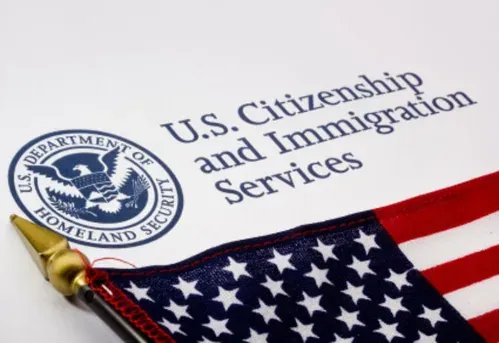
A coalition of immigrant families, workers, university educators, and advocacy groups filed a federal lawsuit on 5 October 2026 challenging two US Citizenship and Immigration Services (USCIS) policies that plaintiffs say could compel eligible green card applicants to leave the United States to pursue permanent residence — separating them from their families and employment in the process.
The case, American Association of University Professors et al. v. U.S. Department of Homeland Security et al., targets policies issued by USCIS in May and August that altered how the agency processes adjustment of status applications — the pathway that allows eligible immigrants already living in the US to seek lawful permanent residence without having to apply at a US consulate abroad. The case remains pending, and no court has yet ruled on whether the challenged policies are unlawful.
What the Two Policies Change
Under the May policy, according to the lawsuit, USCIS officers are directed to treat an applicant's choice to pursue permanent residence from within the United States — rather than through consular processing abroad — as a negative discretionary factor. Plaintiffs say applicants must demonstrate 'unusual or even outstanding' circumstances to overcome that negative weighting, a bar they describe as an unexplained and legally unsupported departure from decades of established practice.
The August policy permits USCIS officers, in certain circumstances, to deny applications outright without first offering applicants a chance to submit additional evidence. Critically, the challengers allege this policy applies retroactively to applications that were already pending when it was issued — raising acute concerns among those who filed under earlier, more accommodating procedures.
Who Filed the Lawsuit and Why
The plaintiffs include the American Association of University Professors (AAUP) and its chapters at Harvard University and Boston University; the Service Employees International Union (SEIU) and two of its affiliates; Americans for Immigrant Justice; and six individual green card applicants pursuing permanent residence through both family and employment pathways. They are represented by Democracy Forward, the American Immigration Council, the American Immigration Lawyers Association, and Colombo & Hurd.
Leslie Dellon, a senior attorney for business immigration at the American Immigration Council, said the new policies mark 'a major shift with very real consequences,' including possible family separation, job disruption, and lengthy waits abroad for consular appointments. 'For decades, people who met the requirements to apply for a green card from inside the United States were able to do so without having that choice count against them,' Dellon said.
The Legal Argument at the Core
The plaintiffs are asking the court to block and ultimately set aside both policies, and to require USCIS to adjudicate affected applications under what they contend is controlling legal precedent. Skye Perryman, president and CEO of Democracy Forward, argued that Congress had expressly established a process allowing eligible immigrants already in the country to seek permanent residence without uprooting their lives. 'The executive branch cannot rewrite that system and then treat people's lawful actions as a reason to deny them said permanent residency,' Perryman said.
Broader Implications for Immigrants
Legal observers note the lawsuit could carry significant consequences beyond the named plaintiffs. Employment- and family-based immigrants who are legally present in the US and eligible to adjust their status could all be affected if the policies remain in force. The organisations involved represent a wide cross-section — educators, researchers, healthcare workers, and service-sector employees — underscoring the scale of potential impact.
This comes amid broader scrutiny of executive-branch immigration policy, with advocacy groups increasingly turning to the courts to challenge agency rule changes that were not subject to formal notice-and-comment rulemaking. How the court rules could set precedent for how USCIS exercises discretion in adjustment-of-status cases going forward.
Point of View
Which is precisely why litigation has become the primary check on them. By treating a congressionally permitted choice — adjusting status from within the US — as a negative factor, the May policy effectively rewrites the statute through administrative discretion rather than legislation. The retroactive application of the August denial policy is arguably the more troubling element: immigrants who filed in good faith under one set of rules now find those rules changed beneath them. Courts will have to decide whether USCIS has the discretionary latitude to move this aggressively, or whether it has crossed into unlawful executive rewriting of an immigration framework Congress deliberately designed.
NationPress
6 Oct 2026
Frequently Asked Questions
What is the lawsuit against USCIS about?
The lawsuit, filed on 5 October 2026, challenges two USCIS policies — issued in May and August — that plaintiffs say make it significantly harder for eligible immigrants already in the US to obtain a green card without leaving the country. Advocacy groups, university professors, unions, and individual applicants are asking the court to block the policies and restore the previous adjustment-of-status framework.
What is 'adjustment of status' and why does it matter?
Adjustment of status is the legal process that allows eligible immigrants already living in the United States to apply for lawful permanent residence (a green card) without travelling to a US consulate abroad. The new USCIS policies, according to the lawsuit, effectively penalise applicants for using this congressionally established pathway rather than pursuing consular processing overseas.
Who are the plaintiffs in the case?
The plaintiffs include the American Association of University Professors and its chapters at Harvard University and Boston University, the Service Employees International Union and two affiliates, Americans for Immigrant Justice, and six individual green card applicants. They are represented by Democracy Forward, the American Immigration Council, the American Immigration Lawyers Association, and Colombo & Hurd.
How does the August USCIS policy affect people with pending applications?
The August policy allows USCIS officers to deny green card applications without first giving applicants a chance to submit additional evidence. Plaintiffs allege it applies retroactively to applications that were already pending when the policy was issued, putting applicants who filed under the earlier procedures at an unexpected disadvantage.
What could happen if the lawsuit succeeds?
If the court sides with the plaintiffs, USCIS would be required to set aside the May and August policies and adjudicate affected applications under the legal precedent that governed adjustment-of-status cases before the policy changes. The ruling could broadly protect employment- and family-based immigrants who are legally eligible to seek permanent residence while living in the United States.