Lula urges Trump to pursue Iran dialogue, hands over 2010 nuclear deal at White House
Synopsis
In a closed-door White House meeting, Brazil's Lula handed Trump a copy of the 2010 Brazil-Turkey-Iran nuclear deal — for the second time — and warned that a military strike on Iran would cause more damage than Trump imagines. The exchange reveals Brazil's quiet but persistent bid to recast itself as a global diplomatic broker, even as US-Brazil trade tensions simmer over tariffs and a Section 301 investigation.
Key Takeaways
Brazilian President Lula met US President Trump at the White House on 8 May 2025 for a closed-door session on trade and global conflicts.
Lula personally handed Trump a copy of the 2010 Brazil-Turkey-Iran nuclear agreement and urged dialogue over military escalation with Iran.
Trump reportedly said "I will read it tonight" and later posted on Truth Social that the meeting "went very well".
Both sides agreed to form working groups to resolve trade disputes within 30 days , amid a US Section 301 investigation into Brazilian trade practices.
Lula called for reform of the UN Security Council , arguing Brazil, India, Germany, Japan, and South Africa deserve larger roles in global governance.
Trump told Lula he had "no intention of invading Cuba", which Lula described as "a great sign".
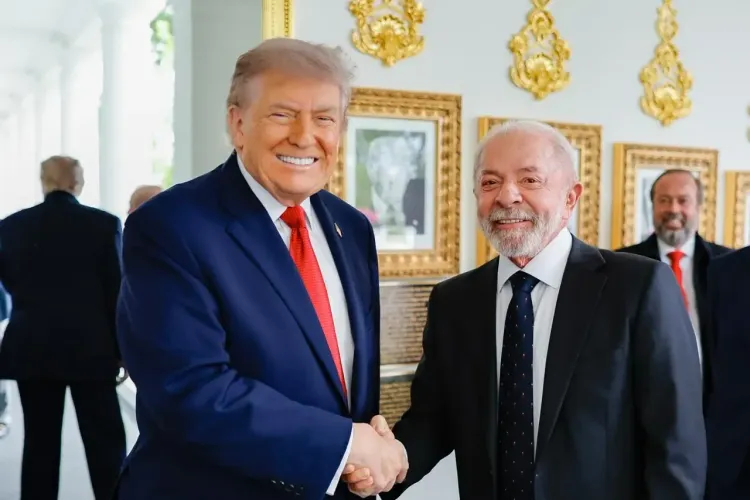
Brazilian President Luiz Inácio Lula da Silva on Thursday, 8 May said he urged US President Donald Trump to pursue dialogue with Iran rather than military escalation, and personally handed Trump a copy of the 2010 nuclear agreement brokered by Brazil and Turkey. The exchange took place as the two leaders concluded a closed-door meeting at the White House, focused on trade, tariffs, and global conflicts.
Lula's Warning on Iran
Speaking at the Brazilian Embassy in Washington after the meeting, Lula said he told Trump that dialogue was more effective than war. "I believe much more in dialogue than in war," Lula said. "I think the invasion of Iran will cause more damage than he imagines."
Lula said he presented Trump with the 2010 Brazil-Turkey-Iran nuclear agreement for the second time, describing it as proof that diplomacy could work. "We managed to convince Iran to accept a revised agreement regarding the non-production of nuclear weapons," he said. Trump reportedly told him, "I will read it tonight," according to Lula.
Why the 2010 Deal Collapsed — and Why Lula Is Reviving It
Lula argued the original deal was undermined by Western powers after its conclusion. "Regrettably, when we finalised that agreement, I do not know why Obama and the European Union — and the rest of the world — decided to ramp up the pressure on Iran," he said. "Possibly because the parties who had brokered the deal were 'Third World' nations."
The 2010 Tehran Declaration, signed by Brazil, Turkey, and Iran, proposed a uranium swap arrangement intended to limit Iran's nuclear enrichment capacity. It was rejected by the UN Security Council, which instead passed fresh sanctions on Tehran within weeks of its signing — a move that deeply frustrated Brasília at the time. Lula's decision to raise the document again signals Brazil's continued interest in positioning itself as a credible mediator in one of the world's most volatile diplomatic flashpoints.
Trade Talks and Working Groups
Beyond Iran, the White House meeting covered bilateral trade tensions, including a Section 301 investigation by the Trump administration into Brazilian trade practices and the prospect of new tariffs on Brazilian goods. Lula said both sides agreed to establish working groups to resolve disputes within 30 days.
"I am very optimistic," Lula said. "We have interest in the United States investing in Brazil again." Trump later posted on Truth Social that the meeting "went very well" and that both sides discussed "Trade and, specifically, Tariffs."
Lula also invited American participation in Brazil's critical minerals sector, including rare earth projects, while stressing that Brazil would not settle for being a raw material exporter. "What we do not want is to be mere exporters," he said.
Cuba, UN Reform, and Geopolitical Positioning
On Cuba, Lula said Trump indicated he had "no intention of invading Cuba", which Lula called "a great sign". He also criticised global powers for failing to reform the United Nations Security Council, arguing that countries including Brazil, India, Germany, Japan, and South Africa deserved greater roles in global governance.
"It is the geopolitics of 2026, not the geopolitics of 1945," Lula said — a pointed reference to the post-World War II architecture that still governs multilateral institutions. The White House meeting notably took place without the traditional Oval Office press appearance; Lula said he had deliberately avoided speaking to reporters before the talks concluded.
State of US-Brazil Relations
The meeting comes amid significant strain in US-Brazil ties over tariffs, technology regulation, and diverging positions on Iran and global conflicts. Despite ideological differences — Lula is a left-wing leader, Trump a conservative nationalist — both sides signalled interest in stabilising the relationship between Latin America's largest economy and the United States.
Lula said the two leaders had developed "chemistry" and described their relationship as "very good". Whether the optimism translates into concrete outcomes on tariffs and Iran diplomacy will become clearer once the agreed working groups begin their 30-day consultations.
Point of View
But as a space where Global South brokers can again be relevant. The more telling detail is that this is the second time Lula has presented the document to Trump, suggesting a sustained lobbying effort rather than a one-off gesture. Whether Trump actually reads it matters less than the optics: Brazil is positioning itself as indispensable to any Iran settlement, and Lula is betting that Trump's transactional instincts may be more receptive to a ready-made deal than his predecessors were.
NationPress
25 Sept 2026
Frequently Asked Questions
What happened at the Lula-Trump White House meeting on 8 May 2025?
Brazilian President Lula and US President Trump held a closed-door meeting at the White House on 8 May 2025, covering trade, tariffs, Iran, Cuba, and UN reform. Lula handed Trump a copy of the 2010 Brazil-Turkey-Iran nuclear agreement and urged dialogue over military action; both sides agreed to form trade working groups within 30 days.
What is the 2010 Brazil-Turkey-Iran nuclear deal that Lula gave Trump?
The 2010 Tehran Declaration was a uranium swap agreement brokered by Brazil and Turkey with Iran, designed to limit Tehran's nuclear enrichment. It was rejected by the UN Security Council, which passed new Iran sanctions within weeks, and was later seen as undermined by Western powers.
Why is Lula warning Trump against invading Iran?
Lula argued that military escalation with Iran would cause wider instability than Trump anticipates, and that diplomacy — as demonstrated by the 2010 deal — is a more effective path. He said, 'I believe much more in dialogue than in war.'
What did Lula and Trump agree on trade?
Both sides agreed to establish working groups to resolve bilateral trade disputes within 30 days. The talks come amid a US Section 301 investigation into Brazilian trade practices and the prospect of new American tariffs on Brazilian goods.
What did Lula say about UN Security Council reform?
Lula criticised global powers for failing to reform the UN Security Council and argued that Brazil, India, Germany, Japan, and South Africa deserved larger roles in global governance, saying the world operates on 'the geopolitics of 2026, not 1945'.