Mexico pushes to scrap US tariffs in USMCA review, Ebrard says

Synopsis
Mexico has drawn a clear line entering the USMCA review: full tariff elimination is the goal, not just reduction. Economy Secretary Marcelo Ebrard’s public framing ahead of the 16–17 June Washington talks sets up a direct clash with a US administration that has made differentiated tariffs a cornerstone of its trade strategy.
Key Takeaways
Mexican Economy Secretary Marcelo Ebrard stated on 2 June that eliminating US tariffs is Mexico’s primary objective in the USMCA review.
The first round of formal bilateral negotiations concluded last week; the US tabled proposals covering rules of origin , steel , aluminium , and economic security .
The second round of talks is confirmed for 16–17 June in Washington, DC , focusing on agriculture and fair competition.
A third round is scheduled for the week of 20 July in Mexico City , aimed at clearing outstanding issues before a trilateral review.
Mexico argues the Trump administration’s differentiated tariff model breaks sharply from the multilateral trading norms that have governed North American commerce for decades.
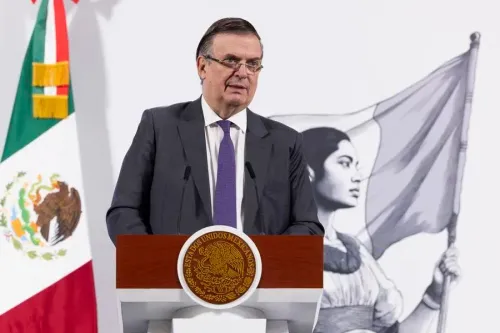
Mexico will make the elimination of existing US tariffs its central objective during the ongoing review of the United States-Mexico-Canada Agreement (USMCA), Mexican Economy Secretary Marcelo Ebrard said on 2 June. Ebrard's remarks signal a firm negotiating stance as bilateral talks between Mexico and the United States advance through a structured multi-round process.
What Ebrard Said
Speaking at a public event, Ebrard confirmed that the US delegation tabled a broad set of proposals following the first round of formal negotiations held last week. “There are a wide range of proposals from the United States regarding content, rules of origin, provisions concerning third countries, and so on,” he told reporters, citing sectors including steel, aluminium, the automotive industry, and economic security.
Ebrard described the Trump administration’s approach to global trade as a “tremendous” transformation, noting that Washington is now applying differentiated tariff rates depending on where goods are produced. “What the United States is creating now is a system in which different parties will be charged different tariffs. It’s very complicated to understand,” he said. Mexican officials argue this model diverges sharply from the multilateral trading framework that has governed regional commerce for decades.
Mexico’s Negotiating Position
While Mexico City’s floor position is to secure the lowest achievable tariffs, Ebrard said the preferred outcome remains a full return to free trade. The economy ministry plans to table a package of proposals at the next meeting that, in his words, “reflect the legitimate interests of the industrial sector.”
This comes amid broader uncertainty over how the USMCA review will reshape North American supply chains, particularly in the automotive and steel sectors where integrated cross-border production is most exposed to tariff differentials.
Upcoming Rounds of Talks
Mexican and US officials have confirmed that the second round of bilateral talks will be held on 16–17 June in Washington, DC, covering agricultural issues, fair competition conditions, and continued discussions on rules of origin.
A third round is scheduled for the week of 20 July in Mexico City, with the goal of resolving outstanding issues before a joint trilateral review involving all three USMCA partners — the United States, Mexico, and Canada — takes place later this year, as required under the agreement’s built-in review mechanism.
Broader Context
The USMCA, which replaced the original North American Free Trade Agreement (NAFTA) in 2020, contains a mandatory six-year joint review clause. The current review is the first of its kind under the agreement. Notably, it is unfolding against a backdrop of sweeping US tariff actions that have already strained trade relations with both Mexico and Canada. The outcome of these negotiations will have significant implications for industries on both sides of the border, with the automotive sector — deeply integrated across the three countries — watching the rules-of-origin discussions most closely.
How far Mexico can move the US toward tariff relief will likely define the commercial terms of North American trade for years ahead.
Point of View
But it sets a bar the Trump administration has shown no appetite to meet. The US differentiated-tariff model is not a negotiating quirk; it is central to Washington’s industrial policy. Mexico’s leverage lies in the automotive sector’s deep cross-border integration, which makes punitive tariffs costly for US manufacturers too. The real question is whether that mutual vulnerability translates into genuine concessions, or whether the review ends with cosmetic adjustments dressed up as a win for both sides.
NationPress
21 Oct 2026
Frequently Asked Questions
What is Mexico’s position in the USMCA review?
Mexico’s stated goal is the full elimination of US tariffs, with Economy Secretary Marcelo Ebrard describing a return to free trade as the ideal outcome. At minimum, Mexico aims to secure the lowest possible tariff rates during the review process.
What is the USMCA review and why is it happening now?
The USMCA — which replaced NAFTA in 2020 — contains a mandatory six-year joint review clause, making the current process the first of its kind under the agreement. The review allows all three partner countries — the United States, Mexico, and Canada — to revisit and renegotiate terms.
When is the next round of US-Mexico USMCA talks?
The second round of bilateral negotiations is confirmed for 16–17 June in Washington, DC, covering agricultural issues, fair competition, and rules of origin. A third round is scheduled for the week of 20 July in Mexico City.
What US proposals were raised in the first round of USMCA talks?
According to Ebrard, the US delegation tabled a broad range of proposals covering content requirements, rules of origin, provisions on third countries, steel, aluminium, the automotive industry, and economic security.
How does the Trump administration’s tariff approach affect USMCA negotiations?
The Trump administration is applying differentiated tariff rates based on where goods are produced, a model Mexican officials say conflicts fundamentally with the free-trade framework underpinning USMCA. This makes negotiations more complex, as Mexico and Canada are being treated differently from other trading partners rather than as privileged regional allies.