Will Nepal Complete Its Parliament Building Before the Elections?
Synopsis
As Nepal prepares for its crucial general elections on March 5, the completion of the new Parliament building hangs in the balance. With a tight schedule and mounting pressure, will the construction meet the deadline in time for the elected officials to take their oaths? The nation's political future could depend on it.
Key Takeaways
Nepal is under pressure to finish the new Parliament building before the March 5 elections.
A constitutional obligation requires the session to be called within 30 days of election results.
The construction project has faced multiple delays and has yet to be completed.
The building complex will accommodate 700 individuals in the lower house chamber.
The new facilities are crucial for the transitioning government and public trust in democracy.
New Delhi, Jan 31 (NationPress) With the general election set for March 5 and results anticipated within two weeks, Nepal is under increasing pressure to finalize its new Parliament building so that elected officials can take their oaths, reports indicate.
A constitutional requirement mandates that the session be convened within 30 days following the final results of the House of Representatives elections, as detailed in a report by the Kathmandu Post.
After spending a decade operating from a rented facility, the government initiated the construction of its dedicated Parliament complex in 2019. The foundation stone for the 12 buildings was laid in September of that year, with a projected completion timeline of three years.
A collaborative effort between the China-based Second Harbour Engineering Company and the Nepali firm Tundi Construction was awarded the contract. However, despite missing the fifth deadline in the past three years, construction remains unfinished.
Historically, the Gallery Baithak located within the premises of Kathmandu's Singha Durbar served as Nepal's Parliament venue since the first general elections in 1959 until the House's reinstatement in 2006.
This reinstated House, following the second people's movement that included representation from Maoist rebels for the first time, also operated from that same location. The movement, known as Jana Andolan II, was an uprising against King Gyanendra's direct rule, uniting various political factions, including Maoist insurgents, in their calls for the restoration of Parliament and democratic reforms.
As the number of representatives in the Constituent Assembly increased in 2008, the Gallery Baithak became inadequate. Consequently, the Birendra International Convention Centre in Kathmandu's New Baneshwor was selected as a temporary location, although the lease was not renewed after an arson incident rendered the property unusable.
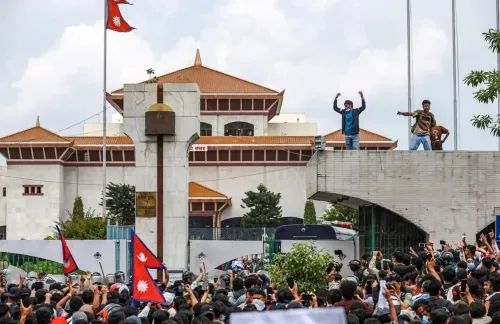
The article notes that the Parliament building was the initial target of the September Gen Z movement and was completely destroyed on September 9. Officials have emphasized that the construction on the Singha Durbar site will be completed on schedule.
“In light of these uncertainties, we have reached out to the government to ensure a timely space for the newly elected House,” stated Eakram Giri, spokesperson for the secretariat, as reported by the Kathmandu Post.
“The Ministry of Urban Development has assured that the new facilities will be ready within a month and a half,” he added.
The under-construction site spans 7.63 hectares and is designed to accommodate 700 individuals in the designated chamber for the lower house. The main floor will have a seating capacity for 400 lawmakers, with an additional 300 seats in the balcony for the press, visitors, and guests.
The hall for the 59-member National Assembly will host over 250 individuals, while another hall with 350 seats is being developed for joint meetings of both Houses.
Although civil work, including the building's structure, has been completed, the interior finishes and the installation of the dome remain unfinished.
Point of View
The urgency surrounding the completion of Nepal's new Parliament building is a reflection of the political landscape. As the country approaches its elections, ensuring that elected representatives have a functional space to operate is crucial for maintaining democratic integrity. The government's commitment to meeting this deadline is essential for fostering a smooth transition and instilling public confidence in the electoral process.
NationPress
20 Sept 2026
Frequently Asked Questions
What is the deadline for completing the Parliament building in Nepal?
The Parliament building must be completed before the general election results are announced on March 5, with a constitutional requirement to convene within 30 days thereafter.
Who is responsible for constructing the new Parliament building?
The construction is being carried out by a joint venture between the China-based Second Harbour Engineering Company and Tundi Construction, a Nepali firm.
What challenges are being faced in completing the Parliament building?
Despite multiple deadline extensions, the construction has not yet been completed, with the interiors and dome installation still pending.
What was the previous location of Nepal's Parliament?
Prior to the construction of the new building, Nepal's Parliament operated from the Gallery Baithak at Singha Durbar since 1959.
Why is the new Parliament building significant?
The new building symbolizes a step toward fulfilling democratic processes in Nepal, especially as the nation approaches critical elections.