BRICS currency not on table 'as of now', MEA confirms at Summit
Synopsis
India shut the door — for now — on a common BRICS currency, but left the window wide open for local-currency trade settlement. The New Delhi Declaration's sharp language on unilateral tariffs signals BRICS is positioning itself as the Global South's voice on WTO reform, even as internal divergences on China's trade influence remain unresolved.
Key Takeaways
MEA Secretary Sudhakar Dalela confirmed there is no proposal for a BRICS currency 'as of now.' Local currency settlement is being promoted as a complement to the global payment system, not a replacement.
Over 350 meetings were held across 30+ Indian cities during India's BRICS chairmanship, yielding 150 practical outcomes .
The New Delhi Declaration voiced serious concern over unilateral tariffs inconsistent with WTO rules.
The declaration supports Ethiopia and Iran's WTO accession bids and acknowledges China's zero-tariff expansion to 53 African nations .
Commerce Minister Piyush Goyal urged BRICS nations to open markets and link payment systems.
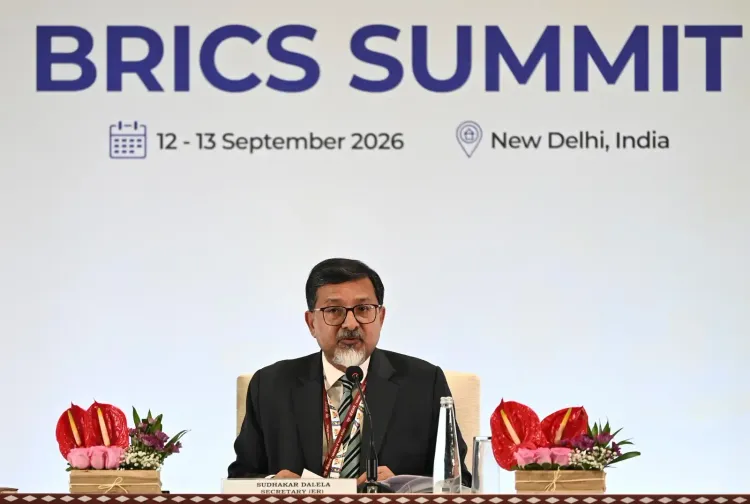
The Ministry of External Affairs (MEA) on Saturday, 12 September categorically stated that there is no proposal for a BRICS currency 'as of now,' even as discussions on trade settlement in local currencies have been underway for some time. The clarification came during a press briefing at the conclusion of the BRICS Summit held under India's chairmanship in New Delhi.
What the MEA Said on BRICS Currency
Sudhakar Dalela, Secretary (Economic Relations) at the MEA, told reporters: 'There is no proposal in the BRICS for a BRICS currency as of now.' He added that local currency settlement is viewed as a 'practical mechanism to reduce transaction costs in bilateral trade' and is being encouraged as complementary — not alternative — to the existing global payment and settlement system.
The distinction is significant. Amid persistent speculation, particularly from Western commentators, about BRICS launching a rival reserve currency, India's position reaffirms its preference for incremental reform over disruption of the dollar-anchored order. Notably, this is not the first time New Delhi has distanced itself from the idea — a similar line was taken ahead of the 2023 Johannesburg Summit.
Key Outcomes of India's BRICS Chairmanship
Dalela outlined several deliverables from what he described as a 'whole-of-nation effort.' Over 350 meetings were held across more than 30 Indian cities during India's year as BRICS chair. He highlighted 150 practical outcomes spanning four pillars, including:
A new BRICS MSME cooperation portal, frameworks for cooperation on global value chains and logistics, collaboration on Digital Public Infrastructure (DPI), a science and research repository, and joint work on startups. Strengthening food and health security and a fresh focus on mental health cooperation were also flagged as important highlights.
New Delhi Declaration Takes Aim at Unilateral Tariffs
The BRICS bloc on Saturday unanimously adopted the New Delhi Declaration, which voiced 'serious concern' over the rise of unilateral tariffs and non-tariff measures that distort trade and are inconsistent with World Trade Organisation (WTO) rules. The grouping reaffirmed its 'unwavering support' for WTO reform and for a 'non-discriminatory, open, equitable, transparent, fair, inclusive, predictable and rules-based multilateral trading system.'
In a nod to Global South aspirations, the declaration strongly supports Ethiopia and Iran's bids for WTO accession. It also acknowledges China's decision to extend zero-tariff treatment to 53 African countries with which it maintains diplomatic ties. This comes amid rising trade tensions globally, with several major economies deploying tariff measures outside multilateral frameworks.
India's Push for Deeper BRICS Trade Ties
Union Commerce and Industry Minister Piyush Goyal on Friday called on BRICS member and partner countries to deepen economic cooperation by opening markets, simplifying regulatory procedures, linking payment systems, and promoting trade in local currencies. His remarks align with India's broader strategy of using BRICS as a platform for South-South economic integration — without upending the existing financial architecture.
With the Summit now concluded, attention will shift to whether the 150 practical outcomes translate into measurable progress on trade facilitation, DPI interoperability, and MSME linkages across member states. The next BRICS chair will inherit both the momentum and the scrutiny.
Point of View
Which is aimed squarely at the US and EU without naming them. Yet the contradiction is glaring: BRICS champions WTO rules while its own largest member, China, routinely faces WTO disputes. India is threading a needle — leveraging BRICS for South-South credibility without ceding ground to Beijing's trade vision.
NationPress
28 Oct 2026
Frequently Asked Questions
Is BRICS planning to launch its own currency?
No. MEA Secretary Sudhakar Dalela confirmed on 12 September that there is no proposal for a BRICS currency 'as of now.' Discussions have focused on local currency trade settlement, not a common reserve currency.
What is the New Delhi Declaration adopted at the BRICS Summit?
The New Delhi Declaration is a joint statement unanimously adopted by BRICS members expressing serious concern over unilateral tariffs and non-tariff measures inconsistent with WTO rules. It reaffirms support for WTO reform and backs Ethiopia and Iran's WTO accession bids.
What were the key outcomes of India's BRICS chairmanship?
India's chairmanship produced 150 practical outcomes across four pillars, including a BRICS MSME cooperation portal, frameworks for global value chains and logistics, Digital Public Infrastructure collaboration, and initiatives on food, health, and mental health security.
Why is BRICS promoting local currency trade settlement?
Local currency settlement is seen as a practical mechanism to reduce transaction costs in bilateral trade. India views it as complementary to the existing global payment system, not a rival — aimed at improving overall trade efficiency across nations.
What did Commerce Minister Piyush Goyal say at the BRICS Summit?
Piyush Goyal called on BRICS member and partner countries to deepen economic cooperation by opening markets, simplifying regulations, linking payment systems, and promoting trade in local currencies.