White House Touts Trump Border Crackdown, Slams Biden Policies

Synopsis
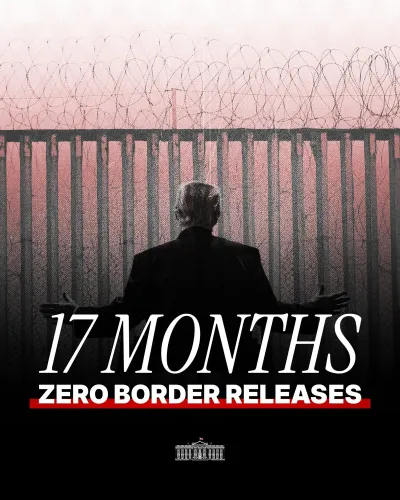
The White House posted a sharp partisan contrast on X, claiming Trump secured the US-Mexico border from Day One while blasting Biden's early-term immigration reversals as a national security danger. The message underscores immigration as a central pillar of the Trump administration's governing record.
Key Takeaways
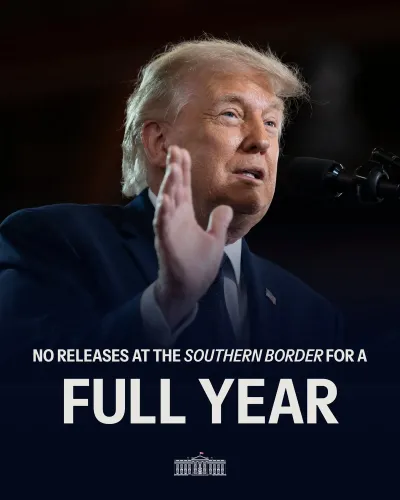
The White House posted on October 28, 2026 claiming President Trump 'locked down' the border from Day One of his return to office.
The post directly attacks Biden 's immigration policies as 'radical open border policies' that endangered national security.
Biden halted border wall construction and ended the 'Remain in Mexico' policy in January 2021 , triggering record migrant encounters in subsequent years.
Trump's first term ( 2017–2021 ) included the Migrant Protection Protocols and physical barrier expansion along the 2,000-mile US-Mexico border .
The messaging marks a rhetorical shift from campaign promise to governing record, suggesting the administration views border enforcement as a political asset.
Congressional action on border funding remains the key arena, as executive orders alone have historically not produced durable immigration reform.
The fight over America's southern border — and who owns its consequences — is back at centre stage. The White House on Wednesday, October 28, 2026, posted a pointed contrast on X, declaring that President Donald Trump 'locked down' the US-Mexico border from the first day of his return to office, while accusing the prior Biden administration of running 'radical open border policies' that endangered national security.
The 'Day One' claim and what came before it
The White House post quotes Trump directly: 'We didn't just talk about securing the border — we actually did it.' The message frames the contrast in stark, binary terms — action versus rhetoric — targeting Biden's early-term executive decisions as the root of a security failure.
That framing has a documented starting point. When President Biden took office in January 2021, he issued executive orders halting border wall construction and directing a review of Trump-era immigration enforcement mechanisms, including the Migrant Protection Protocols — the 'Remain in Mexico' policy that had required asylum seekers to wait south of the border while their cases were processed. Those reversals were followed by record-high migrant encounters at the southern border over subsequent years, a metric Republicans repeatedly cited as evidence of policy failure. Biden's administration did eventually introduce new asylum restrictions in 2024, but critics argued the course correction came too late.
Trump's border legacy and the 2025 return
During his first term (2017–2021), Trump made border security the centrepiece of his domestic agenda — pushing physical barrier construction and the Migrant Protection Protocols introduced in 2019. His return to the White House brought a renewed executive push on the same themes. The research block notes that specific Day One measures from 2025 cannot be independently verified at this date, but the administration's messaging has consistently centred on executive actions to resume enforcement and restrict asylum access.
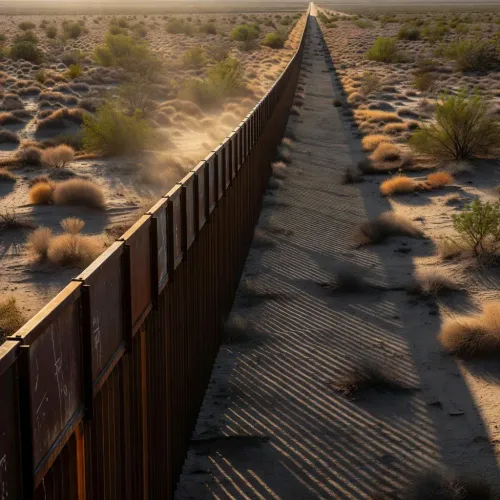
The approximately 2,000-mile US-Mexico border remains one of American politics' most combustible fault lines — a zone where debates over drug trafficking, asylum law, border community safety, and Customs and Border Protection resources converge. Neither party has resolved it legislatively; both have governed it by executive order.
Partisan framing, a familiar playbook
The White House post fits a well-worn pattern: each administration has framed the border as a national security crisis caused by its predecessor. What is notable in this October 2026 messaging is the confidence of the claim — not a promise of future action, but an assertion of accomplished fact. That rhetorical shift, from campaign pledge to governing record, signals the administration believes border enforcement is now a winning card to play heading into any upcoming political cycle.
Congressional action on border funding and asylum processing rules remains the arena to watch — executive orders can shift policy quickly, but durable change requires legislative backing that has eluded both parties for years.
The border debate has never really stopped. What changes is who gets to say they won it.
Point of View
A posture that could prove politically costly if border conditions deteriorate. The post also signals that the White House sees the Biden era not just as a policy divergence but as a liability to be kept in public memory.
NationPress
28 Oct 2026
Frequently Asked Questions
What did the White House post about Trump and the US border?
The White House posted on October 28, 2026 that President Trump 'locked down' the US-Mexico border on Day One of his return to office, contrasting this with what it called Biden's 'radical open border policies' that endangered national security.
What were Biden's border policies that Trump criticised?
In January 2021, President Biden issued executive orders halting border wall construction and ending the Migrant Protection Protocols (Remain in Mexico policy), which the Trump administration argued led to record migrant encounters and weakened border security.
What is the Migrant Protection Protocols or 'Remain in Mexico' policy?
Introduced in 2019 during Trump's first term, the Migrant Protection Protocols required many asylum seekers to wait in Mexico while their US immigration cases were processed, reducing incentives for irregular crossings. Biden ended the policy in 2021; it became a flashpoint in the border debate.
How long is the US-Mexico border?
The US-Mexico border stretches approximately 2,000 miles and has been central to American debates over immigration enforcement, drug trafficking, and asylum processing across multiple administrations.
What happens next on US border policy?
Congressional action on border funding and asylum processing rules remains the key battleground. Executive orders have shifted policy rapidly under both Trump and Biden, but lasting reform has so far required legislative backing that has eluded both parties.