Balochi, Brahui radio cuts under Pakistan's 2026 policy spark student outrage
Synopsis
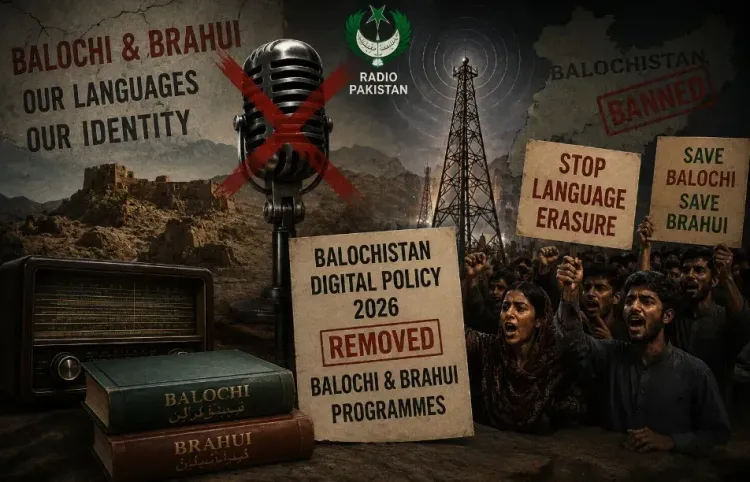
Pakistan's Balochistan Digital Policy 2026 has quietly axed Balochi and Brahui language programmes from Radio Pakistan — and the Baloch Students Action Committee is calling it what it is: a deliberate campaign to erase the linguistic identity of the Baloch people. With the Balochi Academy facing funding cuts and university language departments already under threat, critics say the policy is the latest move in what they describe as an undeclared war on indigenous languages.
Key Takeaways
The Balochistan Digital Policy 2026 has removed Balochi and Brahui language programmes from Radio Pakistan .
The Baloch Students Action Committee (BSAC) condemned the move on 14 May , calling it 'extreme cunning and malice.' Annual funding for the Balochi Academy is reportedly being cut alongside the radio programme removals.
The BSAC alleged that authorities attempted last year to abolish Balochi , Brahui , and Pashto language departments at the University of Balochistan .
The student body demanded the immediate review and withdrawal of all decisions it characterised as targeting indigenous languages.
The Baloch Students Action Committee (BSAC) on 14 May strongly condemned Pakistan's decision to remove Balochi and Brahui language programmes from national radio broadcasts, describing the move as part of a systematic effort to erase the linguistic identity of the Baloch people. The cuts are being implemented under the Balochistan Digital Policy 2026, alongside reported reductions to the annual funding of the Balochi Academy.
What the Policy Removes
According to the BSAC, the Balochistan Digital Policy 2026 has led to the termination of Balochi and Brahui language programmes on Radio Pakistan — one of the last institutional platforms where these languages had a formal presence. The student body also flagged concurrent cuts to the Balochi Academy, which it described as the primary institution working for the preservation and development of the mother tongue.
The organisation alleged that these decisions compound an already precarious situation: both Balochi and Brahui are, according to the committee, already facing the threat of extinction, with no meaningful government programme in place for their promotion or preservation.
A Pattern of Institutional Erosion, BSAC Argues
The student body pointed to a broader pattern of what it characterised as deliberate institutional dismantling. It claimed that last year, Pakistani authorities moved to abolish the departments of Balochi, Brahui, and Pashto languages at the University of Balochistan — described by the committee as the 'ancient and major seat of learning' in the province. Authorities reportedly justified the move by citing declining student enrolment in those departments.
The BSAC rejected that justification, alleging that enrolment had been deliberately suppressed by denying the departments adequate facilities and resources. 'These departments were intentionally denied the facilities needed for students to enrol and study,' the committee stated.
What the Student Body Said
In a sharply worded statement, the BSAC argued that language forms the bedrock of national identity and that its erasure amounts to the erasure of a people. 'Across the world, states provide education in mother tongues and create literature for their advancement so that a vast reservoir of knowledge exists in mother tongues. Yet in Balochistan, instead of developing mother tongues, the government is bent on eliminating them,' the committee said.
The organisation described the policy as being 'implemented with extreme cunning and malice' and demanded that all decisions it characterised as being 'rooted in malice against languages' be immediately reviewed and withdrawn. It also drew a contradiction in government messaging, noting that authorities simultaneously claim to be improving school functionality and literacy rates while imposing what the BSAC called 'restrictions and barriers' on Balochi and Brahui.
Broader Context
The controversy over linguistic rights in Balochistan is not new. Critics and civil society groups have for years raised concerns about the marginalisation of indigenous languages in the province. This is the latest in a series of flashpoints that include debates over medium of instruction in schools and the allocation of public funds to cultural institutions. Notably, the BSAC characterised the current measures as an 'undeclared ban' on mother tongues that has long been in effect, now being formalised through policy.
The Pakistani government has not publicly responded to the BSAC's specific allegations regarding the radio programme cuts or the funding reductions to the Balochi Academy, according to available reports. How authorities respond to mounting pressure from student groups and cultural organisations will be closely watched in the weeks ahead.
Point of View
But the cumulative picture — university department closures, Balochi Academy funding cuts, and now broadcast terminations — points to a structural squeeze on indigenous language infrastructure. What makes this particularly significant is the framing: Pakistani authorities have not articulated a cultural rationale, relying instead on bureaucratic justifications like enrolment data. When a state cannot defend a cultural policy on cultural grounds, it usually signals that the policy is not, in fact, about culture. The BSAC's charge of 'deliberate conspiracy' may be contested, but the pattern it describes deserves independent scrutiny.
NationPress
24 Sept 2026
Frequently Asked Questions
What is the Balochistan Digital Policy 2026 and what does it change?
The Balochistan Digital Policy 2026 is a Pakistani government policy that has, among other measures, led to the removal of Balochi and Brahui language programmes from Radio Pakistan. Critics, including the Baloch Students Action Committee, say the policy is being used to systematically reduce institutional support for indigenous languages in the province.
Why is the BSAC condemning Pakistan's language policy?
The Baloch Students Action Committee argues that the radio programme cuts, combined with funding reductions to the Balochi Academy and earlier attempts to shut language departments at the University of Balochistan, amount to a coordinated effort to erase Baloch linguistic identity. The committee describes the measures as 'extreme cunning and malice' and has demanded their immediate reversal.
Are Balochi and Brahui languages at risk of extinction?
According to the BSAC, both Balochi and Brahui are already facing the threat of extinction, with insufficient government support for their preservation or promotion. Independent linguistic assessments of the two languages' vitality were not available in official sources cited in the statement.
What happened to language departments at the University of Balochistan?
The BSAC alleged that Pakistani authorities moved last year to abolish the Balochi, Brahui, and Pashto language departments at the University of Balochistan, citing declining student enrolment. The student body rejected this justification, claiming that enrolment had been deliberately suppressed by denying the departments adequate resources.
What has the Pakistani government said in response?
According to available reports, the Pakistani government has not publicly responded to the BSAC's specific allegations regarding the radio programme terminations or the Balochi Academy funding cuts. Authorities had previously cited declining enrolment figures to justify changes to university language departments.