Pakistan-US drone deal: Powerus MoU raises regional security alarm
Synopsis
Pakistan's Army quietly signed a drone MoU with US firm Powerus on 16 September, reportedly gaining access to Ukraine-linked UAV technology — a move that has unsettled regional security calculations even as Washington officially maintains a hold on fresh weapons supplies to Islamabad. With Pakistan's record on terror proxies under scrutiny, the deal is anything but routine.
Key Takeaways
The Pakistani Army signed an MoU with US drone firm Powerus on 16 September 2026 , reportedly including an initial UAV order.
Field Marshal Asim Munir represented Pakistan; Brett Velicovich , co-founder of Powerus, confirmed the initial drone-related order.
The deal reportedly grants Pakistan access to Ukraine-linked drone technology , raising regional security alarms.
Pakistan separately signed an MoU with SC Financial Technologies , an affiliate of World Liberty Financial (WLFI) , the Trump family's crypto business, earlier in 2026.
The US has ceased direct weapons supplies to Pakistan but continues F-16 modernisation packages ; the Powerus deal is seen as expanding this arrangement further.
Security analysts have linked Pakistan's military and ISI to proxy use of groups including Lashkar-e-Taiba (LeT) and the Resistance Front (TRF) .
The Pakistani Army signed a Memorandum of Understanding (MoU) with US drone firm Powerus on 16 September 2026, granting Islamabad reportedly access to Ukraine-linked drone technology — a development that has triggered serious concerns among regional security analysts and neighbouring countries. The deal marks a notable signal of revival in US-Pakistan defence cooperation, even as Washington has officially ceased direct weapons supplies to Islamabad.
Key Details of the Powerus Agreement
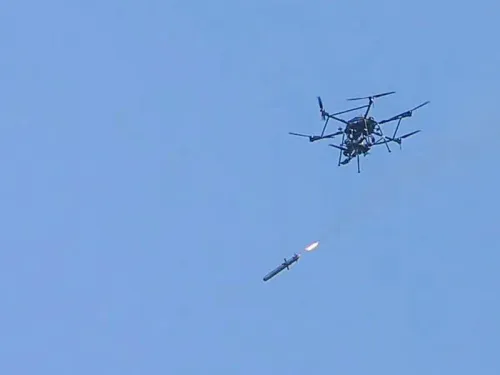
The MoU was signed with Field Marshal Asim Munir representing the Pakistani side, according to reports. Brett Velicovich, co-founder of Powerus, confirmed that the agreement includes an initial order for unmanned aerial vehicles (UAVs). The deal was first reported by PJ Media, citing Velicovich directly.
Notably, this is not Pakistan's only recent agreement with US-linked financial and technology interests. According to PJ Media, Pakistan also signed a separate MoU earlier this year with SC Financial Technologies, an affiliate of World Liberty Financial (WLFI) — the primary crypto business associated with the Trump family.
Why the Deal Has Raised Alarm
Although the United States has halted fresh weapons deliveries to Pakistan, it has continued to approve modernisation packages for previously delivered F-16 fighter jets. The Powerus MoU, analysts argue, expands that grey zone further by potentially broadening Pakistan's autonomous drone capability.
The concern is compounded by Pakistan's record on counter-terrorism. Multiple international intelligence and security experts have, over the years, held Pakistan's military establishment and its Inter-Services Intelligence (ISI) accountable for allegedly using regional terror groups as geopolitical proxies. Proscribed organisations such as Lashkar-e-Taiba (LeT) and its reported splinter group, the Resistance Front (TRF), have been found operating from Pakistani soil, according to security assessments.
The deadly attack in Pahalgam, Jammu and Kashmir — which deliberately targeted civilians on religious lines, according to investigators — has further sharpened scrutiny of Islamabad's internal security posture.
Geopolitical Backdrop
The drone deal comes roughly a year after Pakistani Prime Minister Shehbaz Sharif called, at the Arab-Islamic Summit in Qatar, for the 'creation of an Arab Islamic task force to adopt effective measures toward Israeli expansionist designs' — remarks that underscored Islamabad's positioning within a complex and shifting regional diplomatic landscape.
This context has made regional players especially watchful. For decades, critics argue, Pakistan has remained a difficult security partner — its military leveraging certain militant networks for strategic purposes while seeking advanced military hardware from the West.
What Comes Next
The Powerus deal has yet to attract an official response from New Delhi or Washington. Security analysts tracking South Asian stability are monitoring whether the initial UAV order will be followed by larger tranches, and whether the US government formally sanctions the arrangement or treats it as a private commercial transaction. The outcome could shape how other regional actors — particularly India — recalibrate their own drone and counter-drone procurement strategies in the months ahead.
Point of View
While Washington maintains plausible deniability on state-to-state arms transfers. That distinction may satisfy diplomatic optics but does little to address the underlying security calculus for India and other regional actors. The parallel WLFI crypto MoU suggests Islamabad is actively cultivating multiple channels into the US political and commercial ecosystem — a pattern worth watching. Given Pakistan's documented history with proxy militant networks, the combination of advanced UAV capability and a persistently permissive internal security environment is precisely what makes this deal more than a routine commercial transaction.
NationPress
4 Oct 2026
Frequently Asked Questions
What is the Powerus drone deal signed by Pakistan?
It is a Memorandum of Understanding signed between the Pakistani Army and US drone firm Powerus on 16 September 2026, which reportedly includes an initial order for unmanned aerial vehicles and grants Islamabad access to Ukraine-linked drone technology. Powerus co-founder Brett Velicovich confirmed the deal.
Why has the Pakistan-Powerus drone MoU raised regional security concerns?
Security analysts are concerned because the deal potentially expands Pakistan's autonomous drone capability at a time when multiple international experts hold Pakistan's military establishment and ISI responsible for using terror groups as geopolitical proxies. Groups such as Lashkar-e-Taiba and the Resistance Front have been found operating from Pakistani soil.
Has the United States officially stopped supplying weapons to Pakistan?
Washington has ceased fresh weapons deliveries to Pakistan, but has continued approving modernisation packages for previously supplied F-16 fighter jets. The Powerus deal, a private commercial transaction, is seen as expanding this grey zone further.
Who signed the MoU on behalf of Pakistan?
Field Marshal Asim Munir represented the Pakistani Army at the signing of the MoU with Powerus on 16 September 2026.
What other US-linked agreement has Pakistan signed recently?
According to reports, Pakistan also signed a separate MoU with SC Financial Technologies, an affiliate of World Liberty Financial (WLFI) — the Trump family's main crypto business — earlier in 2026, indicating Islamabad is broadening its engagement with US commercial and political networks.