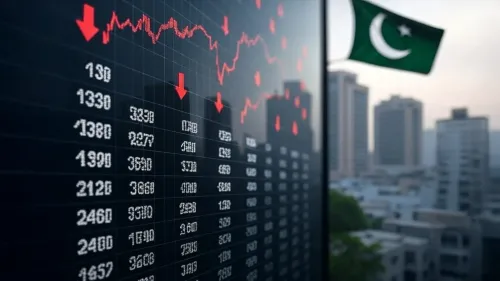
Pakistan equities see $736 million foreign outflow in FY26 amid index downgrade
Synopsis
Pakistan's stock market surged 40 per cent in FY26 — yet foreign investors still pulled out a net $736 million. The disconnect exposes a structural trap: index downgrades by MSCI and FTSE Russell have mechanically locked Pakistan out of global passive portfolios, and West Asia tensions are keeping active managers away too. Domestic buying is holding the KSE-100 up, but it cannot substitute for the depth that foreign capital provides.
Key Takeaways
Foreign investors withdrew a net $736 million from Pakistan's equity market in FY26 , according to State Bank of Pakistan data.
Gross purchases stood at $298.3 million against gross sales of $1.03 billion .
Investors from the US , UK , and Sweden accounted for nearly 80 per cent of total outflows.
Pakistan was downgraded from emerging to frontier market by MSCI in 2021 and FTSE Russell in 2024 , mechanically reducing its index weightage.
The KSE-100 index still surged roughly 40 per cent year-to-date, driven by domestic buying despite foreign exits.
FY26 could be the second straight fiscal year of net foreign outflows from Pakistan equities.
Foreign investors pulled a net $736 million out of Pakistan's equity market in FY26, driven by the country's demotion in global benchmark indices and heightened geopolitical risk stemming from the West Asia conflict, according to data cited from the State Bank of Pakistan (SBP). The scale of the exodus underscores a deepening structural challenge for Islamabad even as its domestic bourse posted one of its strongest performances in years.
Scale of the Outflows
According to the report, foreign investors purchased equities worth $298.3 million during the fiscal year but offloaded shares worth $1.03 billion, producing the net outflow figure of $736 million. Investors from the United States, the United Kingdom, and Sweden accounted for nearly 80 per cent of total outflows, indicating that the selling was concentrated among Western institutional portfolios rather than broadly distributed.
Index Downgrades: The Structural Driver
Pakistan was reclassified from secondary emerging market status to frontier market by MSCI in 2021 and by FTSE Russell in 2024. The twin downgrades reduced the country's weightage in widely tracked benchmark indices, mechanically forcing foreign portfolio managers to rebalance — and, in many cases, exit — their holdings. This is a well-documented transmission mechanism: index reclassification triggers passive fund outflows that can persist for multiple fiscal years after the downgrade event itself.
Geopolitical Risk Compounds the Pressure
Beyond the index effect, escalating tensions linked to the Iran conflict in West Asia stoked broader risk aversion among global fund managers, who reduced exposure to frontier and emerging regional markets. Separately, rising frictions with Afghanistan and climbing global oil prices weighed on sentiment from February onwards, according to the report. The combination of index-driven selling and geopolitical caution proved difficult for inflows to offset.
The Paradox: A Surging KSE-100
The outflows occurred against a striking backdrop: the Pakistan Stock Exchange (PSX) benchmark KSE-100 index surged approximately 40 per cent during the fiscal year to date. Pakistan's Economic Survey 2025-26 attributed the rally to improving macroeconomic fundamentals — lower inflation, a strengthened external account position, and rising confidence in the government's reform agenda. The divergence between a buoyant domestic index and persistent foreign selling illustrates how retail and domestic institutional buying can sustain equity prices even as foreign capital retreats.
What This Means Going Forward
The report noted that FY26 could mark the second consecutive fiscal year in which foreign investors withdrew more capital from Pakistan's stock market than they injected — a trend that, if sustained, risks undermining the macroeconomic narrative Islamabad has been building around its reform programme. A re-rating back to emerging market status by either MSCI or FTSE Russell would be the most direct catalyst for reversing structural outflows, but no such reclassification is imminent. Until then, Pakistan's equity market faces the unusual challenge of sustaining domestic momentum while remaining structurally underweighted in global portfolios.
Point of View
But the more important number is the streak: two consecutive fiscal years of net foreign selling suggests this is structural, not cyclical. Pakistan's index downgrades by MSCI and FTSE Russell have removed it from the automatic allocation universe of trillions in passive capital — a hole that no amount of domestic reform narrative can fill until a re-rating occurs. The KSE-100's 40 per cent rally, while real, is a domestic retail and institutional story; it masks the fact that Pakistan's integration into global capital markets is actually moving backwards. Islamabad needs a credible reclassification roadmap, not just better macroeconomic headlines.
NationPress
20 Sept 2026
Frequently Asked Questions
Why did foreign investors pull money out of Pakistan's stock market in FY26?
Foreign investors withdrew a net $736 million from Pakistan's equity market in FY26 due to two main factors: the country's reclassification from emerging to frontier market status by MSCI in 2021 and FTSE Russell in 2024, which reduced its weight in global indices, and heightened geopolitical risk from the West Asia conflict that drove broader risk aversion. These two forces together prompted foreign portfolio managers to reduce or exit their Pakistan holdings.
How much did foreign investors buy and sell in Pakistan equities in FY26?
According to State Bank of Pakistan data, foreign investors purchased equities worth $298.3 million during FY26 but sold shares worth $1.03 billion, resulting in net outflows of $736 million.
Which countries accounted for most of the foreign selling in Pakistan?
Investors from the United States, the United Kingdom, and Sweden collectively accounted for nearly 80 per cent of total foreign outflows from Pakistan's equity market in FY26.
How did the KSE-100 perform despite the foreign outflows?
The Pakistan Stock Exchange benchmark KSE-100 index surged approximately 40 per cent during FY26 to date, driven by domestic buying and improving macroeconomic indicators such as lower inflation and a stronger external account. However, this rally occurred even as foreign investors were net sellers throughout the year.
Could FY26 be the second consecutive year of net foreign outflows from Pakistan equities?
Yes, according to the report, FY26 is on course to become the second straight fiscal year in which foreign investors withdrew more capital from Pakistan's stock market than they invested — a trend that raises concerns about the sustainability of the domestic-driven market rally.