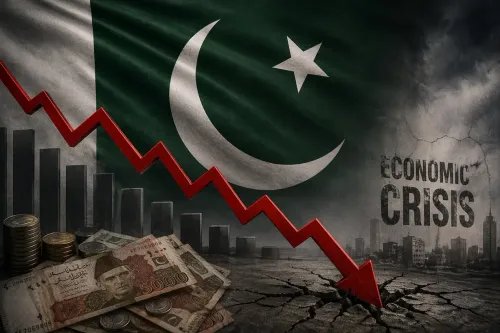
Pakistan forex crisis deepens: $4.8bn debt pressure, FDI down 33%
Synopsis
Pakistan's foreign exchange crisis is no longer just a balance-of-payments problem — it is a structural confidence collapse. With FDI down 33%, multinationals from P&G to Shell exiting, public debt at $138 billion, and growth averaging just 1.7% over three years, the data points to an economy caught in a debt-dependency trap with few near-term exits.
Key Takeaways
Pakistan faces pressure to repay roughly $4.8 billion in external debt amid a deepening forex crisis.
FDI fell 33 per cent in FY26 to $1.195 billion , below 0.45 per cent of GDP.
Multinationals including Procter & Gamble , Shell , Telenor , Uber , and Yamaha have exited or scaled down operations.
Unemployment rose from 6.3 per cent to 6.9 per cent between 2020–21 and 2024–25 , with women and youth most affected.
Public debt reached Rs 80.52 lakh crore ; external debt and liabilities stood at $138 billion by end of FY25 .
Economic growth averaged just 1.7 per cent over the last three years; government debt equals roughly 70 per cent of GDP .
Pakistan is grappling with a worsening foreign exchange crisis, driven by pressure to repay roughly $4.8 billion in external debt, a sharp decline in foreign direct investment, and eroding investor confidence, according to a report in the Times of Oman. The crisis reflects structural vulnerabilities that analysts say have compounded over several years.
FDI Collapse and Multinational Exodus
Foreign direct investment in Pakistan plummeted by 33 per cent in FY26, falling to $1.195 billion from $1.92 billion in 2023–24 and $1.83 billion in 2024–25. As a share of GDP, FDI remained below 0.45 per cent — a level that economists consider insufficient for a developing economy of Pakistan's size.
The declining confidence is also reflected in a wave of multinational exits. Procter & Gamble has decided to shut down manufacturing operations in the country. Shell, Telenor, Uber, Yamaha, and Eni, along with several foreign banks and pharmaceutical companies, have either scaled down or ceased operations entirely. Various policy measures announced by the government to revive investor sentiment have reportedly failed to produce results.
Unemployment Rising, Youth and Women Hit Hardest
Labour force survey data cited in the report shows Pakistan's unemployment rate climbed from 6.3 per cent in 2020–21 to 6.9 per cent in 2024–25. Women and youth bore the heaviest burden of this deterioration, according to the data.
Debt Burden and Fiscal Strain
Pakistan's public debt surged to Rs 80.52 lakh crore by the end of FY25, while external debt and liabilities stood at $138 billion. The report noted that economic growth over the last three years averaged approximately 1.7 per cent, government debt equalled roughly 70 per cent of GDP, and gross financing needs were among the highest globally.
This comes amid Pakistan's heavy fiscal exposure to West Asian economic conditions. The country spends approximately 4 per cent of GDP annually on fuel and fertiliser imports from the Gulf region. The dependence on fuel, food supplies, and remittances from West Asia has placed the economy under significant strain, with Islamabad reportedly ordering austerity measures including school closures and a reduced working week to manage the ongoing oil crisis.
Structural Vulnerabilities and the Road Ahead
Notably, the combination of high debt servicing obligations, shrinking FDI, rising unemployment, and Gulf-linked exposure represents a convergence of pressures that Pakistan's policymakers have struggled to address simultaneously. Critics argue that without meaningful structural reforms and restored investor confidence, recurring debt rollovers will remain Pakistan's primary economic strategy. The next few months — and the outcome of any ongoing engagement with international creditors — will be closely watched as indicators of whether the crisis stabilises or deepens further.
Point of View
Not cyclical — and that distinction matters. A cyclical crisis responds to IMF tranches and rate adjustments; a structural one requires the kind of institutional reform and investor trust that takes years to rebuild. The multinational exodus is the clearest signal: companies do not exit markets temporarily. With FDI below 0.45% of GDP and growth averaging 1.7% over three years, Pakistan is in a low-equilibrium trap where debt servicing crowds out investment, which in turn suppresses growth, which in turn worsens debt ratios. Austerity measures like school closures and reduced work weeks address symptoms, not causes. Until Islamabad can credibly signal policy stability and rule-of-law improvements, the capital flight will continue — and each departing multinational makes the next one marginally easier to justify.
NationPress
26 Sept 2026
Frequently Asked Questions
What is driving Pakistan's foreign exchange crisis?
Pakistan's forex crisis is driven by pressure to repay roughly $4.8 billion in external debt, a 33 per cent decline in FDI in FY26, and weak investor confidence following the exit of multiple multinational companies. The country's heavy dependence on Gulf fuel and remittances adds further vulnerability.
How much has FDI fallen in Pakistan?
Foreign direct investment in Pakistan dropped 33 per cent in FY26 to $1.195 billion, down from $1.92 billion in 2023–24 and $1.83 billion in 2024–25. As a share of GDP, FDI remained below 0.45 per cent.
Which multinational companies have exited Pakistan?
Procter & Gamble has shut down manufacturing operations in Pakistan. Shell, Telenor, Uber, Yamaha, and Eni, along with several foreign banks and pharmaceutical firms, have also scaled down or ceased operations, according to the Times of Oman report.
What is Pakistan's total external debt?
Pakistan's external debt and liabilities stood at $138 billion, while public debt surged to Rs 80.52 lakh crore by the end of FY25. Government debt equals roughly 70 per cent of GDP, with gross financing needs among the highest in the world.
How has unemployment changed in Pakistan?
Pakistan's unemployment rate rose from 6.3 per cent in 2020–21 to 6.9 per cent in 2024–25, according to labour force survey data. Women and youth experienced the sharpest impact of this deterioration.