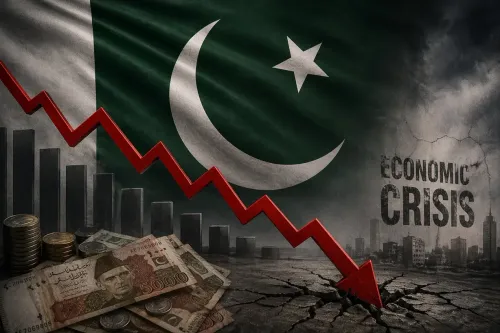
Pakistan investment-to-GDP ratio hits record low 13.1% in 2024
Synopsis
Pakistan's investment-to-GDP ratio has hit a record low of 13.1% in 2024 — down from an 18% four-decade average — as FDI halves, growth stalls at 2.7%, poverty climbs to 45% by the World Bank's lower-middle-income benchmark, and interest payments swallow nearly 70% of federal revenues. The numbers suggest a structural unravelling, not a cyclical dip.
Key Takeaways
Pakistan's investment-to-GDP ratio fell to a record low of 13.1 per cent in 2024 , down from a four-decade average of roughly 18 per cent .
FDI has halved from approximately 1 per cent to 0.5 per cent of GDP between 2018 and 2024 .
Up to 80 per cent of companies reportedly delayed or revised investment decisions due to economic uncertainty.
Average economic growth has slowed to 2.7 per cent since 2019, compared with 5.5 per cent during 2003–2018.
Pakistan's poverty rate has risen to 25.3 per cent ; nearly 45 per cent fall below the World Bank's lower-middle-income threshold.
Public debt has surged from ₨29.9 trillion to ₨95.5 trillion since 2018, with interest payments consuming nearly 70 per cent of net federal revenues.
Pakistan's investment-to-GDP ratio has plunged to a historic low of 13.1 per cent in 2024, down sharply from an average of roughly 18 per cent sustained over nearly four decades, while foreign direct investment (FDI) has halved to just 0.5 per cent of GDP, according to an analysis published in Dawn. The figures lay bare a widening gap between Pakistan's stated growth ambitions and the ground reality of its investment climate.
The Decline in Numbers
Pakistan's investment-to-GDP ratio stood at 17.2 per cent in 2018 before sliding to 15.5 per cent in 2019, coinciding with the launch of an International Monetary Fund (IMF)-backed stabilisation programme. It has continued to deteriorate since, reaching the record trough of 13.1 per cent in 2024. Over the same period, FDI contracted from approximately 1 per cent to 0.5 per cent of GDP — a halving in six years.
What Is Driving Investors Away
The analysis points to a combination of policy uncertainty, high real interest rates, and a contractionary taxation regime as the primary deterrents to long-term capital commitment. These structural headwinds persist even as the government publicly targets annual economic growth of 6–7 per cent under its economic transformation plans.
Notably, up to 80 per cent of companies have reportedly delayed or revised investment decisions due to rising economic uncertainty, according to the report. The analysis warns that inconsistent policies tend to foster speculative activity while eroding investors' risk appetite — the opposite of what a capital-starved economy needs.
Growth and Poverty: The Human Cost
Pakistan's average economic growth has remained at just 2.7 per cent since 2019, compared with an average of 5.5 per cent during the 2003–2018 period — a near-halving of the growth rate. The consequences for ordinary citizens are stark.
World Bank estimates cited in the analysis show Pakistan's poverty rate has climbed to approximately 25.3 per cent, reversing a decline to 21.9 per cent in 2018. Measured against the World Bank's lower-middle-income poverty benchmark, nearly 45 per cent of Pakistan's population now falls below the poverty threshold.
Debt Burden Deepens the Crisis
Pakistan's public debt has surged from ₨29.9 trillion (Pakistani rupees) in 2018 to ₨95.5 trillion in the latest period — a more than three-fold increase. Critically, interest payments now consume almost 70 per cent of the federal government's net revenues, leaving little fiscal space for growth-enabling expenditure such as infrastructure, education, or social protection.
What Needs to Change
The Dawn analysis underscores that businesses require a predictable policy framework to commit capital over the long term. Without structural reforms that reduce real interest rates, rationalise taxation, and establish consistent regulatory signals, analysts warn that Pakistan's investment ratio is unlikely to recover meaningfully. This comes amid broader concerns about the country's ability to meet its IMF programme targets while simultaneously reviving private-sector confidence.
Point of View
And economies that cannot generate jobs cannot reduce poverty. Pakistan's debt-service burden consuming 70% of net revenues means the government is essentially running on a treadmill: borrowing to pay interest, with little left to invest in the conditions that would attract private capital. The 6–7% growth target the government cites is not credible against this backdrop — it is a political aspiration disconnected from the investment arithmetic. The deeper risk is that without a decisive break from policy inconsistency and punishing real interest rates, Pakistan's investment drought becomes self-reinforcing.
NationPress
28 Sept 2026
Frequently Asked Questions
What is Pakistan's investment-to-GDP ratio in 2024?
Pakistan's investment-to-GDP ratio fell to a record low of 13.1 per cent in 2024, down from an average of roughly 18 per cent over nearly four decades. The decline accelerated after the launch of an IMF-backed stabilisation programme in 2019, when the ratio stood at 15.5 per cent.
Why has investment fallen so sharply in Pakistan?
According to the Dawn analysis, policy uncertainty, high real interest rates, and a contractionary taxation regime have discouraged long-term investment. Up to 80 per cent of companies reportedly delayed or revised investment decisions due to rising economic uncertainty, favouring speculative activity over productive capital deployment.
How has Pakistan's poverty rate changed?
Pakistan's poverty rate has risen to approximately 25.3 per cent, reversing a decline to 21.9 per cent in 2018, according to World Bank estimates cited in the report. Measured against the World Bank's lower-middle-income poverty benchmark, nearly 45 per cent of Pakistan's population now falls below the poverty threshold.
What is Pakistan's current public debt situation?
Pakistan's public debt has surged from ₨29.9 trillion in 2018 to ₨95.5 trillion, with interest payments now accounting for nearly 70 per cent of the federal government's net revenues. This leaves minimal fiscal space for growth-enabling public expenditure.
How does Pakistan's recent growth compare with its historical average?
Pakistan's average economic growth has been 2.7 per cent since 2019, compared with an average of 5.5 per cent during the 2003–2018 period — roughly half the earlier rate. This slowdown coincides with the drop in investment and the onset of the IMF stabilisation programme.