CM Fadnavis pitches Maharashtra as India's $1 trillion economy
Synopsis
Chief Minister Devendra Fadnavis used Mumbai's Independence Day reception to unveil Maharashtra's $1 trillion economy ambition by 2029-30, detailing plans for a 'third' and 'fourth Mumbai', Wadhavan Port, GCC clusters and new industrial hubs across the state.
Key Takeaways
CM Devendra Fadnavis pledged Maharashtra will become India's first sub-national entity to reach a $1 trillion economy by 2029-30 .
He projected Maharashtra's economy will surpass those of Singapore and the UAE within two years .
A 'third Mumbai' is being built around the Navi Mumbai International Airport , featuring EduCity, MediCity, Innovation City, Sports City and GCC City zones.
A 'fourth Mumbai' is planned along the Wadhavan Port-to-Virar corridor in Palghar district , with a third airport in development.
Mumbai and Navi Mumbai are emerging as major data centre hubs, while GCC ecosystems expand across Mumbai and Pune.
New industrial clusters are being developed in Chhatrapati Sambhajinagar, Nagpur, Gadchiroli, Nashik and Ahilyanagar , extending growth beyond the Mumbai-Pune belt.
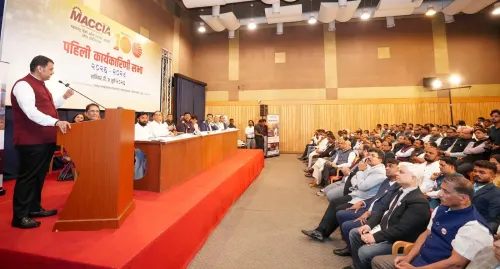
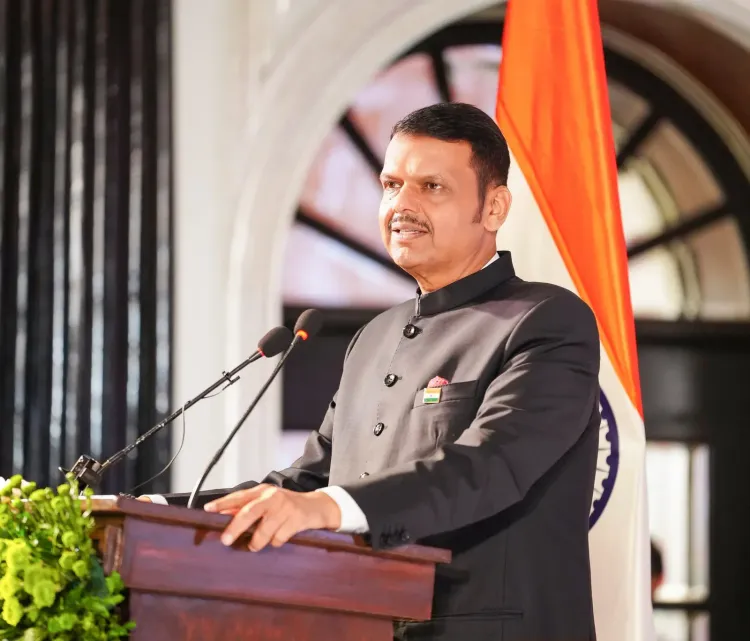
At a reception marking India's Independence Day in Mumbai, Chief Minister Devendra Fadnavis laid out the most ambitious economic roadmap Maharashtra has publicly articulated — a pledge to make the state the country's first sub-national entity to cross the $1 trillion economy mark by 2029-30. That target, and the infrastructure bets behind it, reframe Maharashtra not just as India's industrial engine but as a global economic actor in its own right.
The $1 trillion bet and what drives it
CM Fadnavis stated that within two years, Maharashtra's economy would surpass those of Singapore and the United Arab Emirates — both of which he described as partners rather than rivals, with cooperation preferred over competition. The state's pitch rests on a cluster of already-moving infrastructure plays: the Navi Mumbai International Airport, the Wadhavan Port near Palghar, and an expanding network of Global Capability Centres (GCCs) across Mumbai and Pune.
The Chief Minister positioned Mumbai as the country's financial, commercial and entertainment capital evolving into a major global investment hub, while the Mumbai-Navi Mumbai corridor is being developed as a data centre hotspot. Wadhavan Port, he noted, would significantly strengthen Maharashtra's maritime capacity.
'Third Mumbai' and 'Fourth Mumbai' take shape
Perhaps the boldest urban vision in the address: Fadnavis described a 'third Mumbai' rising around the Navi Mumbai airport zone — a planned urban ecosystem comprising an EduCity, MediCity, Innovation City, Sports City, GCC City and new business districts. A 'fourth Mumbai' is envisioned along the Wadhavan Port-to-Virar corridor in Palghar district, anchored by a proposed third airport for the Mumbai region.
These are not just planning concepts — land acquisition and development processes are already underway, the Chief Minister indicated, signalling that the state is past the blueprint stage on at least some of these projects.
Decentralisation beyond Mumbai-Pune
The address also broke from the traditional Mumbai-Pune binary. Fadnavis named Chhatrapati Sambhajinagar, Nagpur, Gadchiroli, Nashik and Ahilyanagar as emerging development centres receiving industrial cluster investment. Sectors singled out included technology, defence, aviation, compressed biogas (CBG) and clean energy — a deliberate alignment with national priorities on green transition and strategic manufacturing.
The Chief Minister credited diplomatic missions and foreign consuls general — including Poland's Consul General Tomasz Wielgomas, who was present — for channelling international investors toward Maharashtra, describing these partnerships as translating into tangible economic progress.
Maharashtra's role in India's national economic arc
Framing the address within India's broader ambition, Fadnavis noted that India is now the world's fourth-largest economy and is on course to exceed the $5 trillion mark — a target first articulated in 2019 under Prime Minister Narendra Modi. He argued that Maharashtra, as India's most industrialised state and largest GDP contributor, has a disproportionate role in pulling that national number higher.
The event was attended by Legislative Assembly Speaker Adv. Rahul Narwekar, Legislative Council Deputy Chairman Sachin Ahir, ministers including Mangalprabhat Lodha, Chhagan Bhujbal, Aditi Tatkare and Jaykumar Rawal, Mumbai Mayor Ritu Tawde, and consuls general from multiple countries.
If Wadhavan Port opens on schedule and the Navi Mumbai airport becomes operational, Maharashtra's infrastructure story will have moved from aspiration to execution — and the $1 trillion clock will start ticking in earnest.
Point of View
He reframes the state's ambition in global rather than domestic terms, a move designed to attract foreign direct investment as much as domestic political capital. The 'third' and 'fourth Mumbai' framing also signals a deliberate effort to distribute growth pressure away from an already-stressed core city, which aligns with Maharashtra's long-running challenge of managing urban congestion while sustaining industrial output. The real test of this vision will be execution timelines on Wadhavan Port and Navi Mumbai airport — two projects that have faced delays — since the $1 trillion target depends heavily on logistics and connectivity breakthroughs actually materialising before 2030.
NationPress
14 Aug 2026
Frequently Asked Questions
What is Maharashtra's $1 trillion economy target?
Chief Minister Devendra Fadnavis has set a goal for Maharashtra to become India's first sub-national entity with a $1 trillion economy by 2029-30, positioning the state as a global economic powerhouse.
What is 'third Mumbai' and where will it be?
'Third Mumbai' refers to a planned urban ecosystem being developed around the Navi Mumbai International Airport, encompassing EduCity, MediCity, Innovation City, Sports City, GCC City and new business districts.
What is the 'fourth Mumbai' project?
'Fourth Mumbai' is a development concept for the Wadhavan Port-to-Virar corridor in Palghar district, anchored by a proposed third airport for the Mumbai region.
How does Maharashtra compare to Singapore and UAE economically?
CM Fadnavis stated that within two years Maharashtra's economy will surpass those of Singapore and the UAE, describing both as partners with whom the state seeks cooperation rather than competition.
Which new cities are being developed as industrial hubs in Maharashtra?
Beyond the traditional Mumbai-Pune belt, Chhatrapati Sambhajinagar, Nagpur, Gadchiroli, Nashik and Ahilyanagar are being developed as new industrial and economic growth centres with dedicated cluster investments.