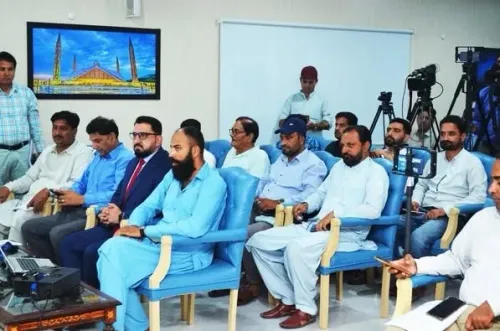
Pakistan's Foreign Media Guidelines 2026 draw global press freedom backlash

Synopsis
Pakistan's new Foreign Media Facilitation Guidelines 2026 require all foreign journalists to register with the government and seek approval before travelling outside three cities — a move condemned by the PFUJ and CPJ as a deliberate assault on press freedom, timed to suppress coverage of deadly unrest in Pakistan-occupied Kashmir.
Key Takeaways
Pakistan enforced the Foreign Media Facilitation Guidelines 2026 on 7 August 2026 , requiring foreign journalists to register with the Ministry of Information and Broadcasting .
Journalists must obtain prior government approval to travel outside Islamabad , Karachi , or Lahore for any news or content production.
The Pakistan Federal Union of Journalists (PFUJ) called the guidelines a 'direct assault on press freedom.' CPJ representative Waliullah Rahmani warned the rules risk exposing journalists to 'administrative retaliation.' The guidelines follow Pakistan's criticism of Al Jazeera 's PoK coverage and the subsequent blocking of the broadcaster's website.
Unrest in Pakistan-occupied Kashmir has reportedly claimed more than 50 lives , with the actual toll believed to be higher.
Global media rights bodies have condemned Pakistan's Foreign Media Facilitation Guidelines 2026, calling them a 'direct assault on press freedom' that threatens to further erode the country's already diminished standing in international media freedom rankings. The guidelines, enforced by Islamabad on Thursday, 7 August 2026, impose sweeping registration and travel-approval requirements on all foreign journalists operating in Pakistan.
What the Guidelines Mandate
Under the new framework, all international media organisations — spanning print, electronic, digital, and social media platforms — must register with the External Publicity Wing of Pakistan's Ministry of Information and Broadcasting. Foreign journalists are required to obtain prior government approval before travelling outside Islamabad, Karachi, or Lahore to produce any news content, documentary, video, or social media material.
Notably, even journalists visiting Abbottabad or Murree — towns near the Pakistan-occupied Kashmir (PoK) border — for leisure must secure a no-objection certificate (NOC). Authorities retain the power to suspend or revoke press accreditation for acts deemed 'against the ideology, sovereignty, security, or public order of Pakistan.'
Condemnation from Journalism Bodies
The Pakistan Federal Union of Journalists (PFUJ) warned that the guidelines will 'further reduce Pakistan's already low global media ranking.' In a statement, the union said the measures amount to 'attacking the freedom of expression and putting curbs on press freedom.'
The Committee to Protect Journalists (CPJ) called on Islamabad to withdraw the guidelines immediately. Waliullah Rahmani, CPJ's Afghanistan and Pakistan Representative, said: 'The Foreign Media Facilitation Guidelines open the door for Pakistani authorities to further restrict international media coverage, prevent journalists from reporting freely outside Pakistan's three main cities, and risk exposing them to administrative retaliation.' Rahmani described the move as 'yet another appalling blow to press freedom in Pakistan, where journalists are already facing an intense crackdown.'
Backdrop: PoK Unrest and Al Jazeera Controversy
According to the CPJ, the guidelines were introduced days after the Pakistani government criticised international reporting on elections and protests in PoK and accused broadcaster Al Jazeera of engaging in 'yellow journalism.' Access to Al Jazeera's website was subsequently restricted in Pakistan. This comes amid escalating unrest in PoK that has reportedly claimed more than 50 lives and left hundreds injured, with the actual toll believed to be significantly higher. The Pakistani military's crackdown on peaceful protesters has drawn international condemnation over human rights abuses.
Broader Demands from International Organisations
Multiple international organisations have urged Islamabad to end what they describe as escalating restrictions on freedom of expression, access to information, and human rights advocacy. Among their demands is the repeal of Section 26A of the Prevention of Electronic Crimes (Amendment) Act, 2025, which critics argue provides a legal instrument for suppressing online speech and press activity.
What Comes Next
With the guidelines now in force, foreign correspondents face immediate compliance pressure. Rights groups have indicated they will escalate the matter to international human rights forums. The situation in PoK remains volatile, and the restrictions on travel outside Pakistan's three major cities could significantly limit independent verification of events on the ground.
Point of View
' Islamabad has built a legal architecture for near-total control of foreign reporting on the region. The timing is telling: the guidelines arrived days after Al Jazeera's coverage of PoK protests drew official fury and its website was blocked. With more than 50 deaths reported and independent verification already difficult, the guidelines ensure that the international community's window into PoK narrows precisely when scrutiny should be sharpest. The demand to repeal Section 26A of the PECA Amendment Act 2025 — largely ignored in mainstream coverage — is the harder fight; without it, digital suppression will continue even if the media guidelines are rolled back.
NationPress
24 Sept 2026
Frequently Asked Questions
What are Pakistan's Foreign Media Facilitation Guidelines 2026?
The Foreign Media Facilitation Guidelines 2026 are a set of rules enforced by the Pakistani government requiring all foreign media organisations and their journalists to register with the External Publicity Wing of the Ministry of Information and Broadcasting. Journalists must also seek prior government approval before travelling outside Islamabad, Karachi, or Lahore to produce any news or media content.
Why have media bodies condemned these guidelines?
The Pakistan Federal Union of Journalists and the Committee to Protect Journalists have called the guidelines a direct assault on press freedom, arguing they restrict international media coverage, expose journalists to administrative retaliation, and will worsen Pakistan's already low global media freedom ranking.
What is the connection between these guidelines and Pakistan-occupied Kashmir?
According to the CPJ, the guidelines were introduced shortly after the Pakistani government criticised international reporting on elections and protests in PoK and accused Al Jazeera of 'yellow journalism,' after which access to Al Jazeera's website was restricted in Pakistan. Ongoing unrest in PoK has reportedly claimed more than 50 lives.
What powers do the guidelines give Pakistani authorities over foreign journalists?
Under the guidelines, Pakistani authorities can suspend or revoke a foreign journalist's press accreditation for acts deemed against the 'ideology, sovereignty, security, or public order of Pakistan.' Journalists must also obtain a no-objection certificate to visit towns near the PoK border even for leisure.
What are international organisations demanding in response?
Multiple international organisations have called on Pakistan to repeal the Foreign Media Facilitation Guidelines 2026 and to revoke Section 26A of the Prevention of Electronic Crimes (Amendment) Act, 2025, which they argue enables broader suppression of online speech and press activity.