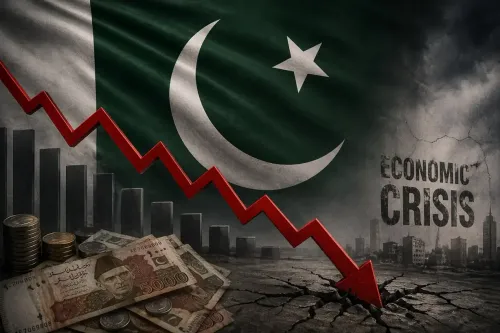
Pakistan rupee debate deepens as REER reaches 110
Synopsis
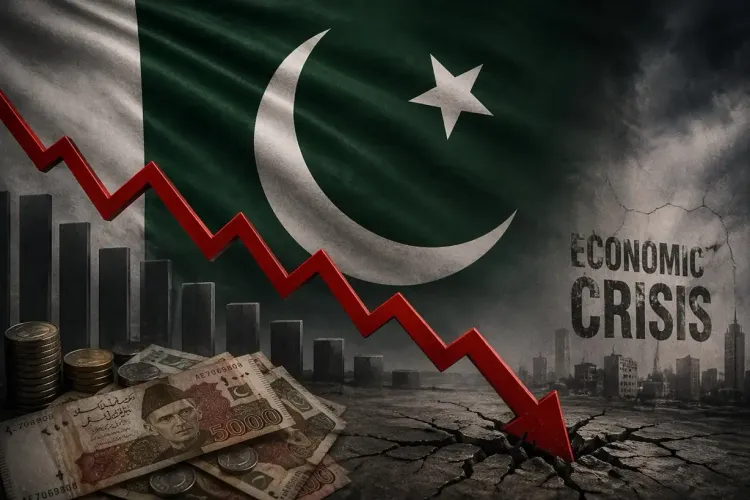
Pakistan's REER reached 110 in October, but a Dawn report argues that the currency debate may be distracting from weak productivity and industrial competitiveness. It estimates sustainable annual growth at around 4%, with roughly 2.5% stemming from population growth.
Key Takeaways
Pakistan's Real Effective Exchange Rate rose to 110 in October .
An economist quoted by Dawn said a REER reading alone does not establish whether a currency is overvalued.
The report cited a modest current account surplus and improving foreign exchange reserves among indicators of external conditions.
The report estimated sustainable annual growth at around 4% , with roughly 2.5% stemming from population growth.
The report identified weak industrial competitiveness and energy-sector inefficiencies among Pakistan's underlying challenges.
Pakistan's rupee has come under renewed scrutiny after the country's Real Effective Exchange Rate (REER) rose to 110 in October, prompting debate over whether the currency is overvalued. A report in Dawn argues that the exchange-rate discussion risks obscuring deeper weaknesses in productivity and industrial competitiveness.
Some commentators interpret the elevated index as evidence that the rupee is being artificially supported. Others caution that the REER alone cannot establish whether the currency is at an appropriate level.
What the REER reading indicates
The REER tracks changes in the nominal exchange rate after adjusting for relative price movements against trading partners. It is an index, rather than a direct measure of the exchange rate at which an economy would be most competitive.
An economist quoted in the Dawn report said: “REER has a legitimate but limited purpose. It measures changes in the nominal exchange rate adjusted for relative price movements against trading partners. But an index reading of 100... doesn't establish an optimal exchange rate. Nor does a deviation from 100 automatically signal overvaluation or undervaluation.”
That distinction is central to the debate: a reading above the index's reference level does not, by itself, settle the question of whether the rupee is overvalued. The report did not identify the economist in the material provided.
External indicators and the rupee
The report points to a modest current account surplus, improving foreign exchange reserves, central bank purchases of dollars and a narrow gap between interbank and open-market exchange rates as signs that the external sector is not facing immediate stress.
It also identifies export growth, remittance inflows and positive real interest rates as market fundamentals supporting the rupee at its current level. These indicators offer context for the currency debate, although the report does not provide figures or a timeframe for each measure.
Foreign exchange reserves and the current account are distinct from the REER: the former provide information about external finances, while the latter compares exchange-rate and price movements with those of trading partners. Together, they give a broader picture than an index reading considered on its own.
Pakistan's productivity challenge
The report estimates Pakistan's sustainable annual growth rate at around 4%, with roughly 2.5% stemming from population growth. On that account, productivity improvements contribute only modestly to the overall estimate.
It points to weak industrial competitiveness, poor human capital development, energy-sector inefficiencies and longstanding political-economy constraints as underlying problems. These challenges concern the economy's ability to produce goods and services competitively, rather than the exchange rate alone.
In the report's assessment, “The broader lesson is that Pakistan's economy possesses or makes little of note that the world wants.” The claim is an assessment of competitiveness, not a finding established solely by the REER figure.
Changing conditions for export-led growth
The report also questions whether currency depreciation followed by export-led growth remains a viable prescription for Pakistan. It cites automation, artificial intelligence, the reshoring of manufacturing and geopolitical fragmentation as changes to the global environment.
It warns that greater use of robotics and artificial intelligence could reduce the advantage of low-cost labour, adding: “The world in which export-led growth is possible for Pakistan may no longer exist.” That is the report's assessment of future prospects, rather than a confirmed outcome.
The debate therefore extends beyond the rupee's index reading to the conditions needed for sustained productivity and export growth. Future assessment will depend on how external indicators and the structural issues identified in the report develop.
Frequently Asked Questions
Why is Pakistan's rupee exchange rate under scrutiny?
Pakistan's Real Effective Exchange Rate rose to 110 in October, prompting debate over whether the rupee is overvalued. Some commentators see the reading as evidence of artificial support, while others say it cannot be assessed in isolation.
Does a REER of 110 prove the Pakistani rupee is overvalued?
No, a REER reading of 110 does not by itself prove that the rupee is overvalued. An economist quoted by Dawn said a deviation from 100 does not automatically establish overvaluation or undervaluation.
What economic indicators support Pakistan's rupee, according to the report?
The report cites export growth, remittance inflows and positive real interest rates as fundamentals supporting the rupee. It also points to a modest current account surplus, improving reserves and a narrow gap between interbank and open-market rates.
What productivity challenges does Pakistan face?
The report identifies weak industrial competitiveness, poor human capital development, energy-sector inefficiencies and longstanding political-economy constraints. It estimates sustainable annual growth at around 4%, with roughly 2.5% stemming from population growth.
Why does the report question export-led growth for Pakistan?
The report argues that automation, artificial intelligence, manufacturing reshoring and geopolitical fragmentation are changing the conditions for export-led growth. It warns that robotics and AI could diminish the advantage of low-cost labour.