Pakistan financial inclusion gap: 133 million adults unbanked amid rising poverty
Synopsis
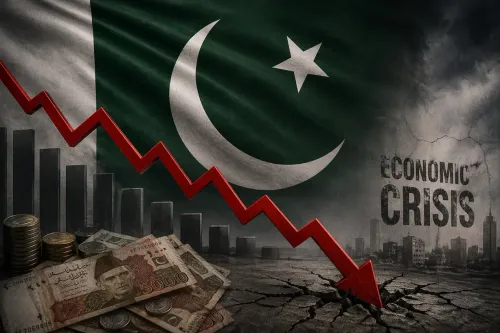
Nearly 133 million Pakistani adults remain outside the formal financial system — and with the Gini coefficient rising sharply to 32.7 and one-third of the population below the poverty line, the Findex 2025 data reveal a country where the tools to escape poverty are least available to those who need them most.
Key Takeaways
Roughly 133.3 million adults in Pakistan remain unbanked or financially excluded, per the Findex 2025 survey.
Only 18.3 per cent of adults hold a formal financial account; digital payments accounts are held by just 19.8 per cent .
Approximately one-third of Pakistan's population lives below the poverty line, set at Rs 8,484 per adult per month for 2024-25 .
The Gini coefficient rose to 32.7 in 2024-25 from 28.4 in 2018-19 , signalling widening income inequality.
High inflation, climate shocks and sluggish employment growth are compounding household financial vulnerability across Pakistan.
Pakistan's campaign to reduce poverty and build economic resilience is being severely hampered by one of South Asia's widest financial inclusion gaps, with nearly two-thirds of the country's adult population still outside the formal financial system, according to a report. The findings, published on 26 September 2026, underscore a structural fault line that experts argue must be addressed if the country is to meaningfully lift living standards.
Scale of Exclusion
Data from the Findex 2025 survey indicate that roughly 133.3 million adults in Pakistan remain unbanked or financially excluded. Only 18.3 per cent of survey respondents held a formal financial account, while a similar proportion reported having a mobile money account. Digital payments accounts were held by just 19.8 per cent of respondents — figures that place Pakistan well behind regional peers on financial access metrics.
Notably, even among those who do hold accounts, usage is narrow. Most account holders primarily rely on financial services for deposits, withdrawals and storing money, with far fewer using them for savings, borrowing or broader financial planning. Experts argue this limits the welfare gains that account ownership alone can deliver.
Poverty and Inequality on the Rise
The financial exclusion data come against a backdrop of worsening economic conditions. According to estimates cited by Pakistan's Ministry of Planning, Development and Special Initiatives, the poverty line for 2024-25 has been set at Rs 8,484 per adult per month under the Cost of Basic Needs methodology. Based on this benchmark, approximately one-third of Pakistan's population is estimated to be living below the poverty line.
Poverty remains more entrenched in rural areas than in urban centres. Income inequality has also widened nationally, with the Gini coefficient rising to 32.7 in 2024-25 from 28.4 in 2018-19. Recent estimates further suggest that income inequality is relatively more pronounced in urban areas — a finding that challenges the assumption that urbanisation alone drives economic mobility.
Structural Pressures Deepening Hardship
The report points to multiple compounding factors behind the financial fragility gripping Pakistani households. Years of high inflation, macroeconomic instability, climate-related shocks and sluggish employment growth have collectively weakened household incomes, eroded savings and pushed millions into financial hardship. These pressures have made access to credit, insurance and formal savings facilities not just useful, but potentially critical for economic survival.
This is not a new challenge — Pakistan has consistently ranked among the lower-performing economies in South Asia on financial access indicators — but the convergence of macro stress and climate vulnerability in recent years has made the gap more consequential than before.
The Policy Push and What Experts Say
Policymakers and economists are increasingly treating financial inclusion as a lever for improving household welfare and broader economic resilience. Financial inclusion, as defined in the report, encompasses affordable access to bank accounts, savings facilities, credit, insurance and payment systems — particularly for low-income and vulnerable groups.
Experts argue that wider participation in the formal financial system can help mobilise savings, expand credit availability, support small business activity and contribute to overall economic growth. However, the gap between policy intent and ground reality remains wide. The majority of Pakistan's population continues to operate outside formal financial channels, and structural barriers — including limited digital infrastructure in rural areas, low financial literacy and restricted documentation — continue to slow progress.
What Comes Next
Bridging the financial inclusion gap will likely require coordinated action across banking regulation, digital infrastructure and social protection policy. Until access and usage both improve at scale, financial inclusion will remain more aspiration than achievement — and the resilience it promises will remain out of reach for millions of Pakistani households.
Point of View
Combined with a poverty line barely above subsistence, means the formal financial system is failing precisely the households that need it most. What is missing from the policy conversation is the demand side — low financial literacy, documentation barriers and distrust of formal institutions are as much an obstacle as supply-side gaps in banking infrastructure. Without addressing both, mobile money targets and account-opening drives will continue to produce headline metrics that mask thin actual usage.
NationPress
26 Sept 2026
Frequently Asked Questions
How many adults in Pakistan are financially excluded?
According to the Findex 2025 survey, roughly 133.3 million adults in Pakistan remain unbanked or financially excluded. Only 18.3 per cent of respondents held a formal financial account, and digital payments accounts were reported by just 19.8 per cent.
What is Pakistan's poverty line for 2024-25?
Pakistan's Ministry of Planning, Development and Special Initiatives has set the poverty line for 2024-25 at Rs 8,484 per adult per month under the Cost of Basic Needs methodology. Based on this benchmark, approximately one-third of the country's population is estimated to be living below the poverty line.
How has income inequality changed in Pakistan?
Pakistan's Gini coefficient — a standard measure of income inequality — rose to 32.7 in 2024-25 from 28.4 in 2018-19, reflecting a significant widening of income inequality over six years. Recent estimates also suggest inequality is relatively more pronounced in urban areas.
Why does financial inclusion matter for poverty reduction in Pakistan?
Experts argue that access to formal financial services — including savings accounts, credit, insurance and payment systems — helps households manage economic shocks, mobilise savings and access capital for small businesses. In Pakistan's context, where climate shocks and macro instability are recurring, financial access could provide a critical buffer against falling into or deepening poverty.
What barriers prevent financial inclusion in Pakistan?
Structural barriers include limited digital and banking infrastructure in rural areas, low financial literacy, restricted documentation among low-income groups and a general distrust of formal financial institutions. Even among existing account holders, usage is limited primarily to deposits and withdrawals rather than savings or credit products.