India can top 10% growth with tech and innovation: FM Sitharaman
Synopsis
Finance Minister Nirmala Sitharaman declared at IIT Madras’s annual alumni conference in Chennai that India can breach 10 per cent economic growth — but only if it stops accommodating ‘naysayers’ and doubles down on technology across agriculture, payments, and innovation. With UPI now live in 11 countries and payment points up 260 times since 2018, she is making a data-backed case that digital infrastructure, not just demographics, will power Viksit Bharat.
Key Takeaways
Finance Minister Nirmala Sitharaman said India can achieve over 10 per cent economic growth by embracing technology and innovation across sectors.
She was speaking at Sangam 2026 , the annual conference of the IIT Madras Alumni Association , in Chennai on 26 September 2026 .
Sitharaman cited drones , geospatial tools , and POS machines in fertiliser distribution as examples of agri-tech empowering farmers.
UPI is now operational in 11 countries , with payment points having grown 260 times since 2018 .
One in every two real-time digital payment transactions globally occurs in India, according to Sitharaman.
She unveiled the book ‘Cashless Nation: How UPI Changed Everything’ by Dr.
Sambamurthy at the event.
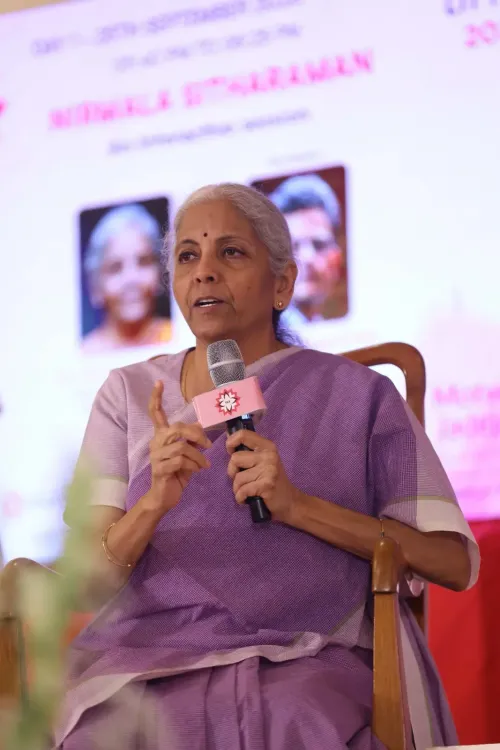
Finance Minister Nirmala Sitharaman on Saturday, 26 September 2026, said India has the potential to surpass 10 per cent economic growth and realise its Viksit Bharat 2047 ambition, provided the country fully embraces technology and innovation across sectors. She was speaking at Sangam 2026, the annual conference of the IIT Madras Alumni Association and IIT Madras, held in Chennai.
The Growth Target and What It Demands
Addressing a fireside chat organised by the IIT Madras Alumni Association, Sitharaman acknowledged that reaching double-digit growth would not come easily. “We have too many naysayers. We have too many people who have vicarious pleasure being derived if India fails. We really cannot afford that. We need to nudge these people to think positively,” she said. The Finance Minister stressed that achieving such growth would require “a lot more effort from all stakeholders.”
Technology Transforming Agriculture
Sitharaman highlighted how technological interventions have already begun reshaping the farm sector, connecting agriculture producers directly to markets and boosting productivity. She cited the deployment of drones and aerial geospatial instruments for precision mapping of land parcels as tools that have meaningfully empowered the farming community. She also pointed to the use of point-of-sale (POS) machines in fertiliser distribution, currently under pilot testing. The system records details of the farmer, land, and crop being cultivated, and then provides recommended fertiliser quantities based on soil, irrigation, and crop conditions — a data-driven nudge toward more efficient input use.
Book Launch: India’s UPI Story
On the sidelines of the event, FM Sitharaman unveiled a book titled ‘Cashless Nation: How UPI Changed Everything’, authored by Dr. Santanu Paul and B. Sambamurthy. The book chronicles the inside story of India’s digital payments transformation, tracing the conception, creation, and rapid rise of the Unified Payments Interface (UPI). Sitharaman noted that UPI is now operational across 11 countries, including France, Singapore, the UAE, Greece, and Mauritius. “From powering seamless payments in India to enabling digital transactions across borders, UPI continues to take our digital public infrastructure to the world,” she said.
UPI’s Scale: A Global Benchmark
The Finance Minister underscored the extraordinary scale of India’s digital payments ecosystem. UPI-enabled payment points have grown approximately 260 times since 2018, extending digital transactions into the remotest corners of the country. She further noted that one in every two real-time digital payment transactions globally now takes place in India — a statistic that positions India not just as a domestic success story but as a benchmark for emerging economies looking to leapfrog legacy financial infrastructure.
Startups and the Innovation Ecosystem
Sitharaman also praised the growth of India’s startup ecosystem, noting that entrepreneurs and innovators are playing a pivotal role in translating technology into ground-level impact. This comes amid a broader government push to position India as a global hub for deep-tech and digital innovation. With the Viksit Bharat 2047 target framing long-term policy ambition, the Finance Minister’s remarks signal that technology-led productivity gains — rather than demographic dividend alone — are increasingly central to India’s growth narrative.
Point of View
Particularly POS-linked fertiliser distribution, is still at pilot stage; scaling it without data-privacy safeguards or rural digital literacy will be the real test. And while India processing one in two global real-time payments is a genuine achievement, the challenge has shifted from adoption to monetisation and credit inclusion — questions the Finance Minister did not address.
NationPress
26 Sept 2026
Frequently Asked Questions
What did Finance Minister Nirmala Sitharaman say about India’s growth potential?
Sitharaman said India can achieve over 10 per cent economic growth by fully embracing technology and innovation across sectors, speaking at the IIT Madras Alumni Association’s Sangam 2026 conference in Chennai on 26 September 2026. She added that realising this would require sustained effort from all stakeholders and a shift away from pessimism about India’s prospects.
How is technology being used in Indian agriculture, according to FM Sitharaman?
Sitharaman highlighted the use of drones and aerial geospatial instruments for precision land mapping, as well as point-of-sale (POS) machines in fertiliser distribution that are under pilot testing. The POS system captures farmer, land, and crop data to recommend optimal fertiliser quantities based on soil, irrigation, and crop conditions.
What is the book ‘Cashless Nation: How UPI Changed Everything’ about?
The book, authored by Dr. Santanu Paul and B. Sambamurthy, tells the inside story of India’s digital payments transformation, covering the conception, creation, and rise of UPI. Sitharaman unveiled it at Sangam 2026 in Chennai on 26 September 2026.
In how many countries is UPI currently operational?
UPI is now operational across 11 countries, including France, Singapore, the UAE, Greece, and Mauritius, according to FM Sitharaman. She also noted that UPI-enabled payment points have grown approximately 260 times since 2018.
What is Viksit Bharat 2047 and how does it relate to Sitharaman’s remarks?
Viksit Bharat 2047 is the Indian government’s vision to become a fully developed nation by the centenary of independence in 2047. Sitharaman framed the over-10-per-cent growth target as a prerequisite for achieving that goal, arguing technology and innovation across sectors are the primary enablers.