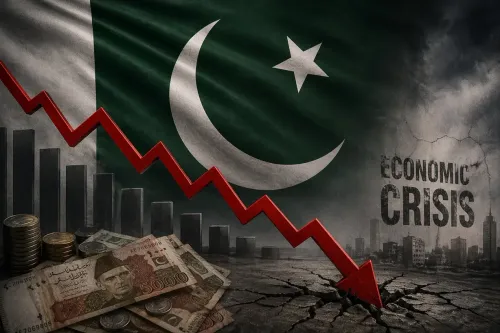
Has Pakistan's Government Debt Surged to 70.7% of GDP?

Synopsis
The latest report reveals a staggering surge in Pakistan's public debt, surpassing the legal cap and raising concerns about fiscal responsibility. This situation reflects deeper governance issues and a reliance on debt that jeopardizes the nation's economic future. What are the implications for the Pakistani economy and its citizens?
Key Takeaways
Public debt has soared to 70.7% of GDP.
Exceeds the legal limit by 14.7% of GDP.
Debt servicing consumes half of the federal budget.
Government’s fiscal discipline remains in question.
Development spending is severely compromised.
New Delhi, Feb 6 (NationPress) The recent 'Debt Policy Statement 2026' released by the Pakistan government indicates that in FY2024-25, the nation’s public debt has surpassed the legal limit by an astonishing Rs 16.8 trillion, reaching 70.7% of GDP, which exceeds the Parliament's allowable maximum of 56%, as reported by the Karachi-based Business Recorder.
This means public debt has breached the legal threshold by a significant 14.7% of GDP, highlighting the government's persistent inability to maintain fiscal discipline.
The article emphasizes that “this violation reveals a profound structural issue within Pakistan’s governance framework: prioritizing spending, increasing borrowing to cover expenses, and later attempting to justify these actions.”
Fiscal discipline rules are often overlooked, with Parliament typically informed only after limits are exceeded, and the executive faces no immediate repercussions for these breaches. It is evident that the country’s core operational model remains consumption-oriented, resistant to reform, heavily dependent on debt, and neglectful of enhancing the economy's productive capabilities, according to the report.
The cumulative result is that half of the federal budget is now consumed by debt servicing, limiting resources for development spending, undermining the PSDP (Public Sector Development Programme), and imposing increasing tax burdens on an already strained population.
Domestic debt servicing has become the largest contributor to expenditure growth in the government’s budget over the past three years, squeezing development investments and depriving the economy of the necessary productive capital to escape the debt cycle. In this grim scenario, the finance ministry's reassurances to Parliament appear unconvincing, as noted by the article.
While acknowledging that the debt-to-GDP ratio has deteriorated over the last fiscal year, the Pakistan government insists on its commitment to the Fiscal Responsibility and Debt Limitation (FRDL) Act, promising to reduce public debt to sustainable levels through fiscal consolidation, achieving primary surpluses, and gradually lowering the fiscal deficit.
However, the roadmap for achieving this remains ambiguous, as the 'Fiscal Policy Statement 2026' reveals that the federal fiscal deficit also exceeded the Parliament-mandated limit by 2.7% of GDP, indicating that both fundamental fiscal metrics — debt and deficit — have been breached at the same time, which undermines the credibility of claims regarding a near-term recovery, the article states.
Early indicators this year are not particularly promising. The FBR has already fallen short of its revenue target for the July-January period by Rs 347 billion, even as the government increasingly resorts to financial engineering to mitigate debt pressures, the article concludes.
Point of View
It is imperative to recognize that while the figures are alarming, they reflect systemic issues that have persisted over years. The path forward requires not just adherence to fiscal rules but a broader reform agenda aimed at enhancing productivity and capacity. The nation must unite in accountability and seek sustainable solutions rather than temporary fixes.
NationPress
26 Sept 2026
Frequently Asked Questions
What is the current public debt of Pakistan as a percentage of GDP?
As per the latest report, Pakistan's public debt has reached 70.7% of GDP.
What was the legal limit for public debt in Pakistan?
The legal limit set by Parliament for public debt is 56% of GDP.
How much has the public debt exceeded the legal limit?
The public debt has exceeded the legal limit by 14.7% of GDP.
What are the implications of this debt crisis?
The debt crisis threatens public spending on development, increases tax burdens, and highlights significant governance issues.
What steps is the government taking to manage the debt?
The government claims to be committed to the Fiscal Responsibility and Debt Limitation (FRDL) Act, aiming to reduce public debt through fiscal consolidation.