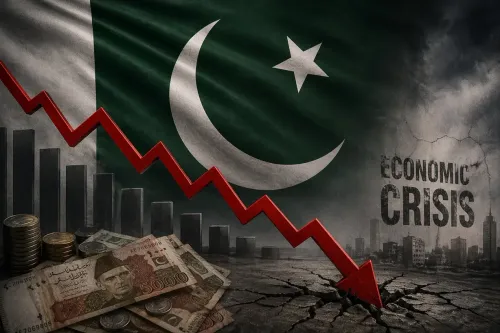
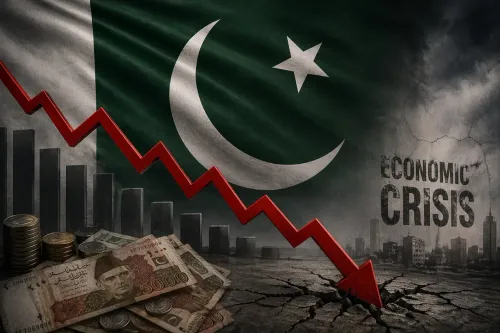
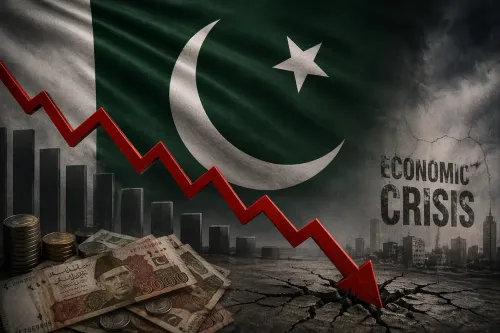
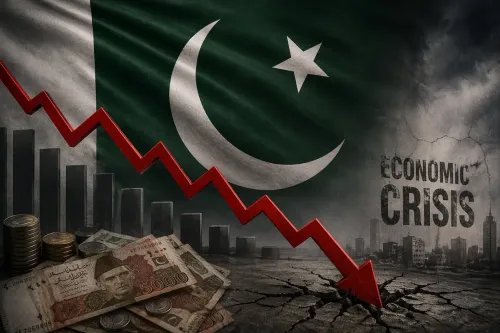
How Did Pakistan’s Public Debt Reach 70.7% of GDP as Fiscal Deficit Exceeds Limit?

Synopsis
Pakistan's finance ministry has acknowledged the rising public debt as a critical challenge, increasing to 70.7% of GDP. This situation is fueled by soaring interest payments and a budget deficit surpassing legal limits. The report underscores the tension between defense spending and public welfare in the country.
Key Takeaways
Total public debt reached 70.7% of GDP.
Public debt per capita rose to Rs 333,000.
Budget deficit exceeded statutory limits by Rs 3 trillion.
Defense spending surpassed budget allocations.
Government's debt management strategy focuses on sustainability.
New Delhi, Jan 29 (NationPress) The finance ministry of Pakistan has acknowledged that "public debt dynamics have posed significant challenges" over the past fiscal year. This increase in public debt is primarily attributed to higher interest payments and fluctuations in exchange rates, as reported by the Karachi-based Express Tribune.
The debt per capita for Pakistanis rose by 13 percent, reaching Rs 333,000 in the previous financial year. This public debt has been classified as a "challenge" due to a budget deficit that surpassed the legal limit by Rs 3 trillion, as revealed in a Fiscal Policy Statement submitted to Parliament.
Moreover, the figures highlight the significant emphasis placed on defense spending in Pakistan's budget, indicating the military's strong influence over governmental decisions, while the welfare of citizens is often sidelined.
While the development expenditure, including net lending, was planned at Rs 1.7 trillion, actual disbursements amounted to Rs 1.4 trillion, which is 84 percent of the intended allocation.
In contrast, defense spending was projected at Rs 2.1 trillion, but actual costs reached nearly Rs 2.2 trillion, equating to 103 percent of the budgeted amount, according to the report.
The fiscal year 2024-25 marks the initial full financial year for Prime Minister Shehbaz Sharif's administration, which took office in April 2024.
The finance ministry reported that total public debt as a share of GDP rose from 67.6 percent in June 2024 to 70.7 percent by June 2025.
From June 2024 to June 2025, the total public debt surged from Rs 71.2 trillion to Rs 80.5 trillion, largely due to increased interest payments—a consequence of extra borrowing to finance expenditures beyond legal limits.
The escalation in public debt, both in absolute numbers and as a proportion of the economy, undermines the federal government's assertions of fiscal discipline. Throughout the year, the government introduced new departments, expanded the federal cabinet, and acquired new furniture and vehicles, all while claiming to pursue austerity.
The finance ministry reiterates that "public debt dynamics have been a crucial challenge" in the last fiscal year, with the rise in total public debt primarily driven by greater interest payments and currency exchange fluctuations.
The government’s medium-term debt management strategy is focused on reducing gross financing needs, extending maturity profiles, and diversifying financing tools to ensure sustainability.
The report also disclosed that the federal government exceeded the 3.5 percent federal fiscal deficit limit set by Parliament, spending Rs 3.1 trillion, or 2.7 percent of GDP.
While revenue collection was close to budget goals, expenditures slightly exceeded expected levels, as noted in the report.
Point of View
It is essential to recognize the challenges posed by the increasing public debt in Pakistan. A balanced approach is needed to address fiscal discipline while ensuring that the welfare of citizens is prioritized over defense expenditures. The government's commitment to sustainability and prudent financial management is crucial for securing a stable economic future.
NationPress
26 Sept 2026
Frequently Asked Questions
What is the current public debt of Pakistan?
As of June 2025, Pakistan's total public debt stands at Rs 80.5 trillion.
How much did the public debt increase in the last fiscal year?
The public debt increased from Rs 71.2 trillion to Rs 80.5 trillion, representing a significant rise.
What factors contributed to the increase in public debt?
The increase was primarily driven by higher interest payments and exchange rate fluctuations.
How does defense spending affect the budget?
Defense spending has been prioritized, often overshadowing welfare allocations, leading to budgetary constraints.
What is the government's strategy for managing debt?
The government aims to reduce gross financing needs, extend maturity profiles, and diversify financing instruments to ensure sustainability.