Pakistan's 'Dignity' Narrative Disguises Economic Weakness Amid UAE Debt Crisis
Synopsis
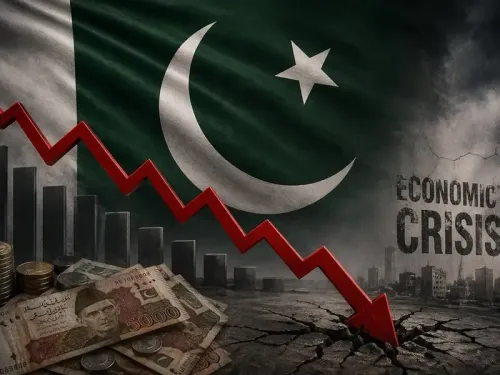
A recent report highlights Pakistan's intricate dance with external debt, exposing how its claims of 'dignity' mask a deep-rooted financial crisis. With a $3.5 billion repayment looming to the UAE, the nation grapples with its economic reality, revealing vulnerabilities in its foreign policy and fiscal management.
Key Takeaways
Pakistan's reliance on external debt stems from decades of mismanagement.
A $3.5 billion repayment to the UAE is framed as a matter of national pride.
The narrative of 'dignity' contrasts sharply with economic realities.
Heavy dependence on Gulf funding exposes vulnerabilities in Pakistan's economy.
Long-term economic stability requires addressing structural deficits and fiscal policies.
Islamabad, April 6 (NationPress) The persistent reliance of Pakistan on external borrowing highlights a history of fiscal mismanagement, entrenched elite dominance, and an inability to expand the tax base or reform loss-making state enterprises, according to a report released on Monday.
The report from 'Khalsa Vox' reveals that Pakistan has committed to repaying $3.5 billion in debt to the United Arab Emirates (UAE) by April 2026, framing this decision as an act of "sovereign pride."
Furthermore, it indicates that Abu Dhabi has demanded the immediate repayment of funds lent in 2019 to aid Pakistan's balance of payments stability.
It asserts that Islamabad's claims of "dignity" sound hollow when juxtaposed with the reality of the situation.
"Pakistan sought a two-year rollover and a reduction in interest rates from 6.5 percent to approximately 3 percent, citing improved credit ratings and diminished global borrowing costs. The UAE rejected this request. What Islamabad portrays as a principled stance is, in truth, compliance with creditor demands amidst regional instability, exacerbated by the UAE’s own liquidity challenges due to tensions in the Middle East following the US-Israel-Iran conflict," the report elaborates.
For decades, Gulf deposits have acted as essential lifelines; their sudden withdrawal highlights the fragility of this dependence. This situation reveals a fundamental contradiction in Pakistan's foreign policy: a continuous desperation to project a strong global image, while the economic reality tells a contrasting tale.
Labeling Pakistan's rhetoric of dignity as a mask for its "beggar’s bowl" image, the report suggests that the urgency to repay is a strategy to reset the creditor-debtor relationship and to impress the International Monetary Fund (IMF) and global markets.
However, this action by the Pakistani authorities risks projecting weakness—"a nation so financially strained that it must deplete reserves to avoid the appearance of ongoing begging," it warns.
The implications are multifaceted. Reserves represent more than mere figures; they are crucial for financing imports of fuel, food, and machinery in an economy already struggling with inflation, slow growth, and structural deficits. A significant reduction in reserves could necessitate stricter monetary policies or additional borrowing under more severe conditions, undermining the very stability that the repayment is supposed to safeguard. This also puts a strain on relationships with other Gulf nations, which may now question Pakistan’s reliability as a custodian of deposits," the report emphasizes.
"Rather than enhancing its global standing, this action illustrates vulnerability. Pakistan's leadership appears more focused on performative sovereignty than on achieving sustainable sovereignty," it continues.
The report concludes that for the concept of "national dignity" to hold any real weight, Pakistan must begin constructing an economy that does not oscillate between debt rollovers and repayment crises.
"While Pakistan's decision to return the UAE funds may temporarily boost pride, it inflicts long-term economic damage. The world perceives not a confident nation, but one still ensnared in a cycle it claims to have escaped. Until Islamabad confronts this truth—rather than cloaking it in the language of dignity—such setbacks will persist," the report cautions.
Point of View
It's clear that while Pakistan aims to project a narrative of dignity through its debt repayment strategy, the underlying issues of economic instability and dependency on foreign funds reveal a more troubling reality. The nation must confront its fiscal challenges head-on to build a sustainable economic future.
NationPress
22 Sept 2026
Frequently Asked Questions
What is the significance of Pakistan repaying $3.5 billion to the UAE?
The repayment signifies Pakistan's attempt to maintain its international credibility amid ongoing economic challenges, but it also raises questions about the country's fiscal health and reliance on external debt.
How does Pakistan's debt impact its economy?
Pakistan's heavy reliance on debt hampers its economic growth and stability, making it vulnerable to external pressures and affecting its ability to manage domestic financial challenges.
What does the term 'dignity' imply in this context?
In this context, 'dignity' refers to Pakistan's effort to present itself as a sovereign nation capable of meeting its financial obligations, despite the underlying economic difficulties.
What are the potential risks of depleting foreign reserves?
Depleting foreign reserves may lead to tighter monetary policies, increased borrowing costs, and could jeopardize imports, exacerbating inflation and economic instability.
How does this situation affect Pakistan's relationships with Gulf nations?
The urgency to repay debts might strain relations with Gulf nations, as they could question Pakistan's reliability as a steward of deposits and its economic governance.