Pakistan's Rice Export Crisis: A 35% Plummet in February
Synopsis
In a shocking report, Pakistan's rice exports have plunged by over 35% in February, questioning the effectiveness of government subsidies. This decline poses serious challenges for the industry and calls for urgent reforms.
Key Takeaways
Pakistan's rice exports dropped by over 35% in February.
Basmati rice exports decreased by 19.21% in value.
Coarse rice exports fell by 42.50% in value.
The government provided a 3% duty drawback for coarse rice.
Industry experts urge reforms for sustainable export growth.
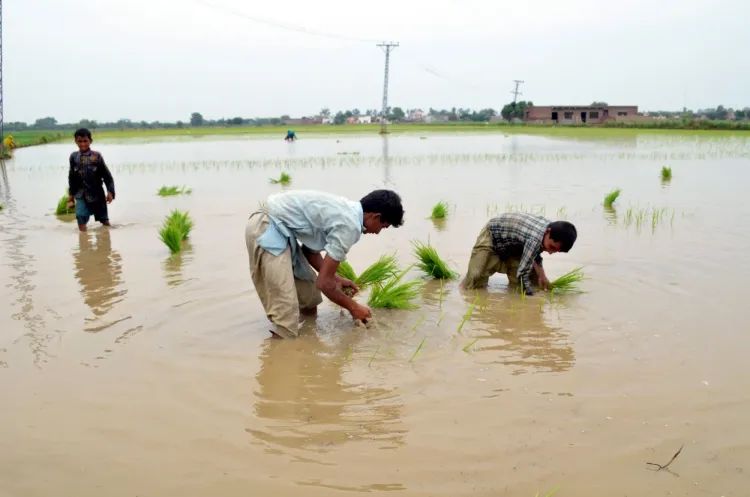
New Delhi, March 20 (NationPress) The export of rice from Pakistan has plummeted by over 35 percent in February, despite the government's subsidy efforts, raising doubts about their effectiveness, as reported.
As per the report published in Dawn, exporters indicated that the subsidy initiative has led to increased domestic prices, which in turn has rendered Pakistani rice less competitive in global markets, thus negating the intended advantages.
Official statistics from the Pakistan Bureau of Statistics reveal that basmati rice exports experienced a 19.21 percent drop in value and a 27.98 percent decline in volume during February.
Additionally, exports of coarse rice also saw a steep decline, decreasing by 42.50 percent in value and 32.94 percent in volume within the same timeframe.
The Pakistani administration had introduced a 3 percent duty drawback on local taxes and levies for coarse rice, while basmati exports received a 9 percent drawback, with approximately Rs 15 billion allocated to bolster exporters.
Exporters attributed the downturn to rising domestic prices and hoarding practices, which have weakened Pakistan's position in international markets. They also pointed out that the sector remains heavily focused on commodity trading with little advancement in creating value-added products.
"Our rice exporters have predominantly remained commodity traders over the last forty years, concentrating mainly on fulfilling export refinance facility performance (ERF) targets instead of evolving into efficient exporters like their regional counterparts," expressed one exporter.
Participants in the industry further noted that the rebates provided through the duty drawback scheme are inadequate to counteract structural issues at the agricultural level.
They stressed that sustainable growth in exports hinges on enhancing agricultural productivity, reducing input costs, and improving supply chain efficiency.
According to exporters, initiatives such as better seed quality, effective irrigation, and lowered costs of fertilizers and energy are essential for enhancing competitiveness. Absent such reforms, subsidies at the export level are likely to yield only minimal benefits.
They have also called for a shift in policy to redirect incentives towards value-added rice products and byproducts to bolster export performance in the long run.
Point of View
It is crucial to highlight the alarming trend of declining rice exports from Pakistan, which raises significant concerns about the effectiveness of government subsidies and the overall competitiveness of the agricultural sector. A nation-first approach requires immediate attention to structural challenges that threaten the economy.
NationPress
23 Sept 2026
Frequently Asked Questions
What caused the decline in Pakistan's rice exports?
The decline is attributed to rising domestic prices and hoarding practices, which have weakened competitiveness in global markets.
How much did basmati rice exports decrease?
Basmati rice exports fell by 19.21% in value and 27.98% in quantity in February.
What measures has the government taken to support exporters?
The government announced a 3% duty drawback for coarse rice and a 9% drawback for basmati, with an allocation of around Rs 15 billion.
What do exporters suggest for improving competitiveness?
Exporters suggest focusing on better seed quality, efficient irrigation, and reduced costs of fertilizers and energy.
What is the future outlook for Pakistan's rice industry?
The future depends on addressing structural challenges and shifting focus towards value-added rice products to strengthen export performance.