Did Pakistan Engage in the Afghanistan Conflict for Global Support?

Synopsis
Khawaja Asif, Pakistan's Defence Minister, claims that the country's involvement in the Afghanistan conflict was politically motivated, seeking support from global powers rather than religious reasons. He discusses the historical context of this involvement and the consequences it has had on Pakistan's society and policy, emphasizing the need for reflection on past decisions.
Key Takeaways
Pakistan's involvement in Afghanistan was politically motivated.
Support from global powers was prioritized over religious reasons.
Historical narratives have long-term effects on society.
Failure to learn from past conflicts has led to repeated mistakes.
Accountability in leadership is crucial for future stability.
Islamabad, Feb 12 (NationPress) The Defence Minister of Pakistan, Khawaja Asif, stated that the nation’s participation in the prolonged conflict in Afghanistan was motivated by the quest for political legitimacy and the need for support from global powers, rather than religious intentions, according to local media.
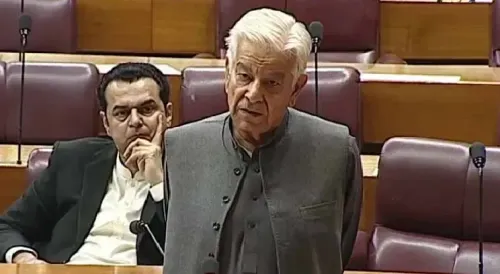
During a recent address at the National Assembly, Asif emphasized that Pakistan's involvement in the Afghan wars, which began during the Cold War and extended post the September 11, 2001 attacks, was a calculated strategy to secure backing from the international community, particularly the United States, reported Afghan media outlet Amu Tv.
“We did not engage in these wars to protect Islam or conduct jihad,” Asif asserted. “Our entry was for political legitimacy and to gain the support of a superpower.”
He pointed out that Pakistan’s policies regarding Afghanistan since its independence have been shaped by changing geopolitical dynamics. Asif argued that what was labeled as jihad during the Soviet-Afghan war was, in reality, a proxy battle involving major global players, according to Amu Tv.
“That was not jihad; it was a superpower’s war,” Asif stated. “For that conflict, we altered our education system, and even today, that curriculum remains largely uncorrected.”
He noted that Pakistan revised its historical narrative to align with the conflict, illustrating the long-lasting social and ideological consequences of these policies. “We reshaped our society, politics, and religion to conform to this so-called jihad,” he added.
Khawaja Asif acknowledged that Pakistan failed to learn from the Soviet withdrawal and once again aligned with the US after the 9/11 attacks, remaining engaged in the Washington-led Afghan war for nearly two decades, as reported by Amu Tv.
“For not just one decade, but two decades, we effectively rented ourselves out,” he remarked, adding, “The sole aim was to secure American support.”
He mentioned that none of the individuals involved in the 9/11 attacks were Afghans, and Afghanistan itself bore no responsibility for the actions taken. Nevertheless, he stated that Pakistan became embroiled in the ensuing conflict following the 9/11 incident. He expressed that the leadership in Pakistan has consistently failed to acknowledge the mistakes made in the past.
Point of View
It's crucial to understand that Pakistan's complex relationship with Afghanistan is a product of its geopolitical strategies over decades. Khawaja Asif's remarks highlight the need for accountability in political decisions, urging a reflective approach towards past alignments while fostering a more stable future for both nations.
NationPress
6 Oct 2026
Frequently Asked Questions
What motivated Pakistan's involvement in the Afghanistan conflict?
Pakistan's Defence Minister Khawaja Asif stated that the country's involvement was primarily driven by political legitimacy and the quest for support from global powers, not religious motives.
How has Pakistan's policy towards Afghanistan evolved?
Pakistan's policies regarding Afghanistan have shifted in response to changing geopolitical dynamics since its independence, often reflecting the interests of major global powers.
What impact did the Soviet-Afghan war have on Pakistan?
The Soviet-Afghan war reshaped Pakistan's education system and historical narrative, leading to long-lasting social and ideological effects that still influence the country today.
What did Khawaja Asif say about the 9/11 attacks?
Asif indicated that none of the individuals responsible for the 9/11 attacks were Afghans, yet Pakistan became involved in the ensuing conflict.
Has Pakistan acknowledged its past mistakes in foreign policy?
Khawaja Asif admitted that Pakistan's leadership has repeatedly failed to recognize the mistakes made in past alignments and conflicts.