Did Pakistan's Defence Minister Just Admit to Renting Out the Country Post 9/11?
Synopsis
The recent admissions by Pakistan's Defence Minister Khawaja Asif regarding the country's role post-9/11 have ignited a firestorm of reactions from Afghan leaders. Their critiques underscore the longstanding belief that Pakistan's dual strategy has significantly impacted Afghanistan's stability and the suffering of its people.
Key Takeaways
Khawaja Asif's admission acknowledges Pakistan's controversial role post-9/11.
Afghan leaders emphasize the need for accountability.
Critics argue that Asif's comments are a revisionist narrative.
The discussion highlights the human cost of Pakistan's policies.
The report calls attention to the strategic complexities in the region.
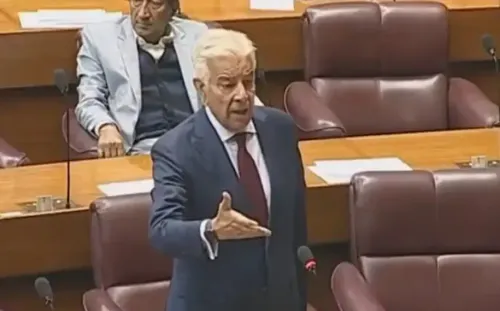
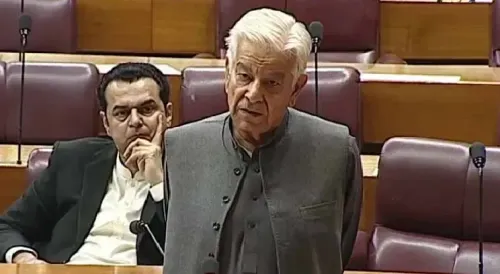
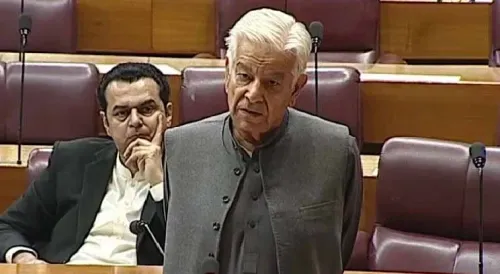
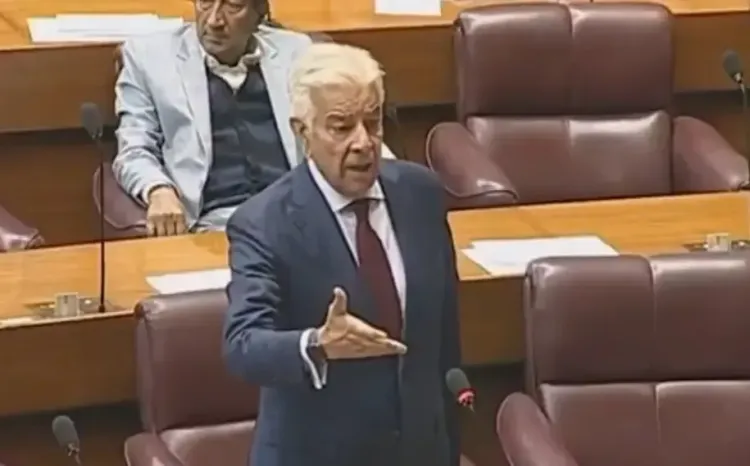
Kabul, Feb 14 (NationPress) Pakistan's Defence Minister Khawaja Asif recently made a startling declaration in the nation’s parliament, stating that the country had "rented itself out" to the United States following the events of 9/11. This admission has reinforced the long-standing beliefs among Afghans that Islamabad has been involved in nurturing militant proxies, shaping regional narratives, and transferring the consequences onto Afghan society, according to a report released on Saturday.
The Afghan Diaspora Network highlighted that Asif’s statements have incited significant backlash from key Afghan political leaders, who collectively criticize the Pakistani political and military establishment for engaging in a double game in Afghanistan. They argue that Asif’s selective acknowledgment offers a glimpse into the situation while obscuring crucial details.
Former Afghan intelligence chief Rahmatullah Nabil provided a robust counter-argument, asserting that Asif’s comments represent "not an honest reckoning but a revisionist attempt to sanitize decades of Pakistani policy."
Nabil points out the inconsistencies in Asif’s narrative, noting that the same politician who now portrays Pakistan's involvement in Afghanistan as a mere political error had previously justified the Taliban's resurgence by claiming to the United States, "Power is yours, God is with us." This contradiction, according to Nabil, reveals a deeper issue: Pakistan's Afghan policy has always interwoven ideology, geopolitics, and opportunism. Reducing it to mere "political mistakes" is, as Nabil states, an evasion of the responsibility for the human toll endured by the Afghan populace, which includes graveyards, displacement, and devastated villages.
The report also notes the perspective of former US Ambassador to Afghanistan, Zalmay Khalilzad, who emphasizes Pakistan’s strategic duplicity throughout the US-led war on terror. Khalilzad points out that while Pakistan received billions in military and financial assistance for supporting US operations, its security forces simultaneously provided refuge to the Taliban insurgency engaged in combat against American troops.
Former Afghan Member of Parliament Mariam Solaimankhil brings another aspect to the discussion, stressing the human cost of Pakistan's policies. She argues that Asif’s comments are "not merely contradictory; they are dismissive of Afghan suffering." Solaimankhil posits that Pakistan's prolonged engagement in Afghanistan was not an unintended consequence of global politics but rather a calculated strategy deeply rooted in ideological manipulation, ranging from educational curricula in madrassas to jihadist narratives. Her critique aligns with Nabil's viewpoint: Pakistan was not merely a bystander to geopolitical pressures but an active architect of the very dynamics that destabilized Afghanistan.
Point of View
It is crucial to recognize the complexities surrounding Pakistan's role in Afghanistan. The statements made by Defence Minister Khawaja Asif reveal a need for accountability and honest dialogue between nations. Understanding the historical context is vital for fostering future cooperation and stability in the region.
NationPress
10 Oct 2026
Frequently Asked Questions
What did Pakistan's Defence Minister admit?
Khawaja Asif admitted that Pakistan "rented itself out" to the United States post-9/11.
How have Afghan leaders reacted?
Prominent Afghan leaders have criticized Asif's comments as an attempt to sanitize Pakistan's historical role in Afghanistan.
What are the implications of this admission?
The admission highlights the longstanding belief among Afghans about Pakistan's dual strategy and its impact on Afghanistan's stability.