Pakistan democracy 'a joke': Report slams civilian leaders for military subservience
Synopsis
A damning new report finds that Pakistan's Independence Day celebrations exposed not national pride but political capitulation — with the president and prime minister openly competing to flatter the army chief, while citizens burdened by economic crisis looked on with indifference. The verdict: democracy in Pakistan has been reduced to a facade.
Key Takeaways
A report by the International Centre for Peace Studies says Pakistan's civilian leadership has effectively surrendered authority to the military establishment.
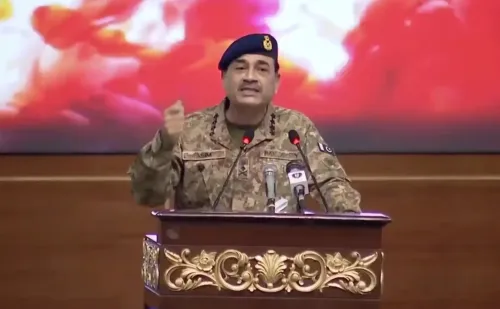
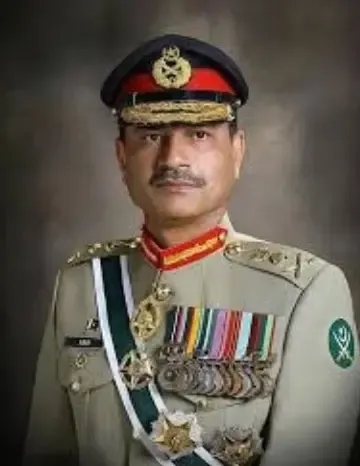
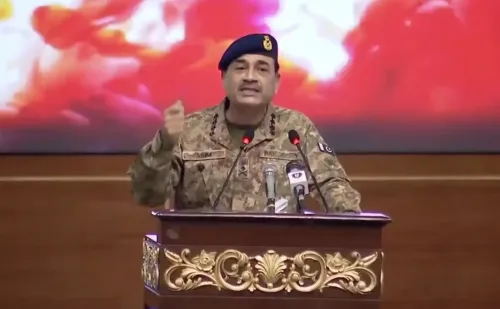
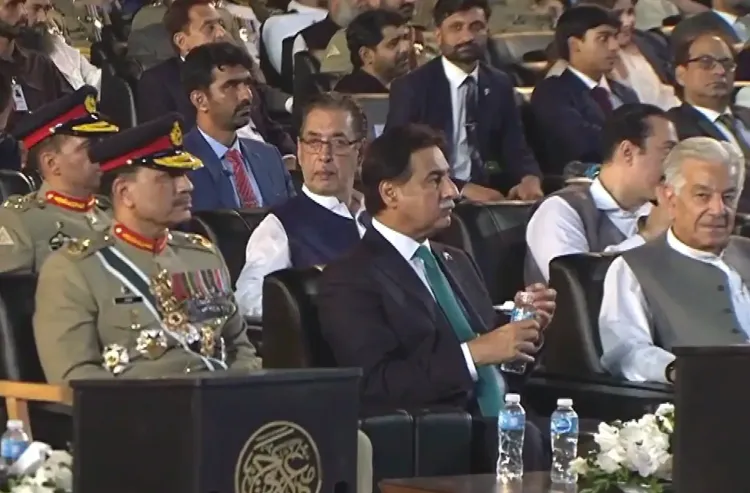
President Asif Ali Zardari and Prime Minister Shehbaz Sharif were criticised for publicly flattering Army Chief Field Marshal Asim Munir at the 79th Independence Day event in Islamabad .
Leaders from only Punjab attended the celebrations; representatives from Pakistan's other three provinces were reportedly not invited.
The report cited economic hardship, soaring prices, rising taxes, corruption, and the imprisonment of Imran Khan as key drivers of public frustration.
The report concludes that Sharif risks becoming the first Pakistani PM to complete a term by 'surrendering authority completely to the army chief,' calling the arrangement democracy 'turned into a joke.'
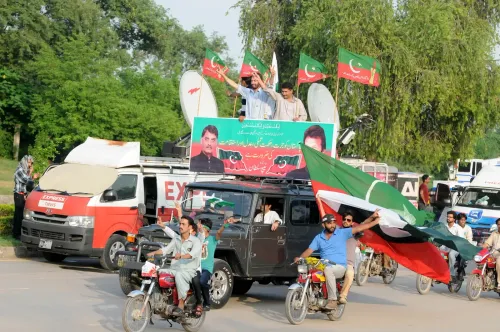
A report by the International Centre for Peace Studies has sharply criticised Pakistan's civilian leadership, arguing that the country's 79th Independence Day on 14 August 2025 laid bare the extent to which elected officials have surrendered authority to the military establishment. The report found that ordinary Pakistani citizens were largely indifferent to the celebrations, weighed down by economic hardship, soaring prices, rising taxes, and rampant corruption.
Key Findings of the Report
The report painted a bleak picture of Pakistan at 79, stating that the country 'appears to be standing at the same crossroads where it was in 1947 — in fact, in a much worse condition.' While a civilian government is officially in charge, it argued, the military establishment has 'taken real control behind the scenes and is effectively running the country.'
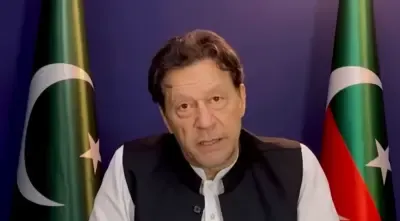
The continued imprisonment of former Prime Minister Imran Khan was cited as a major driver of public frustration. According to the report, many citizens feel that the country's ruling elites are living comfortably while ordinary people are left in 'misery and squalor.'
Independence Day Celebrations: A Province Left Out
The report noted that the Islamabad Independence Day event was attended by Army Chief Field Marshal Asim Munir, President Asif Ali Zardari, Prime Minister Shehbaz Sharif, Defence Minister Khawaja Asif, and Punjab Chief Minister Maryam Nawaz — all representing Punjab. Despite Pakistan comprising four provinces, leaders from the remaining three were reportedly not invited, with the event described as 'visibly hijacked by the military.'
What the Government Said — and Did Not Say
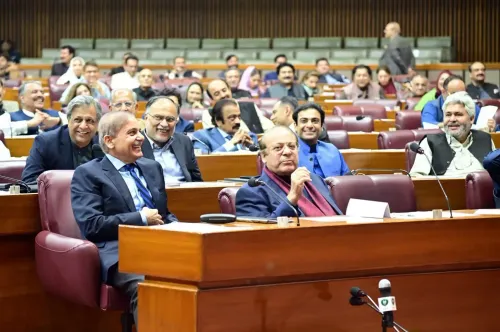
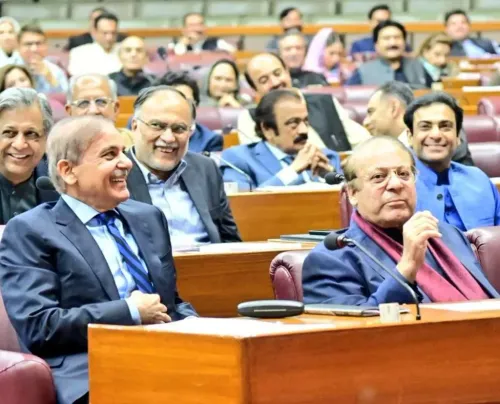
The report reserved particular criticism for President Zardari's address, calling it 'shameful.' It described Zardari as publicly 'ego-massaging' Army Chief Asim Munir, with Prime Minister Sharif doing the same — the two appearing, according to the report, to compete over who could more visibly ingratiate themselves with the military chief.
'The political leadership had nothing to offer in terms of vision or roadmap for the country,' the report stated. It added that unable to deliver peace domestically, the leadership has pivoted to projecting itself as a global peacemaker, 'forcing the media to offer exaggerated space and coverage to it.'
Democracy 'Reduced to a Joke'
The report argued that Sharif risks setting a troubling precedent by potentially becoming the first Pakistani prime minister to complete a five-year term while 'effectively surrendering his authority completely to the army chief.' It characterised this arrangement as 'hybridity taken to its logical conclusion — a de facto military-controlled state apparatus turning democracy into a joke.'
This comes amid longstanding concerns from analysts and civil society groups about the structural subordination of civilian governments to the Pakistani military — a pattern that critics argue has persisted, in varying forms, since the country's founding. The report's findings reflect a growing body of documentation on elite capture of state institutions in Pakistan, and raise fresh questions about the viability of democratic governance there as the country navigates a severe economic crisis.
Point of View
The constitutional fiction of civilian supremacy is not just strained; it is publicly discarded. What is missing from mainstream coverage is the provincial dimension: an Independence Day event from which three of four provinces were reportedly excluded is not a celebration of nationhood — it is a display of factional capture. Pakistan's democratic deficit is increasingly a feature, not a bug, of the current political settlement.
NationPress
9 Oct 2026
Frequently Asked Questions
What did the International Centre for Peace Studies report say about Pakistan?
The report stated that Pakistan's civilian leadership has effectively surrendered authority to the military establishment, with democracy reduced to 'a joke.' It found that citizens were largely indifferent to the 79th Independence Day celebrations due to economic hardship, corruption, and rising prices.
Why was Pakistan's Independence Day event criticised in the report?
The report criticised the event for being 'visibly hijacked by the military' and for excluding leaders from three of Pakistan's four provinces, with only Punjab represented. It also condemned President Zardari's address as 'shameful' for publicly flattering Army Chief Asim Munir rather than offering a national vision.
How does the report describe Shehbaz Sharif's tenure as Prime Minister?
The report argues that Sharif risks becoming perhaps the first Pakistani prime minister to complete a five-year term by 'effectively surrendering his authority completely to the army chief.' It describes his governance model as 'hybridity taken to its logical conclusion.'
What role does Imran Khan's imprisonment play in Pakistani public sentiment?
According to the report, the continued imprisonment of former Prime Minister Imran Khan has deepened public frustration, contributing to a widespread feeling that ruling elites are prospering while ordinary citizens live in 'misery and squalor.'
What is 'elite capture' as described in the Pakistan report?
The report uses 'elite capture' to describe the takeover of state institutions by a narrow ruling class — political, military, and economic — at the expense of ordinary citizens. It argues this has compounded Pakistan's economic crisis, with soaring prices, rising taxes, and rampant corruption disproportionately affecting the public.