BYC slams Pakistan over Gwadar mass evictions, calls it 'state assault'
Synopsis
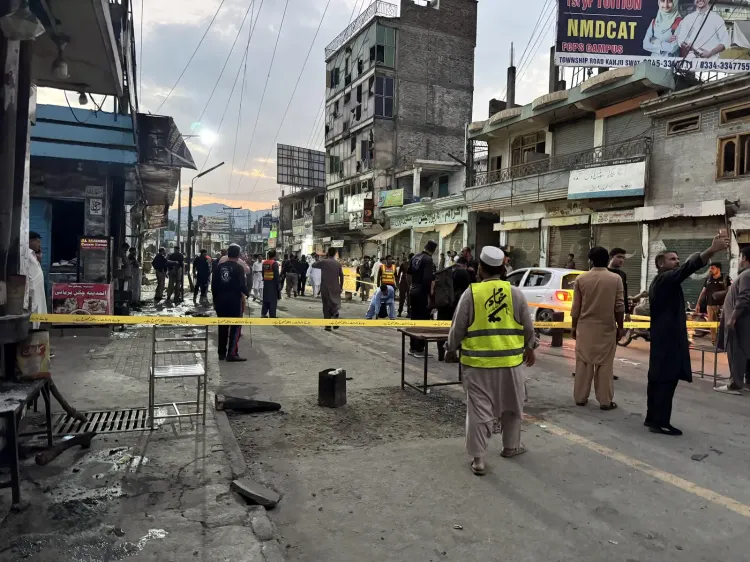
Pakistan's security-driven eviction of nearly 3,000 residents from Gwadar's ancient Sardasht settlement has drawn a sharp rebuke from the Baloch Yakjehti Committee, which calls it collective punishment and a 'state assault.' Critics argue the move fits a broader pattern of displacing Baloch communities to clear the way for CPEC-linked development — raising urgent questions about who really benefits from Gwadar's transformation.
Key Takeaways
The Baloch Yakjehti Committee (BYC) has condemned Pakistani authorities for evicting approximately 3,000 residents from the Sardasht area of Gwadar, Balochistan .
Authorities cited a security threat as justification; the BYC called this a 'pretext,' arguing the state's duty is to protect, not displace, citizens.
The affected area includes Reke Bazaar , Syed Muhammad Bazaar , and Tolgo — described as the social and economic hub of the local community.
The BYC characterised the evictions as collective punishment and part of a systematic state policy along the Makran coast, linked to development interests in CPEC -connected Gwadar.
The rights body demanded an immediate halt to evictions, withdrawal of related orders, and full compensation for displaced families.
The Baloch Yakjehti Committee (BYC), a prominent human rights organisation, has strongly condemned Pakistani authorities for forcibly evicting an estimated 3,000 residents from the Sardasht area of Gwadar district in Balochistan, describing the action as an 'occupation of Baloch land and a state assault on Baloch survival.' The condemnation, issued from Quetta, comes amid growing international scrutiny of conditions in Balochistan, particularly along the Makran coast.
What Is Happening in Sardasht
According to the BYC, the Sardasht area — located near the Shadi Kaur region in Gwadar — is an ancient Baloch settlement that has been continuously inhabited for generations. The locality encompasses Reke Bazaar, Syed Muhammad Bazaar, and Tolgo, which the rights body describes as the social and economic nerve centre of the local community.
Pakistani authorities have reportedly justified the evictions on grounds of a security threat in the area. The BYC has flatly rejected this rationale. 'This justification of security is merely a pretext. The very state constitutionally obligated to protect citizens' lives and property is the one evicting them from their land,' the organisation said in its statement. 'If there is a genuine threat in the area, it is the state's duty to provide protection to the people, not to render them homeless.'
BYC: 'Collective Punishment, Not Security'
The rights body argued that labelling an entire population as a security threat and displacing them constitutes collective punishment — a practice prohibited under international humanitarian law. 'Evicting three thousand people from their homes does not make them safe; rather, it turns them into refugees, unemployed, and displaced within their own homeland,' the BYC stated.
The committee further alleged that the evictions are not an isolated administrative decision but part of a systematic state policy targeting Baloch communities along the Makran coast. 'What is happening in Sardasht is not an isolated incident but a link in the chain of a systematic state policy underway in Balochistan, particularly along the Makran coast,' it said, adding that 'the state's target is not some threat, but Baloch land itself.'
Pattern of Displacement Along Gwadar Coast
The BYC drew attention to a wider pattern of measures it says have progressively curtailed Baloch livelihoods in Gwadar. These include, according to the committee, plans to fence off Gwadar city, proliferating security checkpoints, restrictions on fishermen's access to the sea, curbs on border employment, and now the latest evictions. 'These are all different phases of the same policy,' the BYC noted.
The organisation alleged that Gwadar's land and coastline are being 'sacrificed to so-called development projects and the interests of powerful lobbies,' with the Baloch population 'seen as obstacles and systematically removed.' Gwadar is a key node in the China-Pakistan Economic Corridor (CPEC), and critics have long raised concerns that large-scale infrastructure development in the region has marginalised local communities.
BYC Demands and Calls to Action
The Baloch Yakjehti Committee has called for an immediate halt to all evictions in Sardasht and the withdrawal of all related orders. It has also demanded that displaced families be permitted to return to their homes with dignity and receive full compensation for losses incurred. The Pakistani government had not issued a public response to the BYC's statement at the time of reporting.
As scrutiny of conditions in Balochistan intensifies — both domestically and internationally — the Sardasht evictions are likely to draw renewed attention to the human cost of security-driven displacement in one of Pakistan's most contested regions.
Point of View
Yet Islamabad faces no formal accountability mechanism. With Gwadar's strategic value only rising, the pressure on Baloch communities along the Makran coast is unlikely to ease — and the gap between Pakistan's constitutional obligations and its on-ground conduct in Balochistan remains as wide as ever.
NationPress
29 Sept 2026
Frequently Asked Questions
What is happening in Sardasht, Gwadar?
Pakistani authorities have reportedly evicted approximately 3,000 residents from the Sardasht area near Shadi Kaur in Gwadar district, Balochistan, citing a security threat. The Baloch Yakjehti Committee has condemned the move as unlawful collective displacement of an ancient Baloch settlement.
Who is the Baloch Yakjehti Committee (BYC)?
The Baloch Yakjehti Committee is a human rights organisation that advocates for the rights of Baloch communities in Pakistan. It has been vocal about what it describes as systematic state policies displacing Baloch people from their land, particularly in the Gwadar and Makran coast regions.
Why does the BYC reject Pakistan's security justification?
The BYC argues that labelling an entire civilian population as a security threat and evicting them constitutes collective punishment, which is prohibited under international humanitarian law. It contends that if a genuine threat exists, the state's duty is to protect residents, not render them homeless.
How does this relate to CPEC and Gwadar's development?
Gwadar is a critical node in the China-Pakistan Economic Corridor (CPEC), and critics have long alleged that large-scale infrastructure and port development in the area has come at the expense of local Baloch communities. The BYC has directly linked the evictions to what it calls the clearing of Baloch land for 'so-called development projects and the interests of powerful lobbies.'
What has the BYC demanded?
The Baloch Yakjehti Committee has called for an immediate halt to all evictions in Sardasht, the withdrawal of all related orders, the dignified return of displaced families to their homes, and full compensation for all losses suffered as a result of the displacement.