Russia to factor NATO's growing nuclear strength into military planning
Synopsis
Russia's Deputy Foreign Minister has put NATO — and specifically France — on notice: Moscow is actively rewriting its military planning to account for Europe's expanding nuclear posture. With France extending its nuclear umbrella, Poland and France reportedly planning Baltic nuclear strike drills, and Finland eyeing nuclear weapons imports, the Kremlin says the strategic risk of a catastrophic NATO-Russia clash is rising fast.
Key Takeaways
Sergei Ryabkov , Russian Deputy Foreign Minister , warned on 19 May that NATO's growing nuclear capabilities will be incorporated into Russia's military planning.
Ryabkov singled out France's 'forward nuclear deterrence' strategy, saying European allies hosting French nuclear forces are now under closer Russian military scrutiny.
France and Poland are reportedly planning exercises in the Baltic Sea to practise nuclear strikes against Russia, which Moscow has condemned.
Finland's intention to allow nuclear weapons imports was also cited as a provocation by the deputy minister.
Ryabkov described the risk of a 'head-on clash' between NATO and Russia as increasing, with consequences he called 'potentially catastrophic.'
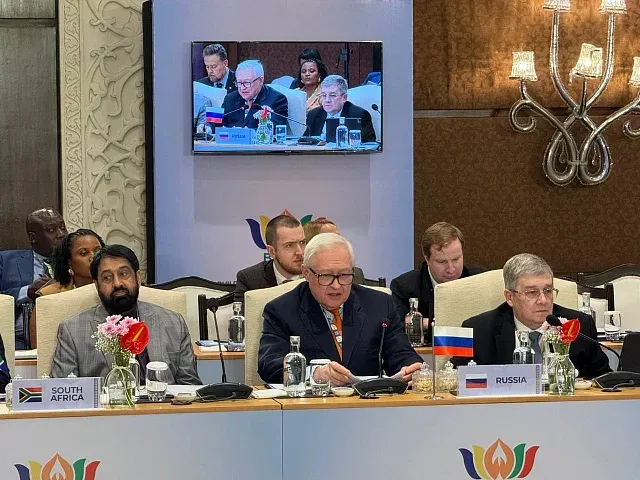
Russia will incorporate the expansion of NATO's nuclear capabilities into its military planning, Sergei Ryabkov, Russian Deputy Foreign Minister, said on Tuesday, 19 May. The statement marks one of Moscow's sharpest public warnings yet about the evolving nuclear posture of European powers within the alliance.
What Ryabkov Said
'We cannot ignore the obvious strengthening of the nuclear component of NATO's overall potential, which is in fact occurring as a result of Europe's efforts to develop its own nuclear capabilities in addition to the US's corresponding umbrella,' Ryabkov said in an interview with local media. He emphasised that Russia 'cannot remain without reactions in military planning' — particularly in response to what he described as France's strategy of 'so-called forward nuclear deterrence.'
Rising Strategic Risks
Ryabkov warned that the 'escalatory narrative' emanating from European capitals about a looming high-intensity war with Russia is compounding strategic dangers. 'As a result of this escalation of tensions, including openly provocative actions in the nuclear sphere, strategic risks and the danger of a head-on clash between NATO and our country, with all the ensuing potentially catastrophic consequences, are increasing,' he said. He characterised the consequences of any direct NATO-Russia confrontation as potentially catastrophic.
France and Poland in Moscow's Crosshairs
Ryabkov specifically called out France's reported expansion of the operational zone of its national nuclear forces into the territory of non-nuclear European allies, arguing that 'under Paris's false slogans about strengthening the security of its non-nuclear allies, the exact opposite is happening.' He said those European countries are now 'becoming the object of closer scrutiny' by Russian military planners responsible for strategic deterrence. He also referenced reported plans by France and Poland to conduct exercises in the Baltic Sea to practise nuclear strikes against Russia, calling such preparations part of an 'accelerated militarisation of Europe, openly directed against our country.'
Finland's Nuclear Weapons Import Plans
The deputy minister also addressed Finland's stated intention to allow the import of nuclear weapons onto its territory — a development Moscow views as a direct provocation. Russia, he said, has 'clearly and unequivocally stated its extremely negative attitude toward such preparations on the part of Europeans.' This comes amid a broader pattern of Nordic and Baltic states deepening defence integration with NATO following Russia's invasion of Ukraine in 2022.
What This Signals
Ryabkov's remarks represent an explicit acknowledgement that Russia is recalibrating its nuclear doctrine in real time in response to European defence moves. Analysts note that such public statements from a senior diplomat serve a dual purpose: signalling resolve domestically while putting pressure on European capitals to pause nuclear-sharing discussions. The trajectory of NATO-Russia nuclear signalling will be closely watched ahead of the alliance's next summit.
Point of View
And Moscow is clearly trying to isolate that argument by framing it as destabilising rather than defensive. What mainstream coverage underplays is the cumulative effect: Finland's accession, France's nuclear expansion, and Baltic Sea exercises together constitute a structural shift in Europe's nuclear geography that Russia cannot absorb without a doctrinal response. The danger is that public statements like this, intended as deterrence, can themselves accelerate the escalatory spiral Ryabkov claims to be warning against.
NationPress
29 Jul 2026
Frequently Asked Questions
What did Russia's Deputy Foreign Minister say about NATO's nuclear capabilities?
Sergei Ryabkov said on 19 May that Russia cannot ignore the strengthening of NATO's nuclear component and will factor it into military planning. He specifically cited Europe's efforts to build independent nuclear capabilities alongside the US nuclear umbrella.
Why is Russia concerned about France's nuclear strategy?
Russia objects to France's reported 'forward nuclear deterrence' strategy, which involves extending the operational zone of French nuclear forces into non-nuclear European allies' territories. Ryabkov argued this makes those countries targets for Russian military planners rather than making them safer.
What is the significance of France and Poland's reported Baltic Sea exercises?
France and Poland are reportedly planning exercises in the Baltic Sea to practise nuclear strike scenarios against Russia. Moscow has condemned these plans as part of what it calls an accelerated militarisation of Europe directed against Russia.
How does Finland factor into Russia's nuclear concerns?
Finland's stated intention to allow the import of nuclear weapons onto its territory has drawn sharp condemnation from Moscow. Russia views this as a direct provocation, particularly given Finland's recent NATO membership following Russia's 2022 invasion of Ukraine.
What are the broader implications of Russia's warning?
Ryabkov's remarks signal that Russia is actively revising its nuclear doctrine in response to European defence moves. Analysts see such statements as serving a dual purpose — demonstrating resolve domestically while pressuring European capitals to reconsider nuclear-sharing arrangements ahead of NATO's next summit.