Senate Democrats Take Action Against Military Conflict with Cuba
Synopsis
A coalition of Senate Democrats has introduced a resolution to limit U.S. military actions against Cuba, igniting a heated debate on President Trump's foreign policy. This legislative move seeks to uphold Congress's authority over war declarations amidst rising tensions between the two nations.
Key Takeaways
Senate Democrats are challenging the Trump administration's military approach to Cuba.
The proposed War Powers Resolution requires Congressional approval for military actions.
Increased tensions between the U.S. and Cuba have resulted from recent U.S. policies.
Lawmakers emphasize the importance of Congress's role in declaring war.
Discussions between U.S. and Cuban officials indicate a potential for easing tensions.
Washington, March 16 (NationPress) A coalition of Senate Democrats has put forward a War Powers Resolution designed to prevent the United States from engaging in military actions against Cuba without the explicit consent of Congress. This initiative is intensifying the ongoing debate in Washington regarding President Donald Trump’s military strategy towards the island.
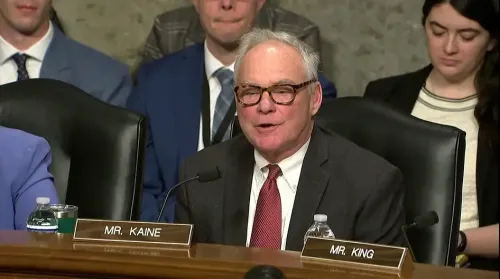
The resolution, spearheaded by Senators Tim Kaine from Virginia, Adam Schiff from California, and Ruben Gallego from Arizona, aims to guarantee that any military involvement by the US against Cuba receives prior authorization from lawmakers.
The proposed legislation mandates the President to “withdraw the United States Armed Forces from hostilities within or against Cuba,” as outlined in the text accompanying the resolution.
This proposal emerges amid escalating tensions following Trump’s imposition of a blockade on oil shipments to Cuba, coupled with his public threats of potential military intervention. The President has asserted that the United States would “address the situation in Cuba” and hinted that the Cuban government could “collapse soon” if it does not reach an agreement with Washington.
Kaine, who serves on both the Senate Armed Services and Foreign Relations Committees, emphasized that the resolution seeks to uphold Congress’s constitutional authority over war decisions.
“When will President Trump realize that Americans prefer lower prices over unnecessary wars?” Kaine remarked in a statement unveiling the resolution.
“Only Congress holds the constitutional power to declare war, yet he operates under the assumption that the US military is a palace guard, initiating military actions in the Caribbean, Venezuela, and Iran without Congressional consent or any justification for his maneuvers to the American public.”
Schiff underscored the need for lawmakers to act before the United States is entangled in yet another conflict.
“The American populace has clearly expressed their desire to avoid further costly wars of choice that inflate prices at home,” Schiff stated.
“The President’s threats towards Cuba indicate where his focus lies next. Congress must assert its authority, or we risk being drawn into another precarious war and losing our constitutionally granted powers indefinitely.”
Gallego also criticized the administration’s stance on Havana, linking it to broader tensions resulting from US military engagements elsewhere.
“As if the fallout from the Iran War and the subsequent rise in oil prices weren’t enough, Trump is now threatening intervention in Cuba as well,” Gallego said.
“He campaigned on an America First platform, but it’s evident he has become a pawn of the war hawks in his party.”
This joint resolution is classified as privileged legislation under the War Powers Act and can be brought to a procedural vote in the Senate after ten days. However, analysts predict that the measure faces significant challenges, particularly in the Republican-led House of Representatives.
The proposal surfaces amid rising speculation that Cuba could emerge as Washington’s next military hotspot following US strikes against Iran and prior tensions involving Venezuela.
Senator Lindsey Graham, a close ally of Trump, recently told Fox News that “the liberation of Cuba is imminent. It’s merely a matter of time.”
Trump himself also indicated that the Cuban government might soon fall, stating in a recent CNN interview that “Cuba is going to fall pretty soon.”
Since January, the United States has enacted a blockade on oil shipments to Cuba, exacerbating fuel shortages that have led to blackouts across the island and worsened an ongoing economic crisis.
Cuban President Miguel Diaz-Canel reported on Friday that his administration has initiated discussions with US officials aimed at easing tensions. He indicated that these talks “were focused on seeking solutions through dialogue to the bilateral differences between our two nations.”
Point of View
It is vital to acknowledge the complex interplay of military strategy and legislative oversight. The proposed War Powers Resolution highlights the constitutional debate over war declarations, reflecting a significant pushback against unilateral military action.
NationPress
1 Oct 2026
Frequently Asked Questions
What is the War Powers Resolution?
The War Powers Resolution is a federal law that aims to check the president's power to commit the United States to armed conflict without Congressional consent.
Who introduced the War Powers Resolution regarding Cuba?
The resolution was introduced by Senators Tim Kaine, Adam Schiff, and Ruben Gallego.
What prompted this resolution?
The resolution was prompted by rising tensions due to President Trump's blockade on oil shipments to Cuba and his threats of military intervention.
What are the potential implications of this resolution?
If passed, the resolution could limit the President's ability to engage in military actions against Cuba without Congressional approval.
How does this resolution affect U.S.-Cuba relations?
The resolution may signify a shift in U.S. policy towards a more diplomatic approach, emphasizing dialogue over military intervention.